



Writing in response to Wole Soyinka’s Distinguished Nyerere Annual Lecture on ‘New imperialisms’, Chambi Chachage unpacks the notion that 'empire building' and a universal move towards imperialism have been the motor of history.
Kiswahili's assimilation of words from other languages while retaining its Bantu grammatical and literary structure is 'a sign of cultural resistance', writes Chambi Chacage, rather than evidence that it is 'being bastardised', as recently argued by Makwaia wa Kuhenga. What Makwaia laments as ‘the transformation of Kiswahili to “something that one may call Kiswa-English” is another phase of expanding Kiswahili’s rich vocabulary by incorporating new synonyms,’ Chachage says.
Economist David Ricardo's theory of 'comparative advantage', despite being highly dubious, continues to exert a high degree of influence on Tanzanian policymakers, writes Chambi Chachage.

With Zanzibar in the throes of political instability as its 2010 elections approach, Chambi Chachage calls for a 'win–win situation' and draws upon Mahmood Mamdani's emphasis on 'survivors' justice'.

It is Norwegian interests in the island’s strategic location and offshore oil deposits that are behind Norway’s recent flurry of engagement in Zanzibar’s local politics and peace talks, writes Chambi Chachage in this week’s Pambazuka News.

In the face of repeated difficulties around the supply of energy in Tanzania, Chambi Chachage writes that problems around power are as much about powerlessness as they are about a power crisis. If power cuts essentially mean the majority of Tanzanians remain a powerless people, it is time for power – energy and political – to be more fairly distributed, the author concludes.
Looking back on Mwalimu Nyerere's tremendous intellectual influence, Chambi Chachage considers the enduring importance of the leader. Noting Nyerere's prescience in arguing against nations surrendering their "power of decision making" to the International Monetary Fund (IMF), Chachage stresses that the leader's legacy is rooted in stimulating impassioned public debate around positive socio-economic change.
Reflecting on the words of female participants at a recent gender festival, Chambi Chachage laments the continued bruising of African pride. The need to prove oneself as an African has never gone away, Chachage writes in this week's Pambazuka News, something which is only compounded in Tanzania by a 'collective imbecilisation'. It is now time that Tanzania and Africa as a whole make their own 'history' and 'herstory', to combat others' discrimination and restore the continent's pride, he concludes.
If you want to put Tanzania’s Prime Minister Mizengo Pinda on the spot, Chambi Chachage tells Pambazuka News, just mention ‘the Zanzibar question’ – whether or not Zanzibar should retain its own separate government. Pinda recently sparked national debate by suggesting that Zanzibar is not a country, when he said that he would like to see Tanzania ‘run by a single government instead of two’. If we don’t ‘take the bull by its horns’ and resolve the Union issue once and for all, says Chachage, it will surely ‘explode’.
Chambi Chachage pays tribute to Professor Haroub Othman, a man passionate about the Pan-African ideals of peace, justice and unity, who was ready to be among 'what is left of the leftists'. Chachage writes that while his encounters with Professor Othman were 'brief, albeit memorable', they were 'filled with lasting humane impressions'.
 cc Chambi Chachage explores when and how ‘settlers’ or ‘natives’ become ‘citizens’, in the first of a series of three articles exploring the idea of dual citizenship with reference to Tanzania. Definitions of citizenship in modern nation-states in ‘societies other than Euro-American ones’ were influenced by how the notion developed in Euro-America and how it was ‘selectively applied in the Africa, Asia, Australia and Latin America in the context(s) of colonialism, imperialism and developmentalism,’ Chachage argues. ‘It is this colouring that we need to unpack as we trace the historical and political trajectories and implications of the idea and praxis/practice of citizenship in Africa,’ says Chacage.
 cc Chambi Chachage doesn’t hate America, he actually loves it ‘a lot’. It ‘could be a model for deracialising the continents’, Chacage believes, as ‘probably the only habitable continent for humans that is not really seen as a continent that belongs to a particular “race”.’ But says Chachage, America is also haunted by what President Obama describes as the 'original sin of slavery and racism', epitomised by the Atlantic slave trade and the genocide of native Americans. Chacage concludes that what he feels is actually what historian Colin Legum describes as a ‘disappointed love’ – the colonised ‘believe there has been no proper recognition of, nor retribution for, the injury of colonialism’, while the colonisers ‘feel let down because Africa has not lived up to the expectations of European liberal values.’
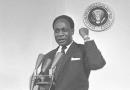
The debate on how to unite African states has not changed significantly since Kwame Nkrumah and Julius Nyerere locked horns on the matter in the early 1960s, writes Chambi Chachage. Exploring Nyerere’s ‘step by step’ approach to building African unity in relation to Nkrumah’s desire to ‘fast track’ the creation of a Unites States of Africa, Chachage concludes that while Nkrumah’s Pan-African vision remains powerful, his approach is unrealistic even today.’ ‘To that end, I will feel with Nkrumah, yet I shall think with Nyerere’, he writes, ‘Africa must unite, albeit pragmatically’.
Thank you for an insightful brief [http://www.pambazuka.org/en/category/comment/46555]. As far as our criticism of the report's apparent "lack of a gender analysis, and narratives (not just descriptions) of how mining operations are devastating lives in local communities" is concerned, I think we should consider the report's disclaimer below and consult its accompanying report: "There are several further concerns about the impact of the mines on local people - notable in the area of human rights, displacement to make way for the mines and environmental pollution.
These issues lie beyond the scope of this report, which focuses on tax and economic impacts, and are instead considered in an accompanying report, Not All That Glitters is Gold: How Tanzania's Mining Boom Has Impoverished Communities, Violated Rights and Degraded the Environment"(page 43). Where can we get hold of this accompanying report?
 cc Chachage explores whether nationals of a country ought to have the option of dual citizenship, in the third and final part of
  cc Chambi Chachage explores when and how ‘subjects' become ‘citizens’, in the second part of