


Book Review: From Mau Mau to Ruto-Must-Go: A Scrapbook of Essays on Kenya’s Struggle Against Imperialism
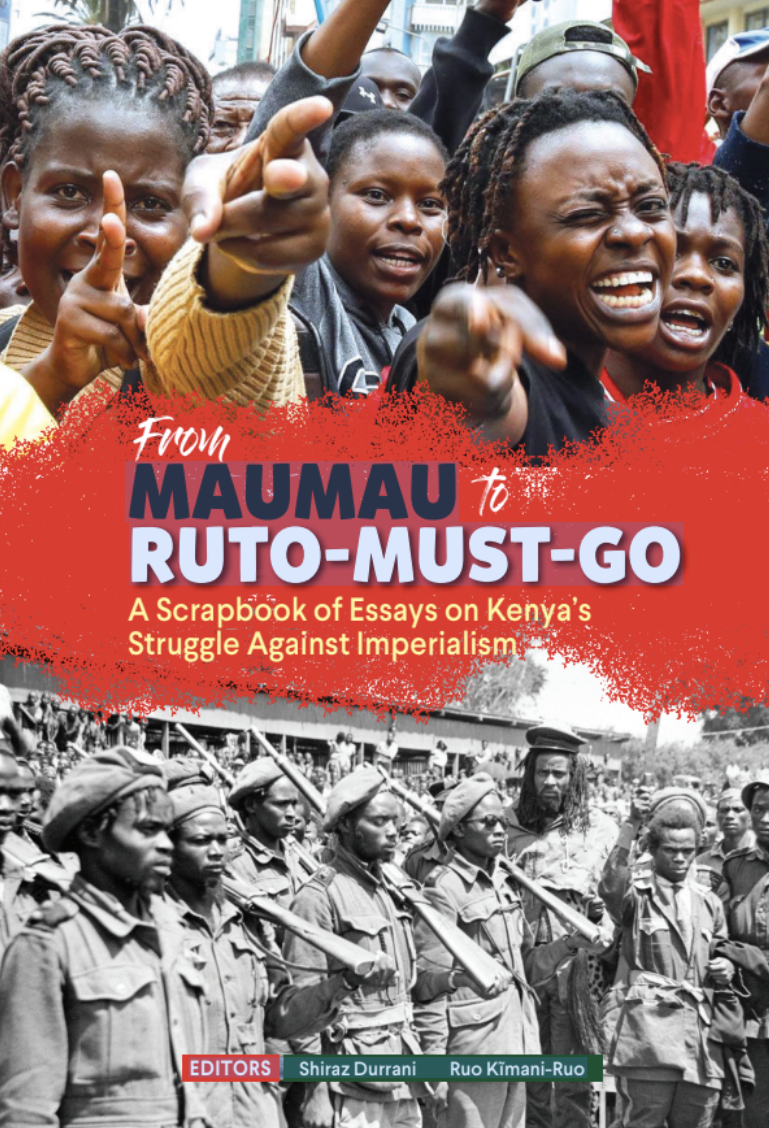
The resistance of Kenyans against British imperialism and political actors doing little to alleviate the sufferings of working peoples of Kenya, manifested respectively through Mau Mau and Ruto-must-go. Mutunga reviews an edited book that documents these struggles.
I recently read a review of the book, From MAU MAU to RUTO-MUST-GO: A Scrapbook of Essays on Kenya’s Struggle Against Imperialism, by Teddy Odira, a young lawyer in Nairobi who published in The Platform for Law, Justice, and Society.[1] I shared the review with one of the co-editors of the book, Shiraz Durrani[2], and asked him what he thought. This is was his response via a WhatsApp text:
It’s a brilliant review, I think. He understands the undercurrents that the book explores and identifies key issues, like land, that have driven resistance. He also sees resistance as an on-going, incomplete struggle. Very well done![3]
What is well said by another is mine. In this review I want to glorify the work of the artist movements in Kenya for breathing life into The Constitution of Kenya, 2010, particularly Article 33[4] that decrees freedom of expression. This freedom of expression has limitations.[5] It is the freedom of artistic creativity that is glorified in two of the articles in the book. They glorify cartoonists[6] and Social Justice Theatre (SJCCTT).[7] Freedom of artistic creativity in Kenya is valued by others including the two mentioned. The others include: poets, spoken word artists, graffiti artists, song-writers, singers, comedians, film makers, and others.[8] Freedom of artistic creativity has been a radical site of struggle in the implementation of The Constitution of Kenya, 2010. Freedom of expression under the Constitution has been the subject of a recently published scholarly work.[9]
This Constitution has been described as progressive and transformative because of the process of its making, its texts on objectives, purpose, and vision to reform, by non-reformist reforms, which maintain the status quo in Kenya. While the ruling elite find the Constitution inconvenient and abstract, these sites of struggle[10] have used provisions of the Constitution to craft political demands, breathe life into these sites through uprising, robust public participation, mass action, and public interest litigation. The quest for an authentic patriotic alternative political leadership is a continuous struggle anchored in these constitutional sites of struggle that the ruling elite has refused to implement. It is argued that such an alternative political leadership that is authentic and patriotic will implement the Constitution by consolidating gains made, and rescuing the weaknesses that are encountered during the process of its implementation.
Glorification
A: In Praise of Cartoonists: Ruo Kimani-Ruo[11]
Ruo Kimani-Ruo praises the cartoonists in words that should not be paraphrased:
…, there has emerged an unprecedented form of political cartoons artwork which has been launched in Kenya with sizzling, scorching, blistering cartoon editorials and other graphics and caricatures of public figures that express the artists’ opinions, with celebrated cartoon artists Celeste and Maddo[12] being joined by Yoko and others-all freely and fearlessly expressing their opinions on public issues and the individuals in government and thereby shedding light on the public mood on issues.…
With these political cartoons, the artists have had a field day and typically combined artistic skills, hyperbole and satire to question authority. The cartoons have drawn attention to, among other things, corruption, electoral inequalities, political abductions and other social ills including violence- and the Consolidated Fund at Central Bank of Kenya (CBK) where billions of shillings are being ‘siphoned and stashed in offshore accounts in the West; and suspicions of embezzlement.[13]
The genius of the cartoonists that I have encountered over decades lies in the interpretation of their work for the powers that be, and the citizens themselves. They are always armed with many interpretations of their cartoons. They use those interpretations to either stay safe when confronted by elites and their machinery of violence, or to mobilize the citizens around the key messages. They invariably keep their mouths shut and let their work engage both the enemy and the friend. Their work requires great critical thinking, taking ideological and political positions in breathing life into the provisions of the Constitution to energize non-reformist reforms.[14]
B: In Praise of Theatre Artists: Zachary J Patterson[15]
Zachary J Pattern glorifies the Social Justice Centres Travelling Theatre (SJCTT) in the following paragraphs:
Interactive scenes show an all-too familiar tale of the oppressed and their oppressors-the spectators become ‘spect-actors’. It is a brilliant way of renewing hope, inspiring the imagination and reviving resistance[16]....
Inspired by communist playwright Bertolt Brecht’s notion of art as tool that can help shape our social conditions, members of SJCTT approach their performance as active participants of the class struggle. The provocative thespians of SJCTT use common language rooted in local knowledge to cut through the apolitical noise and disrupt the established order, exhibiting a clear political perspective drawn from Marxist political theory. Shaped by their surrounding social conditions and informed by historical and contemporary realities, SJCTT deploys techniques of Augusto Boal’s Theatre of the Oppressed to analyze social problems and address the factors of the oppression.[17]
…Their performances are shaped both by appreciation for Kenya’s history of resistance and their shared experiences, resulting in programs rich with historical knowledge and relevance to contemporary issues.[18]
…Inspired by Boal and Brecht, [Ezra] Brain suggests that the nature of political theatre is to disrupt, present a coherent political perspective, and challenge dominant narratives and discourses…From a Marxist perspective, in order for the theatre to be political, it must go beyond entertainment and awareness-building by offering the people a way forward. Performing among community members in Nairobi’s informal settlements, SJCTT introduce[s] unruly protagonists to encourage dialogue amongst the spectators and educate them to consider active participation in politics-which could change their lives for the better.[19]
SJCTT needs to be put in the historical trajectory of links and continuities of revolutionary struggles. Before SJCTT was the University of Nairobi Travelling Theatre (UNTT), and the Kamirithu outdoor theatre that performed Ngugi wa Mirie and Ngugi wa Thiong’o’s play Ngaahika Ndeenda/I will marry when I want. Both performances were the projects of the underground movement, December Twelfth Movement (DTM).[20] Ngugi wa Thiong’o was a member of one of the DTM’s underground cells. The (UNTT) staged various radical plays in high schools all over Kenya. The cast was invariably radical University students from the radical departments in the (UNTT), namely Literature, Law, Political Science, Economics, Sociology, and Religious Studies. We should not forget the Mau Mau’s Kenya Land and Freedom Army ’s (KLFA) poems and songs. This Liberation Army still remains the most revolutionary beacon of Kenyan class struggles. These poems and songs were compiled, edited, and translated from the Gikuyu language into English by Maina Wa Kinyatti.[21] As recently as 10-13 September 2026, some of the cast in SJCTT performed at the Kenya National Theatre, Ngugi wa Thiong’o’s Matigari ma Njiruungi.[22] Ndungi Githuku was the lead actor. He is also the leader of the Field Marshal Band known for its revolutionary poems and songs.
In Lieu of Conclusion: From Mau Mau To Ruto-Must-Go demystified
As I have stated above, the Mau Mau War of Liberation remains the greatest and the main beacon of our revolution. The working peoples of Kenya took up arms to challenge the might of the British Empire. Independence after 78 years of occupation, oppression, and exploitation was a revolution albeit an ordinary one compared to the great revolutions of the 20th Century. Even those two great revolutions of the 20th Century went through links and continuities of ordinary revolutions.
The attributes of a leader who is a comprador in chief, and the glaring personification of the elite in power is President Museveni. I believe Mahmood Mamdani has interrogated and historicized this issue in the case of Museveni.[23] The outsourcing of the Ugandan Army in Somalia, South Sudan, and East Democratic Republic of Congo are clear examples of a leader of an elite that can second guess the interests of imperialism and implement its interests. Although Mamdani does not discuss cultural imperialism in Uganda it is clear Museveni has supported the demands of cultural imperialists in the US and Europe in their quest to get the Parliament of Uganda to enact the draconian Anti-homosexuality Act. The fundamentalist Christian Right in the US and Europe argue that they want to save Africans from the decadence of western values! Indeed, they say this when they are very ignorant of African values that tolerate and accommodate sexual orientation. These cultural imperialists have always described African values as Satanic.
President Ruto is the personification of a collective comprador bourgeoisie, a class that has crucial ingredients in the economic, social, cultural, theological, and political spheres. In a country that has deep divisions on ethnicity, individualization of this class could be seen to be against a particular community and thereby enrich the strategies of ethnic divisions by the same comprador class. The entire comprador bourgeoisie has to be historicized and interrogated so that its ingredients are understood. If there is to be personification it must be to identify the various components of the class and their various respective leaderships. And the link between the comprador bourgeoisie and the imperialist bourgeoisie has to be understood. I believe the Malcolm Xian metaphor of the house niggers is still apt. Indeed, Kenya, and the rest of Africa is a slave plantation, the ruling elites are a den of house niggers, and the masters of the plantation are the imperialism of the Triad (US, Europe, Japan) including other countries that are in the orbit of imperialism, and have interests in Africa, such as China and Russia. President Ruto and the comprador bourgeoisie he leads has supported in continuing to allow military bases in Kenya without the participation of Kenyans that is decreed by the supreme law, The Constitution of Kenya, 2010. He has sent the police to Haiti in defiance of a court order on the issue. The West still pontificates about democracy and the rule of law, but does not comply with our supreme law, finding it abstract and inconvenient, a hallmark of hypocrisy, racism, perfidy, and double standards.
The burning political question in Africa, in my opinion, is the quest for an authentic and patriotic alternative political leaderships. To be such a leadership it must be at the minimum anti-imperialist and anti-comprador. It must be a leadership that loves the working people. It must run to the people of Africa for support when it faces the wrath of imperialism. Such leadership has to embrace people to people revolutionary Pan-Africanism that includes the African diaspora as the basis of the liberation of Africa. It must be a leadership that understands the status quo of the planet which is unsustainable, unacceptable, and undesirable and that has to be overthrown. The growing consciousness of global citizens towards identifying the common enemy of the planet we wish to see must be reinforced and supported in this century through a global solidarity against militarism, ecological degradation, sexism, homophobia, domination, exploitation, oppression, and a planet that puts profits before people. Such leadership should participate in the ongoing debates of a socialist planet. These debates seek a consensus on the socialist paradigm that will liberate the planet by interrogating the socialist experiments in the Soviet Union, China, North Korea, Cuba, Vietnam, and other countries where the revolutionary paradigm has been enacted through liberation wars and movements. That project is absolutely critical to identifying what socialist gains have been made, and the exposed weakness can be the basis for further discussion that could consolidate a revolutionary theory for implementation.
Willy Mutunga was Chief Justice & President of the Supreme Court, Kenya, 2011-2016. He is currently an Adjunct Professor of Public Law, Kabarak Law School and a Member of the Gaza Tribunal Jury of Conscience.
Endnotes
[1] Number 126, July 2026, 118-122.
[2] The other editor is Ruto Kimani-Ruo. See Durrani, Shiraz, and Ruo Kimani-Ruo, eds. From Mau Mau to RutoMustGo. Editor House Facility, 2026.
[3] WhatsApp exchange of texts between me and Shiraz Durrani on Friday July 3, 2026.
[4] 33(1): Every person has the right to freedom of expression, which includes-freedom to seek, receive or impart information or ideas; freedom of artistic creativity; and academic freedom and freedom of scientific research.
[5] 33 (2): The right to freedom of expression does not extend to propaganda of war; incitement to violence; hate speech; or advocacy for hatred that constitutes ethnic incitement, vilification of others or incitement to cause harm; or is based on on any ground of discrimination specified or contemplate in Article 27 (4), namely, discrimination on the basis of race, sex, pregnancy, marital status, health status, ethnic or social origin, colour, age, disability, religion, conscience, belief, culture, dress, language or birth. The courts have ruled that the word sex includes sexual orientation. (It has been my experience that these limitations are flouted, not by Kenyans, but by the Kenyan elite selectively.)
[6] Ruo Kimani-Ruo, “Speaking Truth to Power through Cartoons”, Pages 144-150. Silhouette cartoons have been a recent creation. See pages 90-91; 147-148; 222-223; 225-6.
[7] Zachary Patterson, “Performing Politics: Decolonizing History and Rehearsing Resistance”, Pages 151-157.
[8] Willy Mutunga, “The Artist as a Revolutionary: Micere Mugo and Paul Robinson”, an unpublished tribute in honour of Professor Micere Mugo, poet, actress and intellectual at Kenya National Theatre, Nairobi on 9 August 2023.
[9] Eric Kibet, Freedom of Expression and the Project of Constitutional Transformation in Kenya (Book 2026 Gala Verlag, Glienicke).
[10] Examples of other sites are: Land, Decentralized and democratizing the Imperial Presidency, the Sovereignty of the Kenyan people that anchored the Uprisings of the Gen Z and Millennials in 2024, 2025, and 2026; Chapter on Finance that has exposed odious debts through Public Interest Litigation; culture, spiritualists, religion, beliefs, African justice systems, the Judiciary, Parliament and other institutions, leadership and equality, institutionalization of political parties; regional and international law, the whole gamut of human rights. The site struggle discussed here and the gay rights movement are where great gains have been made. Both are anchored in human rights and social justice, chapter 4 of the Constitution.
[11] Note 5
[12] One could add the names of Gado, Vidula, Kibet Bull, and GAMMZ. Gado and Maddo have published their work in the following publications: Gado, CRISIS..? WHAT CRISIS?!: A Collection of Gado’s Editorial Cartoons, Published in the Daily Nation, the Sunday Nation and the EastAfrican from 2005 to 2011. (Nairobi: BUNI Media, 2012); Maddo, Its a Madd Madd World 2007-2011: The Hot Years (Nairobi: Buni Media, 2012); See also Willy Mutunga, “Activists art for social reform: The Judiciary in transformation as seen by Kenyan cartoonists” in Furthering Constitutions, Birthing Peace: Liber Amicorum Yash Pal Ghai (Nairobi: Strathmore University Press, 2021), 217-240.
[13] Pages 144-45.
[14] Reformist reform reinforces the status quo because they are concessions made by the system to give itself further lease on its life. Non-reformist reforms are the opposite, the nemesis of reformist reforms.
[15] Note 6
[16] Page 151
[17] Page 152
[18] Pages 153-4.
[19] Pages 155-6.
[20] So was Ngugi wa Thiongo’s Detained: A Writer’s Diary (Nairobi: EA Educational Publishers, 1981). The draft of this book was read by the DTM cells and some of the additions, for example, my write-up on pages 219-226, were included in the final publication.
[21] Edit; Maina wa Kinyatti, Thunder from the Mountains: Poems and Songs from Mau Mau (NJ: Africa World Press, 1995). The draft of this book was shared with DTM cells, enriched by the reflections of the members, before it was published.
[22] The Guest of Honour in one of the performances was Professor Wangui wa Goro who was the translator 40 years ago.
[23] Idi Amin, Yoweri Museveni, and The Making of the Ugandan State: Slow Poison (Nairobi: Jahazi Press, 2025), Chapters 12-15.