


The Pan-Africanism of Strangers: Empire, Afrophobia, and the Unfinished Question of African Belonging
From a South African clinic to a Nairobi embassy queue, this essay traces how nation, region and race make Africans foreign to one another and asks what Pan-Africanism owes the stranger.
Empire can leave behind borders without leaving behind the political habit of bordering.
~Tafahri Munjatta
Twenty-five years ago, in Durban, the world gathered to confront racism, racial discrimination, xenophobia and related intolerance. It was the third such World Conference against Racism; the first two, held in Geneva in 1978 and 1983, had produced nothing comparable. Durban's became a comprehensive framework whose reach is still being tested. The 2001 Conference located prejudice within the historical machinery that produced it, naming slavery, colonialism, dispossession, and their continuing consequences, while imagining remedies adequate to histories that had never really ended.
Twenty-five years later, the stranger is still with us; only now, increasingly, the stranger is the person whose African passport establishes nationality but cannot necessarily guarantee belonging. He is the Malawian worker in South Africa, the Rwandan crossing into Tanzania, the Nigerian navigating Tunisia, the Congolese trader moving through East Africa and the Burundian in Nairobi, standing outside his embassy with his documents in hand, wondering whether the city where he has traded for years has become somewhere he must leave. Hundreds of them did exactly that in September 2026, a story this essay returns to.
There is a word increasingly used for this specific mutation: Afrophobia, hostility toward the African other within Africa itself. It names something more specific than a general fear of the foreign: the refusal of one African to recognize another as belonging.
The African Stranger
Imagine a clinic. A person arrives seeking treatment. Before the question of illness comes another question: identification. Who are you? Are you South African? Show me your papers. The encounter appears administrative. Yet beneath the document lies a more consequential political question: Do you belong here?
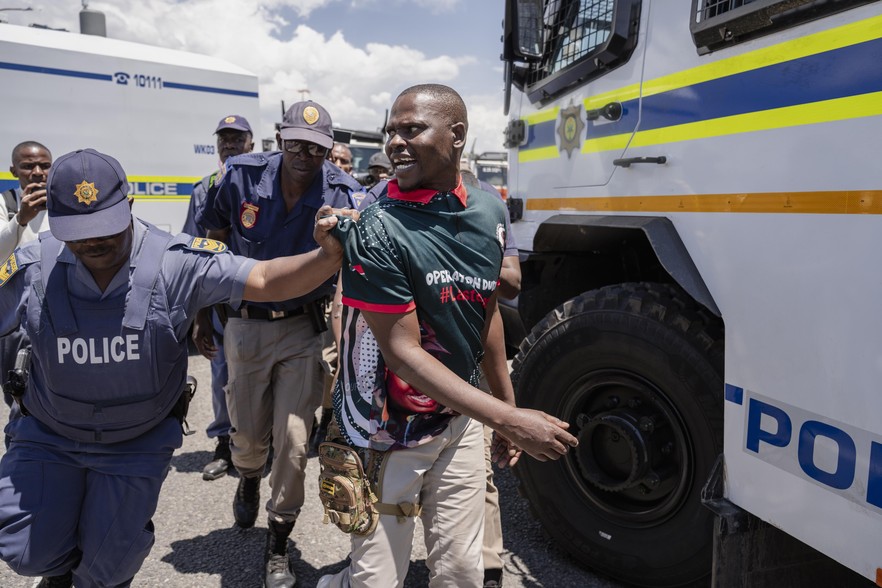
This is one lesson of the struggle around Operation Dudula in South Africa. The movement emerged as a visible and increasingly aggressive force against foreign nationals, presenting migrants as competitors for jobs, consumers of public services and threats to national order. In November 2025, Gauteng High Court Judge Leicester Adams interdicted Operation Dudula[1] from demanding that private individuals produce passports or identity documents to prove their legal status. The order also barred the organization from unlawful conduct amounting to "taking the law into its own hands," hate speech, and interference with access to healthcare and education. The judgment affirmed a basic distinction: immigration enforcement is a state function, not a license for private citizens to police one another.
Foreignness has moved from a legal classification into an everyday social performance: a vigilante outside a clinic claiming the state's authority to ask whether someone belongs. South Africa's current migration crisis has made that experience larger and harsher. The Associated Press reported in August 2026[2] that more than 178,000 African immigrants had fled, been repatriated, or been deported in recent months amid rising anti-immigrant sentiment, protests and violence: more than 115,000 to Zimbabwe, 56,000 to Malawi, and 19,000 formally deported.
The distinction between voluntary return and forced departure is unstable: a person may cross the border without being deported and still have been pushed out. Fear can become a form of immigration control.
None of this makes South Africans inherently xenophobic. Unemployment, overstretched services and political competition are real — but political rhetoric decides where scarcity points:
-
Jobs are scarce because foreigners are here.
-
Hospitals are overwhelmed because foreigners are here.
-
Crime is rising because foreigners are here.
Structural failures acquire a human face, and the migrant becomes an explanation. This is where an older structure of power mutates. Colonial rule established territorial divisions and differentiated forms of belonging; postcolonial states inherited and transformed them. Contemporary capitalism, migration regimes and security systems add further layers that allow exclusion to be administered, delegated, and privatized.
The machinery no longer needs to announce itself as empire; it can speak the language of sovereignty. The stranger is manufactured through institutions, economies and political rhetoric, then made to appear responsible for the conditions that made their foreignness politically useful. But the nation is only the first scale at which this transformation occurs.
A Continent of Conditional Belonging
Move from the clinic to the border crossing, where what used to be routine becomes charged: a trader who once moved freely now encounters new questions, new documents, and new uncertainty. For decades, African regional organizations have attempted to construct political spaces in which an African crossing an African border does not automatically become a foreigner. ECOWAS has developed one of the continent's most extensive free-movement regimes; the East African Community's Common Market similarly provides the basis for free movement, residence and establishment.[3]
Yet political belonging can be more fragile than the treaties that proclaim it. In Kenya, that fragility became visible in September 2026. After President William Ruto ordered authorities to close small-scale businesses operated by foreign traders without the required permits, hundreds of Burundians gathered outside their embassy in Nairobi seeking documents to return home.[4]
The Kenyan government subsequently announced a 90-day amnesty for undocumented East Africans, pledging "absolute zero tolerance" toward harassment, intimidation or xenophobia. Burundians kept queuing for travel documents anyway, some citing threats from neighbors, and others saying they no longer felt welcome.[5] The East Africa Law Society intervened, warning that under the EAC Common Market framework nationality could not by itself be treated as evidence of illegality.[6] Kenya retained the right to enforce its own licensing and immigration laws; what it could not do, the lawyers argued, was let nationality substitute for due process.
The distinction matters: an administrative question about authorization becomes a question about legitimacy, and legitimacy becomes a question of whether someone should remain. A person may possess the right documents and still find belonging conditional. The Burundian has not ceased to be African; the Kenyan has not ceased to be Kenyan. The regional project has to confront the distance between those facts and the person crossing between them.
In January 2025, Burkina Faso, Mali and Niger formally left ECOWAS. The organization nevertheless instructed its members to continue recognizing their ECOWAS passports and identity cards,[7] and until further notice, to preserve their citizens' rights to visa-free movement, residence and establishment. Meanwhile, the three states have been constructing their own regional bloc through the Alliance of Sahel States. Burkina Faso began circulating the AES passport in January 2025,[8] and the alliance rolled out a common AES biometric identity card that November, serving as both travel document and security tool.[9]
The symbolism is pointed: two passports now compete for the same body, one naming you citizen of the bloc your government no longer belongs to, the other of the bloc built to replace it. The African who crosses the border has not ceased to be African. What changes is the political apparatus recognizing their Africanness. The same split makes the point from the opposite direction: at one moment they are a regional citizen. Then a passport-holder, a work-permit applicant, an immigration case, a security concern. The category contracts. This is the paradox of African integration: mobility imagined as liberation, while states remain invested in deciding who may cross, stay, or must explain themselves.
The African Union's 2018 Protocol on Free Movement of Persons, Right of Residence and Right of Establishment[10] makes the larger aspiration explicit. It connects free movement to continental integration, Pan-Africanism and a common destiny. Yet the protocol remains an unfinished institutional project rather than a continent-wide reality.
Africa has imagined free movement more successfully than it has built the political conditions for it. Pan-African aspiration encounters national calculation and that interaction the continent wants integration, while states still want control. The traveler lives inside the contradiction.
Colonial borders divided populations into subjects and administrative categories; postcolonial states now exercise those same powers for their own ends. But the national and regional scales are not the whole story. A third scale entangles the production of foreignness with race and civilization itself.
When African Is Not Enough
The Sahara has been treated, in colonial and Orientalist cartography alike, as a civilizational wall: Hegel's line between a "historical" North and an Africa outside history. For centuries it was in fact a zone of encounter: trade, migration, scholarship, conquest, settlement, religious exchange. Neither North Africa nor the lands south of the Sahara have ever possessed one identity.
Modern political categories make the Sahara carry meanings it did not always carry. Tunisia offers a disturbing example: in February 2023, President Kais Saied publicly framed irregular migration from what his government called "sub-Saharan Africa" as a demographic threat,[11] a category built to be feared, not to be geographically or historically precise, and what followed was an intensification of racist violence and state repression against Black migrants and refugees.
Based on interviews with 120 refugees and migrants,[12] Amnesty International's investigation found a migration and asylum system characterized by racist policing and widespread human-rights violations in Tunis, Sfax and Zarzis. The organization recorded "chilling testimonies of dehumanizing sexual violence, severe beatings and other torture and cruel treatment" inflicted by members of the Tunisian National Guard.
The categories accumulate: African, then racialized as "sub-Saharan," then Black, then migrant, then undocumented, then a demographic threat. Each designation creates another route through which belonging can be narrowed. The issue was never what North Africans think of Black Africans south of the Sahara, or whether African identity divides along a north-south line. The "North-South divide" is not a geographic fact; it is a racial category inherited from the same cartography that invented the civilizational wall. A person can be simultaneously African, Nigerian, Christian or Muslim or neither, Black, migrant, undocumented and poor. Under different political circumstances, any one of those identities can be made dominant. The danger begins when an identity becomes an instrument of exclusion, and the process does not stop at Tunisia's borders.
In Libya, the International Commission of Jurists warned in 2026[13] that migrants intercepted at sea and forcibly returned face "a real risk of arbitrary detention, torture, sexual violence, enslavement and onward transfer to places they could face real harm."
At the furthest edge, the foreigner stops being someone who does not belong and becomes disposable, another mutation of empire, as European migration policy operates beyond Europe's own territorial frontier. The EU's 2023 agreement with Tunisia[14] provided financial and technical support partly to deter Europe-bound migration. The agreement remains amid Amnesty International warning on escalating abuses against African migrants and the lack of effective human-rights safeguards.
The European border has migrated. It no longer requires Europe to stand physically at every point where movement is stopped. Europe's own power to intercept, detain and deport has been delegated to the Tunisian National Guard and coast guard, paid and equipped through the agreement above, to do what Europe no longer does directly. The same is true for Libya.
But this is not a story in which Europe acts and Africa obeys. African governments retain agency and make their own choices inside an international system where migration control has become a condition of financial, diplomatic and security partnership.
This is empire after empire: not the disappearance of power, but its mutation. The old hierarchy survives through partnerships, border management, security cooperation, demographic anxiety, and the language of sovereignty itself. And so, the stranger has now appeared at three scales. The nation can make an African foreign. The region can make African belonging conditional. And the continent itself can fracture "African" into categories of race, region, nationality and civilization. This leaves Pan-Africanism with a question more difficult than unity.
The Pan-Africanism of Strangers
What is Pan-Africanism if it cannot enlarge belonging? The answer cannot be that Africans are one because Africans are the same; they are not. Africa contains extraordinary differences of language, religion, ethnicity, history and political experience, and any serious Pan-Africanism has to begin from that plurality rather than pretend it away. Its radical proposition is harder: difference does not have to become foreignness.
This changes the meaning of integration: regional integration is not a mechanism for increasing trade. Free movement is not an economic convenience. The African Passport is not a travel document. Each weakens the machinery through which one African becomes a stranger to another.
The AU's free-movement project matters because it imagines belonging beyond the rigidity of national citizenship. The project is incomplete, but capable of making African identity institutionally consequential rather than a sentimental declaration.
Yet institutions cannot complete that work alone: a treaty can permit movement while suspicion follows the traveler, and a continental declaration can proclaim unity while an African migrant sleeps outside a clinic because someone has decided their presence is illegitimate.
It has to become a practice of making difference livable, confronting an uncomfortable fact: Africans can inherit structures of exclusion, adapt them, and deploy them against one another without external compulsion. That is neither a Pan-Africanist failure nor proof that colonialism explains everything; it is the harder terrain between inheritance and agency. The structures are inherited; the choice to keep using them is not. The responsibility cannot be inherited away.
The question is no longer whether Africans can unite, but whether they can construct forms of belonging spacious enough to survive difference. Every day, somewhere on this continent, that question arrives disguised as an encounter. Does difference become curiosity, negotiation, exchange and relation? Or does it become suspicion, documentation, policing and expulsion?
Pan-Africanism is not tested by how easily Africans recognize themselves in one another. It is tested by what happens when they don't.
The Unfinished Question
This brings us back to Durban, where the 2001 conference located racism within the structures that produced vulnerability, insisting that historical injustice remained connected to present conditions.
Twenty-five years later, the challenge is to recognize the forms exclusion takes when it changes language. The racial order can speak through the immigration raid, the identity checkpoint, the demographic threat, the deportation deadline, and the quiet assumption that some Africans are more naturally entitled to Africa than others.
The unfinished question of Durban is therefore larger than whether racism has survived. It is whether the political technologies sorting human beings into insiders and outsiders can be recognized even inside institutions governed by people once subjected to racial exclusion themselves. That is the uncomfortable lesson of the African stranger.
Empire can leave behind borders without leaving behind the political habit of bordering: the reflex to sort, check and suspect outlives the institution that trained it. A postcolonial state can become sovereign while reproducing exclusions that sovereignty makes possible. And a continent can proclaim unity while continuing to produce strangers at its edges, its checkpoints, its clinics and its camps.
Pan-Africanism was never a promise that Africans would become identical. It was a wager that difference need not become separation, and separation need not become foreignness. That wager remains unfinished.
The deepest challenge, then, is not whether Africans can declare themselves one; they already have. It is whether they can build institutions, economies and political cultures in which belonging does not depend on becoming sufficiently like one another to deserve it.
The stranger is where that promise becomes concrete. It must mean African Union states finally ratifying the Free Movement Protocol, eight years after its adoption and the East African Community and the AU treating crises like Kenya's crackdown or South Africa's mass displacement as regional emergencies, not internal affairs. It must mean a government's "zero tolerance" pledge carrying consequences for the neighbor who threatens, the landlord who evicts, and the official who looks away — not a statement read only after the queues form. And it must mean African governments refusing migration partnerships that trade cruelty for aid, and refusing to let vigilantes, or panic, do what no state has authorized.
Twenty-five years after Durban, the unfinished struggle against racism reaches into an uncomfortable place: the clinic, the checkpoint, the market stall, the embassy queue, the places where Africans decide who among them gets to belong to Africa.
The question is no longer who is African? It is who gets to belong? A continent becomes politically whole when its differences can remain differences without requiring someone to become foreign. That is the Pan-Africanism of strangers. And it may be the Pan-Africanism we have yet to build.
Tafahri Munjatta is a Kenyan writer and cultural analyst whose work draws on decolonial thought, ancestral cosmologies, and speculative imagination to interrogate power, memory, and regeneration through political, spiritual, and mythic lenses, imagining more liberated futures.
Endnotes
[1] GroundUp, "Judge interdicts Operation Dudula," 4 November 2025. https://groundup.news/article/judge-slaps-interdict-on-operation-dudula
[2] Farai Mutsaka and Gerald Imray, "More than 178,000 immigrants have suddenly fled or been deported from South Africa. Here's why," Associated Press, 8 August 2026. https://abcnews.com/International/wireStory/178000-immigrants-suddenly-…
[3] East African Community, "Common Market," EAC. https://eac.int/common-market
[4] "Kenya offers amnesty for migrants after Burundians rush to leave," Reuters, via Al Jazeera, 8 September 2026.https://www.aljazeera.com/amp/news/2026/9/8/kenya-offers-amnesty-for-mi…
[5] "Burundians seek papers to leave Kenya despite amnesty," Reuters, via Citizen Digital, 9 September 2026. https://citizen.digital/article/burundians-seek-papers-to-leave-kenya-d…
[6] "You can't do that: Regional lawyers call out President Ruto, remind Kenya of EAC obligations," The East African, September 2026. https://theeastafrican.co.ke/tea/news/east-africa/you-can-t-do-that-reg…
[7] ECOWAS Commission, Press Statement on the Withdrawal of Burkina Faso, Mali and Niger, 29 January 2025. https://www.ecowas.int/wp-content/uploads/2025/01/FINAL_Press-Statement…
[8] IDTechWire, "West African military states to launch new biometric passports after ECOWAS exit," January 2025. https://idtechwire.com/west-african-military-states-to-launch-new-biome…
[9] "Afrique de l'Ouest: Rétro 2025/Carte et passeport AES — L'arsenal identitaire de l'espace sahélien opérationnel," AllAfrica, 5 January 2026. https://fr.allafrica.com/stories/202601050252.html
[10] Protocol to the Treaty Establishing the African Economic Community Relating to Free Movement of Persons, Right of Residence and Right of Establishment, African Union, 29 January 2018. https://africanlii.org/akn/aa-au/act/protocol/2018/african-economic-com…
[11] "Tunisia: Two Years On From EU Deal, Violence Against Migrants in Tunisia Remains Rife," RFI/AllAfrica, 8 November 2025. https://allafrica.com/stories/202511080004.html
[12] Amnesty International, "Tunisia: Nobody Hears You When You Scream — Dangerous Shift in Tunisia's Migration Policy," 6 November 2025.
https://www.amnesty.org/en/wp-content/uploads/2025/11/MDE3001802025ENGL…
[13] International Commission of Jurists, "HRC62: ICJ calls for an end to abusive migration externalization practices in Libya and Tunisia," 2026. https://www.icj.org/hrc62-icj-calls-for-an-end-to-abusive-migration-ext…
[14] Françoise Kadri, "EU, Tunisia sign 'strategic' deal on migration, economy," Al-Monitor, 16 July 2023. https://al-monitor.com/originals/2023/07/eu-tunisia-sign-strategic-deal…