


Bangui,
Who could remember to smile
when those guns fed us lead
In Bangui our hearts bled
Crying for sanity
Bangui,
Who remember's Stanley's fatal whip on our backs
Chopped arms, now firearms in Bangui
Lighting Ubangi with flowing dead blood
Bangui never dies
Determined to silence the ghosts of Brazza
Leopold, Bozize and Bokassa
I stand bold with African pride
I have died many times before
Made to kiss the aroma of mother Congo
And still I germinate
Bangui, I am a seed
I will never die
I will never wither
I will gyrate in the rhythms of Cavacha, Rhumba and Samba
Let the dust of the boots drown in Ubangi
Bangui
The French have a historic role in the current crisis in the Central African Republic in assisting dictators install themselves into power. A way forward is for a Christian and Muslim Monitoring Group to identify individuals perpetrating hate crimes and help bring justice to all victims
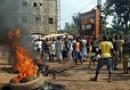
Last week’s appointment of Catherine Samba Panza as CAR’s transitional president, the third female head of state in Africa, raises a glimmer of hope that this troubled nation at the heart of the continent could finally end its long history of coups, political violence, ethnic-based exclusion and grinding poverty

The violent political conflict in the CAR continues to claim innocent lives, cause massive displacement and destruction of property. The efforts being made to end the carnage and restore the country will not achieve much without taking into account the role of France in destabilising CAR
France has over the decades been a key player in the violent drama of Central African Republic politics. But there are other interested parties involved. CAR is a case study of how neo-colonial greed can destroy a country
An analysis of the factors that produced the recent coup d’etat in the Central African Republic reveals the interests of France, the US and neo-colonial African forces
African states must resolve the conflict inside the Central African Republic in order to avoid further French and US military involvement argues Abayomi Azikiwe
Thousands of people who have returned to their homes in areas close to Ndélé, in northern Central African Republic's (CAR) Bamingui-Bangoran region, after years of displacement, are living in difficult conditions as the security situation is still precarious, say officials. Between 2009 and 2011, Ndélé was the scene of fighting between government troops and various armed rebels, forcing thousands to flee.
Nineteen people were killed in the country’s cholera outbreak last year. More than 300 people cases were reported, and an epidemic was declared on 30 September 2011. Though neighbouring countries, including Cameroon, Chad and the Democratic Republic of Congo, have experienced outbreaks over the past decade, the Central African Republic had not seen a cholera case in as many as a dozen years. Today, the cholera outbreak is finally on the decline.
The Central African Republic (CAR) has been in the throes of a humanitarian crisis for more than a decade. Army mutinies, coups and attempted coups, rebellions, gangs that kidnap for ransom and, more recently, elements of Uganda’s notorious Lord’s Resistance Army have made life for civilians, especially in the north, extremely challenging, unpredictable, and very dangerous. As IRIN’s new documentary film, Under the Gun, demonstrates, many Central Africans have little say over where they live even.
Vincent Munié looks at France's strategies and machinations in the Central African Republic.
Buried deep in the mixed-bag of the November 19 2007 presidential agenda, a meeting took place between Nicolas Sarkozy and Francois Bozizé of the Central African Republic (CAR). The secrecy and brevity of the encounter (27 minutes) belies a certain degree of discomfort. In fact, CAR is by no means an insignificant country to France.
CAR attained independence in 1960 from its former colonial master after decades of exploitation, but this did not diminish France’s political and military influence. Why then, was this meeting so quietly and hurriedly held? It appears that a chasm has opened between France and CAR.
At the beginning of 2007, relations between the two countries seemed normal. In the spring, Birao, the capital city of the Vakaga region which lies in the far north-east on the border with Chad and Sudan’s Darfur, briefly hit the headlines. In the same period, France was in the midst of an electoral campaign period, and consequently, there was little media focus on what role the French military was playing in this strategic region. And yet, on the 4th of March, in the first such campaign since Kolwezi in 1978, the French carried out an aerial assault on Birao, which had been under attack from the rebel Union of Democratic Forces for Unity (UDFU).
This new rebel force was formed in September of 2006 and brought together three armed groups composed of disillusioned ex-comrades of Bozizé, former officers who had served under ex-president Ange-Felix Patassé, and soldiers disgruntled with their pay. The Central African rebellion is a heterogeneous one; The movements oscillate between a Pro-Patassé political stance and a criminal tendency. However in order to understand the attack of 4 March, 2007, one must track back to November 2006, when a force of 50-odd men first seized control of Birao and several other areas of the North-East (Sam Oandja, Ouanda Djalle, etc.).
It took a month for the Central African army, supported by Bangui-based French troops and F1 Mirage fighter jets from N’Djamena to repulse the rebels toward Chad and Sudan. The tension was palpable. This is despite the fact that in February of the same year, a peace accord was signed in Sirte, Libya, between President Bozizé and Abdoulaye Miskine, on behalf of the UDFU. On the ground the rebels under the new leadership of Damane Zacharia dismissed the accord.
SOLDIERS RUNNING AMOK
At the beginning of March, Daman Zacharia announced a second assault on Birao. He declared that he was taking on the French, for what he saw as their interference in national matters. Since November 2006, France had maintained a small Special Force detachment of 128 in Birao. On the night of 3rd March, this force came under heavy artillery fire.
Two Mirage F1 fighter jets dispatched from Chad quickly destroyed the artillery nests. The following night, 50 troops from the 3rd Marine Infantry Parachute Regiment were dispatched form Bangui to a small airstrip 12 km from Birao to setup a launch-point for Transall and Hercules carriers bringing in troops from Central Africa and about one hundred French legionnaires. The Central African Army, with the manpower and logistical support from the French, were thus able to regain control of the town and its surrounds.
Zacharia and his forces were headed for Bangui, and were it not for Paris, the government of Bozizé would have fallen. The Central African conflicts are seen as wars of the poor. The UDFU has never had more than 500 combatants, while the national army has 5000 men, of which the fighting force is less than 2000. For a country size of France, this is very small.
After the March conflagration, Birao was left in ruins: 70% of houses were burnt and looted. There were very few civilian casualties given that all the town’s inhabitants had sought refuge in the bush. However, the destruction of the millet reserves, just before the onset of the rainy season, portends a certain famine for an impoverished population that is totally dependent on its meager agriculture production.
Although all parties deny responsibility, its seems that the national army bears a huge culpability for the pillage. In this forgotten part of a forgotten country the military once again has the dubious distinction of turning on its own citizens. The soldiers in Central Africa seem to be out of control. The terror metered out by the army in the North West is a major cause of the insecurity in the area. Of particular concern is the presence of the ubiquitous dreaded presidential guard – drawn from “ex-freedom fighters who were brought in from Chad to bolster Bozizé’s coup in 2003.
There have been massacres, rape, torture and looting… all perpetrated under the guise of fighting the rebel group Armée Populaire pour la Restauration de la République et de la démocratie (APRD), the country’s second rebellion. The presidential guard has launched several attacks on the civilian population. The national army (formed by France) is responsible for the massive displacement of citizens (200,000 displaced in the North-West).
Clearly, France would not gain from attention on its involvement in CAR. However, the national army has become a dubious ally. There were several calls from the French Foreign Ministry over the summer, urging the CAR government to rebuild confidence between the army and the citizenry. At the beginning of November 2007, Bozizé himself acknowledged the atrocities and took symbolic measures. He invited the rebel groups to the negotiating table. Their demands, put forward primarily by the Central African People’s Liberation Movement (MLPC) of former Prime Minister Martin Ziguélé, revolve around the disputed 2005 elections, army atrocities and the mismanagement of economic reforms.
France still does not seem ready to cut its ex-colony loose. Under a 1960 defence accord, France is obligated to intervene in the event of foreign aggression. The current rebellion is, however, of local origin – and not orchestrated by Khartoum, as has been suggested in official circles. France’s presence in the region has taken on an “unquestionable” character. The March military operation is but a symptom of a much bigger problem.
MUTINIES AND SHENANIGANS
After a brutal colonization of the Oubangi-Chari, the first “French” town, Bangui, was established in 1889. Independence did not end French patronage, making CAR a textbook example of what is referred to as “Franco-Africa”. After the “fortuitous” death of the republic’s founder Barthélémy Boganda, France has always systematically maintained a firm grip on power by propping up and deposing its protégés; David Dacko was twice installed and deposed, Jean-Bedel Bokassa proclaimed himself emperor and was overthrown by France in Operation Barracuda, André Kolingba set up a military regime, Felix Patassé was the first “democratically-elected” president, and the latest in line is Bozizé.
In a review of the cooperation, the two permanent bases of Bouar and Bangui were closed in 1998, following the “mutinies” of 1996 during which French soldiers seized control of the capital. In 2002 an operations centre consisting in part of the Special Operations Command (COS), was set up through Operation Boali… Another sign of France’s continued influence is the presence of General Henri-Alain Guillou as presidential military advisor, along with about 60 other officials in various ministries.
Whereas CAR has been relatively untouched by the systematic industrial depredation suffered by its neighbours, its central position on the continent fits in with France’s political and economic strategy. In the course of the last fifty years, CAR has secretly become a feeding-trough. The sustained lawlessness has favoured the wanton extraction of minerals, precious stones and illegal ivory trade. The 1979 diamond affair is just a tip of the massive iceberg that is the exploitation and expatriation of gold and diamonds by French businessmen. The same has been true for the rapacious exploitation of timber and rubber resources through concessions given to individuals engaged in tropical misadventures. The Kolingba (1982-1993) and Patassé (1993-2003) regimes have followed on in the same style.
France has more or less maintained some military presence in CAR since independence, and at the same time exercises the same political patronage as in the rest of the sub-region. An important part of this presence is France’s ability to monitor the neighbouring countries. In addition, France has always favoured Africa as a military training ground. So far, France has been able to prevail militarily, given that none have taken on a terrorist character as has happened in the Middle East. The hand of France has also been clearly seen in African politics, as was the case in Rwanda and Côte d’Ivoire.
The French media also has a significant part to play: on 14 July 2007, France 2 carried a rare report on CAR that glorified the role of French troops in the Birao rebellion, without addressing the question as to why France was there in the first place, the root causes of the rebellion, the state of the country, or even the atrocities committed by the CAR army.
It is true that the CAR crises do not constitute an all-out war or a humanitarian crisis of the kind that stirs up international attention or emotions. At the same time the country continues to suffer silently in grinding poverty. The Human Development Index list CAR as the 5th –poorest country. The state is practically non-existent outside the capital, hardly giving any assistance to a population left to its devices. In January 2008, civil servants went on strike to demand salary arrears. On 18 January, the prime minister resigned. Since 1960 the country has been yoked with leaders chosen more for their obsequiousness than their managerial acumen. As a result the CAR has been impoverished, hence justifying the need for “aid” – military, economic and political.
Bozizé did however deign to take liberties against his colonial master and protector. In April 2007, the government suddenly decided to nationalize the petroleum sector, in the process excluding Total, which until that point had been the major shareholder in SOGAL, the hydrocarbon management company. Further still, the president’s nephew Sylvain, Ndoutingaye, minister for mines, was given the economy portfolio, against the advice of Sarkozy and the World Bank. Strict financial conditions were also imposed on Areva’s exploitation of the Bakouma mine. Areva had recently acquired Uramin, the Canadian company that held uranium-mining concessions in CAR. The final act of defiance was Bozizé’s visit to Omar El-Bashir, his Sudanese counterpart, despite France’s disapproval.
At the same time France has been accused of ties to a “rogue regime” thanks to its links with the national army. Despite efforts at transparency, the national army remains largely unaccountable, given that officers accused of crimes are simply dismissed without charges. The heralded national dialogue remains an illusory promise. Although diplomatic pressure has been brought to bear, France withdrawing its troops would be the key factor. Only a couple of military advisers were withdrawn this summer. South African diplomats however continue to work in the corridors of power. A peace accord was signed in March when Thabo Mbeki quietly visited Bangui. As a result of this visit, the presidential guard was placed under the tutelage of thirty South African military instructors. At the end of the day, the stakes are rising in the race to take over patronage of CAR.
The CAR revolt is not an isolated case. Chad’s Idriss Déby showed an independent streak in the Zoe’s Arch saga. Niger’s president Mamadou Tandja has been actively seeking out other economic partners. In this context, France’s traditional bilateral ties, the military cooperation and economic networks seem to be on the wane. France has subsequently insisted on the deployment of a European Union force (EUFOR), which will effectively double the number of French troops on the ground in the strategic Chad/CAR area. Their mandate remains unclear as far as Mission “Epervier” or Operation Boali are concerned, raising the likelihood of confusion.
In 2007, however, a mere military presence is not enough to guarantee France’s pre-eminence in the country. As her paratroopers and soldiers descend upon the capital and patrol its streets, they walk past the ruins of the Sports stadium, where Bokassa was enthroned. This gift from the Giscard-d’Estaing regime, continues to crumble and decay by the day, while a mere forty metres away rises the city’s grandest structure: a beautiful thirty-nine thousand-seater stadium. A gift from China.
*Vincent Munie is the director of Survie-France.
*This article appeared in the French edition of Pambazuka News and was translated by Josh Ogada.
*Please send comments to [email protected] or comment online at http://www.pambazuka.org/
The UN refugee agency has announced it is coordinating an operation to bring help to some 26,000 refugees who fled insecurity in the Central African Republic and are now living in precarious conditions scattered along the eastern border of Cameroon.
Since fleeing his home in northern Central African Republic (CAR) on 3 December 2006, Abdoulay Douga Mandja Noel, 40, has lived rough in a border town called Am-Dafock shared by the CAR and Sudan. Abdoulay fled months of fighting between the army and a rebel coalition, the Union des forces démocratiques pour le rassemblement (UFDR), which is seeking inclusion in the government of President François Bozize, whom they accuse of sidelining them.
An increasingly grim security situation in northern Central African Republic threatened the progress made since elections in 2005, Toby Lanzer, United Nations Resident/Humanitarian Coordinator in that country, said at a Headquarters press conference this afternoon (16 January 2007).
A Central African Republic court convicted deposed President Ange Felix Patasse of fraud in a one-day trial on Tuesday (August 29) , sentencing him and two co-accused in absentia to 20 years of hard labour. Patasse, who lives in Togo after being overthrown in a 2003 military coup by current president Francois Bozize, has refused to recognise the authority of the court.
A top court in Central African Republic has referred its former president, Ange Felix Patasse, and Congo's Vice-President Jean-Pierre Bemba to the International Criminal Court in The Hague on war crimes charges. Patasse's security forces backed by fighters from Bemba's then-rebel movement in neighbouring Congo and mercenaries from Chad are accused of executing and raping civilians as they put down a coup attempt in the former French colony in October 2002.
A donor conference for the Central African Republic (CAR) began on Monday in the Cameroonian capital, Yaounde, organised by the UN Office for the Coordination of Humanitarian Affairs (OCHA)."New dramas emerge regularly," OCHA said. "Following banditry in the country's north since late December, thousands are still homeless, while 45,000 refugees have fled to Chad, 15,000 of whom have left their homes since June 2000." UN agencies and NGOs struggle to get funding to support the internally displaced. OCHA said although most major donor governments have confirmed their attendance at the Yaounde meeting, organisers were not optimistic that pledges or commitments would be made at the event.
The 2006 session of the CODESRIA sub-regional methodological workshops will explore the conditions for the employment and validation of qualitative perspectives in African contexts. To this end, the workshops will be open to all the social research disciplines. These disciplines are uniformly confronted with broadly similar difficulties of understanding social reality and the challenges posed by techniques of data collection and analysis, which, on account of their ''qualitative'' nature, are suspected by some to be seriously lacking in scientific rigour.
At least 2,000 villagers in two provinces in the northwest of the Central African Republic are hiding in the bush without food while an equal number has fled to neighbouring Chad recently to avoid fighting between the army and bandits, local sources said. At the same time, humanitarian workers said on Friday displaced villagers in the provinces of Ouham and Ouham Pende were in dire need of relief aid as insecurity had prevented humanitarian agencies from providing help.
Schools across the Central African Republic (CAR) have reopened and services have resumed in other sectors since civil servants ended their two-month strike over salary arrears on Thursday (January 5). "Our demand over unpaid salaries was partly met, as the government has accepted to pay three months' wages in 30 days," said Noel Ramadane, the vice-chairman of the country's largest trade union, the Union syndicale des travailleurs de Centrafrique. "This shows the goodwill of the CAR authorities to find a solution to our grievances."