


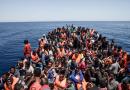
Who should be held accountable for the continued violations of rights, and the deprivations of life and dignity, experienced by African refugees and migrants?
Why are Africa’s leading regional bodies not stepping up to protect and defend refugees and migrant workers in Libya, asks Nunu Kidane.
[Yohannes Woldemariam's article is a] '… good comprehensive article that wastes no space or words and states the facts, historic and contemporary, quite clearly. Thanks.'
by Yohannes Woldemariam is one of the best written analysis I have read on this matter in a long time. Good points on the policies of the Eritrean government that are driving hundreds and thousands out of their country, the role of EU's migration policy and the overall responsibility of the global community. Thank you.
P.S. I happened to be visiting Italy, in Sicily at the time of this and you can read more of the findings of my organisation from www.BlackAllianceBlog.blogspot.com
In a potent challenge to the Bush administration’s stated aim of increasing security on the African continent, Nunu Kidane argues the US’ sudden interest in the military AfriCOM initiative to reflect both unease over future control of natural resources and the increasing Chinese presence in Africa. As a means of actively opposing the initiative’s progress, the author urges readers to participate in the Resist AfriCOM campaign to say a clear and unequivocal ‘no’ to Washington’s AfriCOM programme.
When Eritrea earned independence from Ethiopia in 1991, it was seen by many as a revolutionary moment that would usher in freedom and equality. But more than fifteen years later, the “reality is the liberation-army-turned-government is led by a brutal dictator and his handful cronies. There are no systems of representation or participation in the government. Sadly, those who paid the highest price in the armed struggle, the former fighters men and women are the ones who suffer the most today,” Yet in the midst of it all Nunu Kidane finds hope.
===
My country Eritrea is in the news again and hardy on a positive note. The conflict with Djibouti reported in the New York Times and European press is not the news I would have liked to read about. Over the past decade, starting with the border clash with Ethiopia in 1998, Eritrea has been the cause of, or in some way directly linked to conflict and destabilization of the Horn of Africa half a dozen times.
What saddens me is that Eritrea, during the days of the struggle for independence, was a country that held such high hopes and promises for us as Eritreans, and for the Horn of Africa, indeed for the continent as a whole. It is a small country in North East Africa, by the Red Sea, with approx 4.5 million people, which a fierce sense of independence and pride in the people’s ability to do it on our own.
When it won de facto independence in 1991, it appeared indeed the defiant attitude of going against the grain of global political trends had paid off. The future looked hopeful and the people were united in the insurmountable challenge of nation building ahead.
Whenever I introduce myself as Eritrean in academic circles or with progressive Africa supporters from the old days, they tell me how much they had supported Eritrea’s struggle for liberation. They tell me their pride in supporting the women’s equality movement that was grassroots and led by Eritrean fighters, a model of self determination and securing full rights for women at all levels. The liberation movement was more than an armed struggle; it was visionary in planning for social and economic transformation of a country and its people that linked with the struggle of people in similar struggles the world over.
Whenever I or other Eritreans are greeted in such ways, for what our country used to be, there is a deep sense of loss and sadness that overcomes us. It is difficult to know what to say in response because the reality of what Eritrea is today cannot be further from the vision of our aspirations at the time of independence some 17 years ago.
The reality is the liberation-army-turned-government is led by a brutal dictator and his handful cronies. There are no systems of representation or participation in the government. Sadly, those who paid the highest price in the armed struggle, the former fighters men and women are the ones who suffer the most today. Both at the hands of the government as prisoners in their own ‘free’ country, as forced fighters in various conflicts with Eritrea’s neighbors, or from the high cost of food and fuel and the worsening economy which has left nearly one third of the country malnourished and at the brink of starvation.
In the early days of the Eritrean struggle for independence, Eritrean women were celebrated as heroes unlike any seen before in Africa. Despite the traditional limitations of the conservative culture which does not allow women to participate in any social and religious activities alongside their brothers, Eritrean women in the Eritrean People’s Liberation Front (EPLF) proved that cultures could be challenged and changed. Women wearing short military pants, hair in afro, slinging Kalashnikovs were our pride in depicting strength of body and character. Unlike other liberation fronts where the women were relegated to the kitchens and as support to their male counterparts, Eritrean military forces were made up of nearly thirty percent women. Not only was the military integrated fully, but women held leadership positions and participated in all health, education and agricultural programs that supported the rural communities. Violation of women’s rights was a serious crime and rape was punishable by death.
Where are those women now? What happened to their voices and the ‘equality’ that was supposed to translate into economic power? If one were to do a quick search on google for “Eritrean women” you would hardly find any evidence of the history of these women fighters. Right after you go past the postcard tourist photos of women in traditional drab and right past the “date Eritrean women” link, you may find the link to the National Union of Eritrean Women. Although still in operation, a discredited association which parastatal despite claiming to be non-governmental. Not only is it a weak association, but the NUEW has betrayed its historic mission by being a mouth piece of justifications and rationalization of the government for the repression and violation against Eritrean women today.
The Eritrean diasporic community was highly supportive of the struggle at home, financially and in policy advocacy in the US, Europe and the Middle East. It was the most mobilized of all African immigrant communities in the world, sending millions of dollars each year, from remittances of the hard working members of its population eager to return home after liberation. Eritreans were drunk with national pride that bordered arrogance and chauvinism, convinced that Eritrea was unique in what had been achieved during the liberation struggle, and once independent, it would prove to be a model of economic success and envy of the world. We in the diaspora were too trusting of the leadership and never posed questions of political balance and accountability process of our leaders. We were the cash cows that sent money regularly to our families and the movement and we were to pay a high price for this, still do.
A few years back, I spoke to Prof. Horace Campbell, a good friend and author of author of “Reclaiming Zimbabwe” about the sad state of affairs in Eritrea. Professor Campbell had supported Eritrean movements and the EPLF in the decades of the struggle. I described to him the state of paralysis that Eritreans in the diaspora seem to be in, stuck in disbelief that the reality of economic crisis and political repression is indeed the same country they had given so much for. Stuck in a state of apathy that comes from a profound state of betrayal by those we trusted most.
His response has been useful for me to reflect on. He said that this moment in history would pass and Eritreans would again “reclaim” their liberation for its true value and meaning, for social transformation into an equal society guaranteeing the rights of its people. However, he emphasized that this current state of crisis is an important stage for Eritreans to go through in order to never repeat their blind trust on their leaders. Difficult as this period is, that Eritreans at home and in the diaspora will draw the important lessons of discerning and challenging those who claim to lead and represent us. We will fully engage and set up mechanisms and systems of accountability of leaders and political groups, challenged to prove in open democratic ways, how they stand to serve their people and their country honestly.
As an Eritrean, my sense of pride in my national identity, my country and my people continues unchanged. The current leadership does not represent me, nor speak for me and other Eritreans. I do not feel conflicted or confused by those who claim to call me unpatriotic for being openly critical of the current regime. It is in fact the opposite is true; I speak out for love of my country and my people, not to do so would be ignoring the pleas of those silently waiting in crowded prisons, not to do so would be to ignore the calls of Eritreans who are waging a different struggle inside the country, against a repressive state that is bent on holding on to power against the wishes of its people.
*Nunu Kidane is a native of Eritrea and a member of Friends of Aster Yohannes. Aster is a former fighter and admirable woman who has been imprisoned since December 2003. Read more about her at:
*Please send comments to [email protected] or comment online at http://www.pambazuka.org
This year’s World Social Forum was held in Nairobi Kenya, the first in the African continent. Many who participated in it have written their accounts of the Forum, and the significance to the movement building towards another, a better world. What seemed to be missing from the accounts I’ve read is that while we were in Nairobi, the US bombed the East African country Somalia in what was falsely justified as a move to eradicate Al Queda operatives in the Horn of Africa.
In the many workshops dealing with peace and security held at the Forum, few raised the importance of our presence in Kenya, a country which has played a key role in providing support for US military offensive against neighboring Somalia.
The increasing US military role in Africa should be a concern to all of us and the January 23rd bombing of a defenseless people, while the Social Forum was on its 3rd day, should have raised alarm from the progressive peace movement. US military attack of Somalia should be seen parallel to US aggression in Iraq and Afghanistan.
How then to explain the silence of the US peace movement on Somalia. Perhaps US-based organisations don’t have the proper analytical framework from which to understand the significance of the Horn of Africa region. Perhaps it is because Somalia is largely seen as a country with no government and in perpetual chaos, with 'fundamental Islamic' forces not deserving of defense against the military attacks by US in search of 'terrorists'.
The US has officially made known the intention to have the largest US military presence in Africa, known as AfricCom. The rationale for this of course is to curb further spread of Islamic fundamentalists presence in Sub Sahara Africa which viewed as open ground for possible Al Queda recruitment.
US political and military alliance with Ethiopia – which openly violated international law in its aggression towards Somalia, is destabilizing the Horn region and begins a new shift in the way the US plans to have permanent and active military presence in Africa.
Four days after the bombing of Somalia, one of the largest peace protest was held in Washington DC on 27 January. Somalia remained off the agenda by the expressed intent of the organizers to keep single focus on Iraq and ‘bringing the troops home’.
Does this mean the US public only responds to messages of peace as narrowly defined as securing the safety of US military personnel in Iraq? Visions of the global peace movement cannot be limited the interests and concerns for particular geographic areas and people. What drove hundreds of thousands out to the Washington DC protest in the friging cold weather is beyond self-interest and the concern for all lives, Iraqi, American, Afghani and Somali !
Somalia goes to the relevance (or irrelevance?) of Africa in US history; lack of proper framework from which to understand current political events in the continent and ways of engaging the general public.
It is bad enough that the Washington Consensus views Africa through the lens of national security concerns, or as a source of oil and other minerals. The peace movement, which speaks for all peace-loving people in the US and the world, should maintain a different perspective if we are to move towards the vision that 'another world is possible'.
* Nunu Kidane is Network Coordinator for Priority Africa Network (PAN) based in Oakland, California – [email][email protected]