


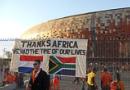
Set the cost of the Fifa World Cup against South Africa’s development needs, and ‘you can't but conclude that we didn't need it, nor could we afford it. So why did we go all out to host such an unnecessary event?’ asks Andile Mngxitama.
 cc As South Africa nears its fourth election since 1994, Andile Mngxitama laments the country's overall lack of progress toward genuine black liberation in the post-1994 era. Highlighting Steve Biko's emphasis on 'conscientisation' to counter the normalisation of black people's material and mental subjugation to the entrenched white power structure, Mngxitama decries the continued suffering of the poor black majority in post-1994 South Africa, arguing that the race-based understanding of impoverishment once used to describe marginalisation has now been effectively eradicated under the anti-racialist hegemony dominant in national discourse. With the state still essentially rooted in its apartheid-era model of white capitalist accumulation and exploitation – albeit with a new black leadership at the helm – Mngxitama contends that the country has simply moved into a neo-apartheid phase of little discernible distinction from its past, stating that to vote within such a system would merely be to grant it legitimacy.
Mandela is, in some ways the perfect embodiment of post colonial Africa, a continent blessed with so many possibilities but consistently producing so much disappointment. The African dream of liberation has become a long nightmare. As Mandela turns 90 the country he helped found some 14 years ago is in a mighty mess. Its hatred of black people has reached the apex with the mass slaughtering and displacement of black Africans (apparently a good 20 or more of the more than 60 dead are South Africans). Post 1994, has been much celebrated for the benefits it bestowed upon a few, silence has befallen the fate of the black majority which has been bequeathed a bestial existence.
Mandela’s 85th birth day was a Coca Cola affair. The multinational corporation was given full rights to throw a party for our founding father. Coke milked his name dry, everything was branded, serviettes to programme - the whole affair was televised live. This forced a friend to remark that we need another “Free Nelson Mandela Campaign." At 90 Mandela must be allowed his well deserved rest. But it’s hard to think of this likable man of the 20th century Africa outside politics. He is resistance, Robben Island, freedom, magnanimity, compromise and hope for many, but what is his real legacy?
A few years ago Chinweizu wondered loudly about the icon of liberation who voluntarily builds his house as a replica of the prison house he was kept him during the last days towards his release. Who build a prison for a house? Our Mandela is a symbol, like his country, of things shiny and good and things horrendous.
Prof Wole Soyinka was moved to comment on the “soulless truly horrendous” sculpture of Mandela which presides over the Mandela Square in Sandton our Mecca of consumption, which lives cheek by jowl with the sprawling Alexandra township. Sandton feeds on the blood of Alexandra, the place from which the recent spade of Negrophobic attacks emanates. Cornel West, firstly praised Mandela as a the Socratic spirit of “going against the grain” then on reflection from the distance of the USA he warned against the “Santa Clausification of Mandela - Big smile, domesticated, tamed, defanged with toys in a bag."
At 90 Mandela is all these things, but more, he is the African dream that never became. His 90th bash will be held in London, what the official website says is his second home, images of Toussaint Louverture perishing in the loving embrace of his friend Napoleon Bonaparte flashes by. Now we wait for Barak Obama to conclude a circle started in 1994 in South Africa, White Supremacy today needs a little melanin too. Black suicide is endemic, 1803 it was Haiti, 1994 South Africa, and maybe 2008 December the USA. Happy 90 Tata!
*Andile Mngxitama is a Johannesburg based land rights activist and member of the We write editorial collective.
*Please send comments to or comment online at http://www.pambazuka.org/
http://www.pambazuka.org/images/articles/385/49180xenophobiaSA.jpgWEEK ONE
The sms’s came fast and furious. As furious as the fiery images we were subjected to by our television and our daily newspapers. I dreaded opening a newspaper for days - afraid of being confronted by yet another grisly product of the negrophobic xenophobic violence, which by the end of week three had claimed the lives of about one hundred people and displaced about 100 000, according to some estimates. The mind spins out of its axis, out of the normal.
As the Alexander Township burnt, I was reading text messages from my cappuccino-loving Tito Mboweni-fearing middle class friends. The messages were generally along these lines; “I’m so embarrassed to be South African right now”, or more engaging: “I’m so tired of feeling angry about this and not being able to do something about it…” . Email lists held similar messages of shame; at least Winnie Madikizela-Mandela went to Alexander and told the terrified victims cramped at the police station; “We are sorry, please forgive us. South Africans are not like this”, before hopping back into her nice car and driving back to her life.
Black Perspectives on the South African Human Rights Ruling Against the Forum for Black Journalists
The details surrounding the Forum for Black Journalists (FBJ) and Radio 702's Katy Katapodis showdown have been rehashed in the media ad nauseam and while these may soon be blurry bits of yet another tantalising 'racism' story, what is likely to remain stubbornly in our memories is that the HRC ruled in favour of the complainant. This decision, which made little or no reference to the submissions made at the hearing called by the commission (other than Katapodis'), has been warmly accepted by those who preach the gospel of non-racialism, integration and transformation in the New South Africa.
Mainstream media reports have been inundated with praises, from both blacks and whites, of this essentially anti-black ruling but this is hardly surprising in a white supremacist country where black interests are often shelved and hardly recognised as such. It is even less surprising then that there have been few voices in the media that represent the marginalised black perspective that rejects the decision not only in terms of the immediate consequences for the FBJ and other black organisations but its implications on blackness as a whole. Granted some black organisations have come out with their hands behind their heads desperate to show those who matter that they are the custodians of non-racialism but the conspicuous absence of black voices is hardly a reflection of a blanket acceptance of the HRC's decision. There are quiet rumblings among blacks who are slowly being hit by the hard reality that this decision is perhaps an unapologetic, institutionalised affront on our blackness.
We Write What We Like (wewrite) is calling for contributions on this issue not only to give space to those whose unpopular views have been rejected in the mainstream but to engage black thinkers in a much needed dialogue.
Wewrite is an online journal for black thought, which was launched in 2005.
Send your submissions to [email][email protected] by the 30th of May 2008.
Andile Mngxitama, special issue Editor.
I have been a great admirer of the contemporary Kenyan literary and intellectual movement for sometime now, a movement personified in Kwani? amongst others. As a relatively young South African, I have searched with no success for an equivalent development here at home. I have been mesmerised by Wainaina’s imagination and masterly use of irony. Mukoma’s political insights which are many years older than him, I cant forget the dancing poetry of Shaila Patel. But when the election related bloodletting occurred, im afraid their wailing pens went flat. They have certainly written, they have initiated and joined the peace movement, but im afraid they haven’t said anything. Maybe that is the cost one pays for success and international glory.
Why would these great minds of our time, appear like many Desmond Tutus presiding over the TRC collective mourning ceremony? Why have they banished from their pens, incitement to liberation and the attack on the neo-colony and its degenerate democrazy (apologies Fela)?
Every time I read these idols of mine, I hear “peace”. What peace? I ask. The poor of Kibera are trapped in one of the most vicious structural violence known to humanity, every single day of their miserable existence. Haven’t we felt the bitter tears of the surviving mau mau fighters? When we were in Nairobi for the WSF last year, we were told stories of state sanctioned mass killings of the poor youth, they apparently shoot to kill even for stealing a cell phone. And we talk peace? Is it not a great miracle that some people born in Kibera reached the age of 25? But for the majority of Kenyans life after Uhuru has not been a bed of roses, we also know of the never ending killings for land and forests.
My gripe more than anything is predicated upon the spectacular failure to raise an alternative voice which is not hobbled by international NGO humanitarian discourses deeply trapped in liberal democratic appeal. I yearn for a voice which would confidently redirect the violence consuming the poor of all tribes, which is organised above by the democracy elites whose sole purpose is looting. Why I don’t hear someone talk about revolutionary violence? Why I don’t hear someone say death to Kibaki and Odinga! Unity amongst the poor! Why? Because we are now struggling for peace? Not even a little justice?
The people of Kenya has every right to chose who will rule over them, in short which elite group must come in and eat as they seat in the grand stand cheering on. That’s democracy ala our new colonisers. But surely we can warn them that they need not kill each other so that their respective leaders may eat. We have a responsibility to point out that the so called democracy is really not worth dying for, maybe we should point out that it’s a little better to die fighting for your own freedom against the tyranny of money now embodied in Kibaki and Odinga.
Please let’s stop the talk of peace, which is nothing but a call to return to the abnormal normalcy of elite rule predicated upon the perpetuation of structural violence against the poor. Here in SA, it was interesting to watch through eyes burning with tear gas and gun power, how the apartheid monster turned the terms of our liberation movement into a negotiations for peace after unleashing untold violence against the blacks using black hands like the Inkatha Freedom Party thugs (remember the misleading talk of black on black violence?). So we negotiated a peaceful transition which ensured the perpetuation of black suffering.
Am I losing my mind? It’s ok if I’m, because reading Wainaina’s latest missive in the mail and guardian about those bloody Tanzanians, I have good reason to believe I’m in good company…
Andile Mngxitama reexamines the revolutionary potential of Black consciousness via a critical look at the politics and philosophy of the Black Consciousness Collective (BCC).
The idea of writing this letter struck me whilst at my home village eNgcobo in the former Transkei. Our village, which is know as eNyanga is part of a place with a strange name- “All Saints”. eNyanga is situated in the belly of mountains. To the North is Kalinyanga, the south is Gilindonda and east the Qhuthubeni mountain. These are enchanting plains. Here I was generally engaged in the rituals and other festivities of our people, when my mind drifted to the Black Consciousness Collective (BCC).
Walking the land of Ngqika, it occurred to me that the BCC is far too important to be ignored. I also realized that I harbor some sense of impatience if not utter contempt at some of the habits (what I consider intellectual snobbery in particular), and gestures of arrogance from its members. I also acknowledge that my interaction with the collective, its members and sympathizers is rather perfunctory to say the least- but still the BCC is such an important and promising initiative that I would be remise to give it a miss. So I thought I should attempt a structured engagement which could afford us a basis for engagement.
Let me say it at the outset, my intention is to seek clarity for myself on the role, politics and philosophy of the BCC amongst others. I regard this as the first installment in what must naturally be a mutually educational discourse for all of us. Yes, old dogs can ans should learn new tricks too!
I gather from the name of the collective that it is committed to or rather it is about Black Consciousness. That’s well and good but which of the various contrasting and contending BC streams does the BCC align itself? Like in Marxism, we can no longer take for granted that when we say “bc” we are all referring to the same thing.
THE FOUR FORMS OF BLACK CONSCIOUNSESS IN CONTENTION
I can immediately think of at least four contending versions of bc for instance: Firstly there is the BC of sterile cultural expressionism which is about promoting mindless consumption in aid of the capitalism madness of our age. It’s the BC of Stone Cherry and Eric Miyenis of this world, its in agreement with the thesis proffered by the author of that despicable pamphlet of death, masquerading as serious work of on the black question- The Capitalist Nigger (which is our national best seller by the way).
Secondly, and this is the off shoot of the first type of BC, its the noisy status bound hip-hop and urban spoken words projects with their “African” regalia to boot. Practitioners of this bc simulate rebellion whilst they work their ways towards acceptance in the existing anti-black mainstream of the commercial cultural beast. The Rosebank Underground. These are by and large poets for hire. Their dead poetry repeats itself into a deadening crescendo utterly devoid of the beauty of authentic black rage.
Then there is the BC of monuments and icons. This is primarily promoted by institutional custodians of BC like Azanian People’s Organisation (AZAPO). This kind of BC is mute and deaf on the prevailing black condition; it finds refuge in past glories and burdens the dead with the projects of now. It thrives on “ifs”, and exists in an inconsolable sorrow devoid of the impatience and appetite for “Bolekaja.” Bolekaja as you may recall means “Come down let’s fight!” A term used in western Nigeria by passenger lorry touts and made famous by Nigerian literary critic Chinweizu. This BC cannot inspire blacks to rebellion and fire.
Then there is the BC of BEE, the least said about this the better (of course this version has strong affinities with the first two alluded to above). BEE is about a new class of plunderers who use their black skin and our black collective experience of sorrow to insert themselves in the economic mainstream built and sustaining itself on stolen black land, labour and the African “being”. These new agents of accumulation by theft and dispossession provide legitimacy to white monopoly capitalism, which must be vanquished if blacks are to have a chance to liberation. Capital in our country needs to be brought to justice and answer for its sins and atone for the near death agony it inflicted/afflicts on the black body.
The last version is what I’d like to think of as the real living BC, which resides within the excluded multitudes. It’s a bc of the black margins. This BC finds concrete expression in the young girl of Khutsong hurling a rock at an oncoming Caspire in an act of courageous defiance and rage against the arrogance of post apartheid democratic power which looks and acts like the apartheid monster. Its stones against bullets again, produced by the arrogance of state power instead of the uncompromising commitment to the art of persuasion/engagement/listening/dialogue/response/respect. These are the birth marks of true freedom. This living BC resonates with the thousands that partake in what the media calls “service delivery protests”. For me BC and Biko live in those cracks of the great unwashed every time they cry ya basta! From Khutsong to Chiapas. It may be opportune to remind ourselves of how Biko’s philosophy of black liberation. Biko said
“Blacks are out to completely transform the system and to make of it what they wish. Such a major undertaking can only be realized in an atmosphere where people are conscious of the truth inherent in their stand. Liberation, therefore, is of paramount importance in the concept of black Consciousness, for we cannot be conscious of ourselves and yet remain in bondage. We want to attain the envisioned self, which is a free self
PHILOSOPHY OF CHANGE AND THE BCC
I realize that I have been presumptuous on a number of points, but I have now gone too far to halt myself, so I am going to ask this: Is the BCC at the beginning again? In other words at the point of re-imagining BC? My question really is this, what does the BCC mean by BC? Implicit in this question is both a philosophical and practical consideration, what does BCC wants to achieve with its BC? A related but side and inconsequential issue is this, what is BCC’s BC attitude to the ANC’s politics of non-racialism and integration -as a theory and now as practice of party in government? I am sure you also may have to allude to the existing political formations such as Azapo, SOPA and BPC which proclaim bc as their guiding philosophy or ideology (a rather oppressive term really, this ideology business).
I think it a little passé to raise the old question of the unity of thought and action. But I think I need to be explicit in case its not taken care of in the broad set of “identity” questions I ask above. In my engagement with members of your collective it seem to me that one can read a few contradictory attitudes toward this question of the unity of action and thought or lack thereof. I heard, I hope correctly, for instance that action is already implicated in thought. This means there is no action, which is not preceded by thought. I agree that this is generally a truthful assertion. But is it automatic that thought ends in action, or thought here is also action? A dialectical unity? But then how do we judge effectiveness? Or is there no physical materiality in this process? Then of course I think there are certain forms of “thought” which are anti-thought and action, such as formulistic Eurocentric “logical” philosophy.
I also recognize that Nazis, colonialists and imperialists have their own intellectuals and philosophers. So from this point of view there is nothing progressive about philosophy a priori. I would not now want to raise my ‘pet hate’ subject - the anti-black origins of most of western philosophy (how do you deal with this?). I think a bit of Foucault quickly shows how everything is implicated in power, self- interest and subjectivity. But of course I am not interested in abstracted philosophical assertions. I am interested in the specificity of your collective’s “thought” process and its relation to “action” aimed at the structures of oppression and denigration of back people.. Surely, the sum total of your “action” cannot be reduced to creating spaces for “critical dialogue”, although I would under duress accept such engagement as action too.
If I were to walk ahead of your response on this one, I would say, I’m inspired by the likes of the originators of the negritude movement (Suzanne Ceseair, Aime Cessaire, but less so the likes of Sengor). These pioneers “culled” a lot of fire from the Surrealists and gave that philosophical movement some flames of rebellion in exchange – and in the process created the possibility of action against all sorts of colonialisms. I also remember well, old Karl Marx admonishing his German fellow philosophers for being obsessed with interpreting the world when the point was to change it.
Allow me to go religious a little. You see, I grew up in a religious family even if later I bacame agnostic- I have done my time in the trenches in the service of god, so there must be some residual matter of this past in me. I agree with Terry Eagleton, we can’t but be what we are. So I beg your indulgence, just to draw a parallel if not a lesson from the holy book. In the book of James, James postulates on matters of “Faith and Actions” (I hope to substitute “faith” for theory if not philosophy), he teachers us that; “ suppose there are brothers and sisters who need clothes and not have enough to eat. What good is there in you saying to them, “God bless you! Keep warm and eat well!”- if you don’t give them the necessities of life? So it is with faith: if it is alone and includes no actions then it is dead…. So then as the body without the spirit is dead, so also faith without actions is dead”.
I think it was Lenin who said he has yet to see a successful revolution without a revolutionary theory, but he also laughed at the idea of theory without action. Cabral said something alone those lines when he theorized on the issue “theory and practice”. I find Paulo Ferere much useful on this score, personally. His dialogical method, of cause is not perfect, shows that there is no possibility of learning or clarification, or even building critical consciousness without doing. Action allows reflection on the concrete, leading to improvement and critical awareness. This is the revolution!
Of course those students who started SASO in the late 60’s were deep into philosophy but they understood oppression as a concrete truth, deeply implicated power. Racial capitalism or apartheid is as concrete as the N1. SASO students understood very well that oppression couldn’t be dislodged by philosophic disputations alone. It’s my contention that no one has yet contributed to changing the world for the better by simply holding a “correct philosophy”. In fact under certain circumstances, to “philosophize” is a great sign of betrayal and cowardice. My view in fact is that its of little use to philosophize outside action aimed at dislodging the white supremacist edifice deeply ingrained in the structures of politics, economics and even the whole cultural plain (here I understand culture in its broadest sociological sense). To try play philosophers without action is actually a self-serving and a safe option which also provides an alibi for doing nothing, it’s not unlike the “superfluous men” of 19 century Russia. This reminds me of the warnings from the pen of the mad one- Dambudzo Marechera, in his majestic “The Black Insider.” Somewhere Dambudzo writes;
“An excessive indulgence of the senses and thoughts… leads to the kind of decadence which can paralyze all action. To tick all the orifices of pleasure and stimulate all the possible orgasms of intellectual heights would be to sort of contrast demanded by this sordid war”.
Incidentally, I happen to think that black people the world over live in a state of a one sided sordid war which has not given us respite since the disastrous encounter with the white world starting with slavery, moving to colonialism, and imperialism to day. I’m permanently flabbergasted by the patience and laxity from the black world living through this living hell. Only we blacks can afford this type of absent-mindedness in the middle of war of decimation. We are wont at keeping us busy with inane, irrelevancies; this is the curse of our black skin. Somewhere else in the same text Dambudzo raises a matter which I think is relevant to this letter and to people like us;
“…we used to joke about being fucked out by everything but never to the extent of seeing the uttermost truth at the center of the jest. There was the gulf –as we saw it- between student thinking and activities and the workers-themselves whom I did not feel we had any qualifications to lead in anything. I had seen how “education” had given us too early a veneer of experience which our own elders mistook for mature and solid knowledge of a world that has rapidly ceased to be ours and had become a whiteman’s play ground for investment, good living, and casual tormenting of Caliban”.
My point is that we (western educated black middle classes) are already deeply implicated in whiteness, our souls and minds are held captive by whiteness. Our philosophies are by and large alien. We have nothing to say to the great multitudes of our people except to give them disdain and scorn- we call them “the masses” with no sense of irony. I have heard some of you say, “the masses think….”, and generally this would be to create a caricature- a mass of undifferentiated beings gravitating in colossal confusion and ignorance, and then we self congratulatingly arrogate clever philosophic positions to “ourselves” – we are the philosophers! The end result of his snobbish and vulgar valorization of our philosophic prowess leaves the “masses” all looking like Zuma. This in my mind is the perfect colonial representation of the black world.
Marechera on the other hand displays a liberating self-awareness of the place and general uselessness of the “educated” classes. Cabral, was crude but in my mind hugely correct to call for a “class suicide” of the “educated” anti-colonial African classes. No one listened and we have reproduced what Chinuweizu correctly calls: “the black colonialists”- with no discernable exceptions all our African political, academic, intellectual and business leaders are black colonialist!
BCC AND AVENUES FOR CHANGE
This brings me inevitably to politics. And here I understand politics narrowly as the exercise of power at state/government level. I wish to raise a few questions, here. Firstly, does the BCC have any shared conceptual clarity on the “nature” or “character” of the post apartheid state? I argue that there has been no rapture in this post apartheid state from the white supremacist one which was designed for serving white interest, the only substantial difference is that now this colonial, racist state is managed by black former liberation movement cadres. This reduces these managers of the racist state to indunas of whiteness.
Secondly, and I think we reflected a little on this, does the BCC have a general attitude to the state qua state? If so what? This is really a ‘question of power’, to borrow from Bessie Head. I was reminded of the sterile exchange we had with a member or sympathizer of BCC sometime back- it went on like this (I’m paraphrasing)-
“The state has failed everywhere?”. person 1
“No the state can and must be subordinated to serve the interest of the people”, person 2.
“no there is no record of the state ever serving the people” person 1
“what about Venezuela and Bolivia…” person 2
“oh! Venezuela is going to save us all now. Hahahaha”- person 1
“ok, the Ven experiment is flawed buts it’s the real and existing example of what can be done”, person 2
“oh! No! my lord! Examples are poor substitute for argument, all which one needs to do is just to provide a counter example”- person 1 (reclining on his chair with the smile that talks victory).
The poverty of the above encounter, resides not in the bad formulation of argument and counter argument, in my book, but on the politics/philosophic perspectives informing the interlocutors (of course the arguments can be improved a lot and shed some more light). For instance is person 1, making a universal statement which they purport to be true in all situations? Then of course this becomes abstract disputation, which would not yield to evidence. Then we have abandoned philosophy and have entered the world of ideology.
Is the second person on the other hand postulating that the state is necessarily a good thing in all situations over time and space? I think not. But I think the above drunken exchange points to sterility of a kind of argumentation devoid of “people centered” perspectives. The issue of the state or non state can no longer be debated outside the history of the state and the different perspectives/ideologies informing the theorization of the state. To argue against the state without distancing one from the likes of Milton Friedman and his latter day apostles in the form of the World Bank, IMF, the WTO and other agents neo-colonialism is to be on the side of death by default. There have always been various anti state positions, and one must be aware of this to avoid confusion. For instance I find the example of Zapatistas and theory of “changing the world without taking power” ala John Holloway quite seductive, but I realize that one must deal with the impressive current now sweeping Latin American, signified by the state driven left transformations ala Bolivia. Ecuador, Venezuela etc. Then there is the Chiapas example and multiple peasants and other movements of the excluded.
These are some of my initial thoughts, questions and postulations. And I realize this intervention is more “pragmatic” than “analytical”. This morning, in this new year, the sun is shining bright outside. 2007 was indeed a year of the Zunami. Let 2008 be better for black people the world over.
Mao Tse Tung was on to something when he penned this poem:
So many deeds cry out to be done
and always urgently
the world rolls on
time presses
ten thousands years are too long
seized the day
seize the hour
* Andile Mngxitama is a Johannesburg based land rights activist and member of the Wewrite editorial collective.
* Please send comments to or comment online at http://www.pambazuka.org/
It’s a sign of how bad things are when even the modest proposal that everyone on planet earth gets fresh water and enough to eat is fighting talk. – Terry Eagleton
Naomi Klein aptly described the first World Social forum as “the end of the end of history”. The fall of the Berlin Wall signified the end of a utopia gone badly wrong. Thatcher and her followers were able to speak with confidence that There Is No Alternative to the barbarism of capitalism devouring the guts of most of humanity. For sometime, Fukuyama’s apocalyptic “end of history” seemed real. It became almost impossible to breathe and dream. The hegemony of global capitalism had reached maddening proportions. It is said that in 1992 Nike paid Michael Jordan to advertise its shoes, and here was the madness - he earned more than the entire East Asian industry which produces those shoes.
Then in 2001, the city of Porto Alegre, situated in Brazil’s southern state of Rio Grande do Sul, reverberated with a fresh call: “Another World is Possible!”. The birth of the World Social Forum was a noisy affair. The force of this new possibility stood in contrast and opposition to the rigid and soulless World Economic Forum happening at the same time on the beautiful island of Davos in Switzerland. Those who took the side of the wretched of the earth looked to Porto Alegre, and those who worship the power and logic of money turned to Davos. The battle lines were drawn. Ever since, world politics have not been the same. This year will see the fifth installment of the World Social Forum return to its base after the 2004 event was held in Mumbai, India. The WSF has come to mean many things to many people: celebration of hope, new ways of doing and thinking, and the limits of resistance to capitalism in our times.
African murmurs
The 80s saw Africa saying NO! to the devastation visited upon the continent through the killer medicine of the Structural Adjustment Projects (SAPs) of the World Bank and the IMF, which required iron-fisted men to carry out their mission – from the safe distance and sanctity of parliament and state houses – in the name of development and democracy. To achieve this madness nothing was spared; even the anti-colonial history and memory was appropriated, as was revolution and socialism. But the African NO! was simply named “food riots”; this was a resistance which did not speak for itself and the IMF quickly worked these “ food riots” into its four-staged re-colonisation strategy, revealed by Joseph Stiglitz after his sojourner as a servant of the devil.
The call for Africa’s “second liberation” was stillborn and was appropriated into a limited desire for “multi-party democracy”. Instead of freedom from the shackles of neo-colonial bondage, multi-party democracies continued the one-way traffic of African wealth to the North and domestic suburbs where the national representatives of the system reside. In the words of the African revolutionary thinker A.M. Babu:
"It is much better for the international bourgeoisie for locals to supervise their own dependency, it lessens tensions and the real master is invincible. We are busy chopping each other’s heads through military coups and the struggle for power in order simply to prove ourselves better supervisors on behalf of international capital, and to enjoy the rewards in wealth or absolute power”.
What Babu did not anticipate was the effective utilization of democratic discourses and the ideology of development to sustain the same position in the interest of global capitalism. African leaders chose to do unto themselves what global capital would otherwise do unto them. As South Africa’s ruling party (Mandela’s African National Congress) policy ideologue put it:
"We don’t oppose the WTO. We never joined the call to abolish it, or to abolish the World Bank or the IMF. Should we be out there condemning Imperialism? If you do those things, how long will you last?"
Resistance was colonized, tamed and tailored to serve the purpose of the hegemony of money. Resistance needed to liberate itself from the party, the leader, the old orthodoxies, hierarchies and empty discourses. It was the creative power of resistance and poetry of the indigenous people of Chiapas in Mexico which gave the world the beginnings of a new language – a language which found expression within the WSF. What started in Africa as a murmur now found a name – the monster was named “neo-liberalism”. The dream returned, history could be made again. Chiapas fortified the possibility of the peoples of the world to say a collective NO! and many YESES!
In the past five years, the view that there is no one answer, no one single manifesto, no pre-determined history (as the nineteenth-century Russian populist Herzen declared, “History has no libretto”) seemed both to gain ground and drive the desire to make history afresh through trial and error, rather than rely upon the certainty of yesteryears’ political fantasies. Of course, those who held old views found new energy from the emergent global peoples’ resistance – Marx, Lenin, Mao and even Stalin occasionally reared their heads. The freedom from the burden of certainty was best articulated by one of the World Social Forum’s superstars, the French small-scale farmers’ leader and bane of agri-business, José Bové. When asked whether the Seattle gathering represented a new internationalism, Bové answered:
"There are no pre-conceived ideas. Those days have gone – thank goodness – when popular movements were slotted into theoretical constructs. Seattle showed the opposite. People came together not with any worked out theory, but to take action… far too long, theories and analysis have been shuffled around, promising change. People today have lost confidence in these theories. Seattle revealed the existence of an informal worldwide network. "
The birth of the WSF is generally perceived to have carried on the spirit of the 1999 battle of Seattle. The collective NO! saw the closure of a meeting of the World Trade Organisation (WTO) right within the belly of the beast. From there onwards the evil triad of the WTO, World Bank and IMF could only hold their meetings behind army barricades. The people of the world had won the moral high ground despite their leaders’ shameful genuflection to these institutions. The WSF gave the new resistance a space to share the new language. By and large, the forum strove to be anti-hierarchical and non-vanguardist. The WSF spoke about “space”, “reflections” and “networks of resistance”. These new discourses and praxis somehow gave expression to a movement of movements, but there were shortcomings – and deep ones, too.
If Klein was ecstatic about the first forum, by the third she was crying “highjack!”. The event had been taken over by established left-leaning political parties and the Latin American big men: Lula of Brazil, Chavez of Venezuela and the ever-presence of Castro, even in his physical absence. Perhaps the most devastating critique came from the pen of the respected radical thinker James Petras, who saw the 2002 meeting as a “tale of two forums”. One forum promoting reformism and accommodation could be found representing the established political parties, NGOs and a myriad of intellectuals, and was based in the main venue, the Pontifical Catholic University (PUC). On the other hand, there was the more radical, anti-establishment forum which occurred in hundreds of small and big meetings, circles of articulation and self-organized spontaneous conversation away from the university and media attention. Others began to argue that the WSF had become a jamboree of a motley concoction of agendas and interests, as recent greetings from one of the regular attendees shows:
"Hope you all doing well. I’m in Porto, and now joining the throngs who pretend to struggle, we the passport wielding, credit card swiping, voyager mile accumulating, cyber connected, defenders of the rights of the working class, the Dalits, the landless peoples’ rights for self-determination. I watched with glee as the internationalists were hooking up at airports, hotels, taxis. “Hi comrade, long time. Since Mumbai”. “Hi comrade, long time, since Cancun, are you going to Hong Kong. I am still struggling to get funding”. Yeaaaaa., this is the new age struggle; and I am part of it. Now that I have more time on my hands (thanks to?donor sponsored air-conditioned hotel room)…"
The biggest conceptual and organizational challenge to the WSF came from a parallel meeting, organized under the catchy name “Mumbai Resistance 2004” (MR). The critique delivered by MR 2004 was devastating (if not over-stated at times); tough questions were asked around the origins and funders of the WSF. One of the most serious charges was that the WSF is nothing but a valve and a permitted space of dissent, and does not really threaten the interest of global capital. MR 2004 pointed to the once CIA-controlled Ford Foundation as one of the main funders, and the agenda of the moderate French players, such as ATTAC and Le Monde Diplomatique, was also held up as evidence of the castrated possibilities of the WSF. MR 2004 did not mince its words: he who pays the piper plays the tune. True, more and more global South NGOs found legitimacy by association, and Northern Funders continue to determine, in particular, the African representation to the WSF. These were often the same donors who would not touch national movements and counter-hegemonic projects at a national level. Increasingly, those who have sustained and given impetus and life to the WSF find themselves outside; the Zapatistas are excluded because they are involved in armed combat, the FARC of Colombia was denied space for a press conference in 2002.
Lack of Black Voices
One of the key fault lines in the WSF activities has been the lack of a platform to build and raise the black voice and black issues. This is surprising given the fact that Brazil is home to the biggest black population outside of Africa, and racism continues to ensure that the darker you are, the lower you find yourself in the Brazilian social ladder. The lack of prominence of the black question in the global resistance, and at the WSF in particular, can be accounted for by examining the historical inequities which developed along the color line. A second factor is the historical denial of race as a legitimate area of resistance. This is partly a result of the out-dated Marxist philosophies raven with arrogant universalizing Eurocentrisms, which privileged class over any other category of exclusion.
* Andile Mngxitama is a Johannesburg based land rights activist and member of the Wewrite editorial collective. This is the introductory editorial to the latest edition of – A Journal for Black Thought. In the edition, the problem of exclusion is discussed by Radha D’ Souza and Michael Abrahams. Frank Wilderson debates the uneasy relationship between Marxism and the Black Subject, and Aziz Choudry points to how global struggles run the risk of eclipsing older struggles such as those of the indigenous peoples in places like Canada, USA and New Zealand. The promises and challenges facing the ASF are examined in a piece by Amanda Alexander and Mandisa Mbali.
* Please send comments to [email protected]
>>>>>Links to news from the WSF
- Euphoria in short supply at WSF
http://www.tni.org/archives/bello/euphoric.htm
- News and reports from the WSF
http://www.choike.org/nuevo_eng/eventos/10.html
- Blogside at the WSF
http://dorseynation.blogspot.com/
- Updates from the WSF
http://www.choike.org/nuevo_eng/informes/2603.html