


Neocolonial Trees
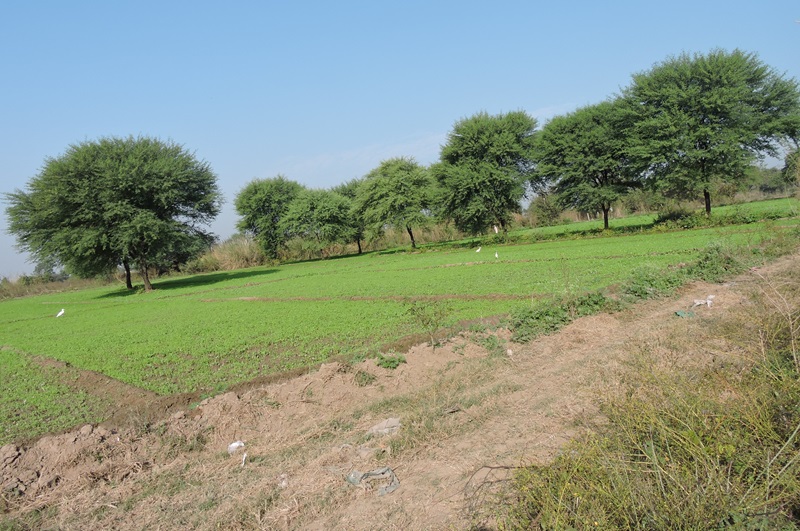

Karim F Hirji discloses how two of Tanzania's horticultural treasures of historic import are succumbing to subtle neocolonial domination.
I know next to nothing about trees. Yet, this post is anchored on a tree, Vachellia nilotica.
Vachellia nilotica is commonly referred to as Indian gum arabic tree or thorny acacia. In Swahili, it is called Mgunga tree. Between 5 to 20 meters tall, Mgunga trees are dark green expansive shrubs with yellow flowers, numerous seed pods and a bark that seeps gum. Tree parts are used for varied purposes in different regions of the world. The Masai of East Africa, for example, boil the pods and the inner bark in water, and use the liquid as medicine.[2]
I recently learned that an over 125-year-old Mgunga tree in the Old Moshi township in northern Tanzania has a profound historical importance to our nation. Mangi (Chief) Meli was a valiant Chagga chief who, with several other area chiefs, put up stiff resistance to the German invaders. On 2 March 1900, he and 18 local chiefs were executed in the vicinity of this tree by the colonialists. While the atrocity is commemorated every year in the Moshi area, it garnered little national attention until recently. As a 76-year old Tanzanian with an interest in history, I should have known about Mangi Meli, but I did not.[3]
The Old Moshi Mgunga tree is now a tourist destination. The site has a statue of Chief Meli and a plaque bearing the names of all executed there. The former German court in the vicinity is now a museum where historic photographs and animated films can be viewed, thanks to a joint effort of local authorities and two media organizations from Germany. Guided tours include ‘the ruins of the German military base, a chapel and a cemetery of [German] military personnel’.[4]
Tourism
The Tanzanian landscape teems with exquisite game reserves, and land and marine parks as well as the famed Mount Kilimanjaro, which attract over two million international and regional visitors. The tourism and travel sector employs about a tenth of the paid labor force and accounts for some 20 percent of the nation's GDP. A host of two- to five-star brand name hotels offer comfort and savory local and global cuisine. Guided tours are aplenty. Safety is not an issue.[5]
Promotion of tourism is an integral aspect of national policy in Tanzania. The revitalization of the Old Moshi Mgunga tree site reflects this policy. Schoolchildren may also visit the place for a concrete view of our history. Surely, it is a win-win effort?
Challenging Tourism
There was, though, a time when this vision faced sharp scrutiny. I recall a vibrant public debate in the early 1970s critiquing the wisdom of promoting tourism in the context of promoting socialist development. The contentious exchange, spearheaded by radical students at the University of Dar es Salaam, occurred in the pages of the state-owned paper, Daily News. It was later collated in a book by Issa Shivji and published by Tanzania Publishing House.[6] I note these details to underscore that the level of critical debates where governmental policies came under the microscope was higher in those days of state-controlled media than in the present era of so-called free media. Major media today, private and public, toe the official line in an almost slavish manner.
The advocates of greater investment in tourism held that Tanzania had the potential to generate sizable revenues which could be channeled to the development of agriculture, industry and social services, in line with the policy of Socialism and Self-Reliance. Public oversight would ensure that not a few capitalists, but the people would benefit from the tourist projects. Neglecting tourism would relegate our people to poverty.
The detractors of tourism were not against expanded opening of the national parks, game reserves and beaches to external visitors. But, in the weak, dependent, externally oriented economy, where the socialist forces faced stiff opposition from a recalcitrant state bureaucracy, they argued that the revenue would, for the most part, be siphoned off abroad, enhancing dependency and indebtedness. Lip service would be paid to the socialist ideals as the workers in the sector would be offered low wages and few benefits. Using the experience of other countries of the Global South, they argued tourism would promote a subservient mentality reminiscent of the colonial era. They promoted an initial focus on laying the basis of an integrated economy that could stand on its own feet and creating solid socialist structures. Expanding the tourist sector should be done gradually. The critics were falsely labeled as isolationists. They were internationalists who favored interaction between peoples but in terms of equality and respect.
Needless to say, the advocates of tourism gained the upper hand, and the voices of the critics were silenced. Tourism is an indispensable pillar of the present-day neoliberal economy beset with massive youth unemployment and underemployment. Higher education has expanded but has lost value and meaning. Most graduates are unable to perform in crucial subjects and skills above high school level. It is a two-tier system where a few receive quality education while the rest are mired in a morass. Upper end tourist hotels deliver first class service but most of their workers do not earn a living wage. A room cleaner in a Sheraton in Los Angeles gets over $15 an hour but one in a Dar es Salaam Sheraton is lucky to get $15 per day. But both deliver the same quality of service.
The development of the Mgunga tree in Old Moshi as a tourist venue, accordingly, follows the same template. Ironically, it is a German inspired initiative backed by German funds and especially publicized in Germany. They come here to commemorate their history, remember their heroes, with the fate of the local people and leaders, a collateral outcome. There is no official apology, let alone compensation, for the atrocities committed by the German colonialists. Since such tourist ventures benefit the local business class and conform to the governmental private-public partnership policy.
In tourism, as well as in most sectors of the economy, it is the foreign investors and international financial institutions whose voices count. Following the recent election-related violence and criticism from human rights organizations, the government is seeking greater economic linkages with the BRICS family of nations. But how that will affect tourism is an open question.
Dar es Salaam Botanical Garden
Traversing Samora Avenue going to the seashore, you find the National Museum on your right and the Dar es Salaam Botanical Garden on the left. Begun as a testing plot for varied export crops during the 1890s by a German agronomist, it was later turned into a well laid out garden with a wide repository of local and external common and exotic plants, shrubs and trees. Elegant peacocks and quacking ducks stalked the grounds. Each item bore a plate with its scientific name engraved. Maintained by a couple of full-time gardeners, visitors entered without charge through the always-open gates during daylight hours.
My recollection is that it started to fall into disrepair in the early 1990s when the budget for many public services was slashed and privatization became the guiding theme for economic policy. By the 2020s, it was a shocking sight. Many plants were on the verge of extinction. Hardly any had a name plate. My daughter and her children, who live in California, visited us in July 2026. After a morning in the Garden and the adjacent National Museum, they reported that both places were worse than what they had seen two years ago. It was a low point of their visit. And there were just a handful of tourists and locals in sight.
They, however, did not know that the German city of Hamburg has stepped in to rescue the garden. Dar es Salaam and Hamburg being sister cities. Dar es Salaam and Hamburg signed their respective first city twinning agreement and became sister cities on July 1, 2010.[7]
“The management of the Hamburg Botanical Garden traveled to Tanzania in November 2023. Concrete plans have already been made in seminars, workshops and working groups as to how the botanical garden in Dar es Salaam can be rebuilt and led into the future and what role cooperation with Hamburg could play in this.”[8]
The Department of Botany of the University of Dar es Salaam is involved in the restoration project, but the GIS Academy of Hamburg and the Hamburg Botanical Garden will be in the driver’s seat, setting priorities, providing expertise and funding, and organizing activities.[9]
Neocolonial Dependency
Tanzania has an abundance of botanical expertise and adequate resources to plan and implement the restoration of the Dar es Salaam Botanical Garden to its old glory and beyond. The Department of Botany of the University of Dar es Salaam and the Sokoine University of Agriculture have between them hundreds of highly qualified professorial staff in botany and related subjects. In addition, the Tanzania Horticultural Association brings together over 25,000 small to large horticultural producers, producing among other things, quality fruits, vegetables and herbs for export.[10]
Yet, the Dar es Salaam Botanical Garden and the Mgunga tree site in Old Moshi are allowed to fall into disarray until people from outside step in to rescue them. And to add insult to injury, the saviors originate from the nation that once upon a time ruled our nation with utmost brutality.
These projects are publicized as decolonizing initiatives that promote a decolonial form of tourism. The truth, though, is the opposite. If, after sixty-five years of Independence we cannot maintain our vital gardens and botanical sites through our own effort, the inescapable implication is that our trees are acquiring a neocolonial hue.
A neocolonial tree grows but its roots are not robust. Further, very few individuals acquire most of their fruits while the majority have to do with a much smaller basket. And while the fruits in the hands of the former are sweet and succulent, those left over for the masses are dry and bitter.
Accordingly, the fruits of the over 5% rate of growth in the Tanzanian economy in the recent years have been unevenly distributed. The nation has two dollar-billionaires and five individuals with close to or over 500 million dollars in net worth. Yet, three quarters of the population earns less than US$3.65 a day and one quarter earns less than US$1.35 a day. Their net worth per person is perhaps less than one thousand dollars. Many have negative wealth.[11]
“[The] data show that in spite of many years of strong economic growth, more wealth, and more jobs, the purchasing power of the poorest 20 per cent of the Tanzanian population has decreased from 7 to 6 per cent.”[12]
The rising level of income inequality in Tanzania is accompanied and perhaps accentuated by high levels of inequalities in access to key social services and infrastructure, including healthcare, education, electricity, and water and sanitation.[13]
Tourism is a prime facilitator of vast economic inequalities. The modern-day tourist garden abounds in neocolonial trees. It seems to me that the historic Old Moshi Mgunga tree and those in the Dar es Salaam Botanical Garden are being subtly captured by a neocolonial venture. But what do I know about trees?
Karim F Hirji is a retired Professor of Medical Statistics, author of thirteen books with numerous peer-reviewed and general papers to his credit. He can be reached at [email protected]
Endnotes
[1] Wikipedia (2026 - Vachellia nilotica). Harvinder Chandigarh, CC BY-SA 4.0 <https://creativecommons.org/licenses/by-sa/4.0>, via Wikimedia Commons
[2] Wikipedia (2026 - Vachellia nilotica). https://en.wikipedia.org/wiki/Vachellia_nilotica
[3] Joseph J (2026) The 126-year-old tree that still marks Mangi Meli's execution, The Citizen (Tanzania), 30 July 2026, page 8.
[4] Joseph J (2026) The 126-year-old tree that still marks Mangi Meli's execution, The Citizen (Tanzania), 30 July 2026, page 8.
Orio GM (2026) Old Moshi, Decolonial Travel Guide Tanzania, 30 July 2026, https://decolonial-travel-guide-tanzania.com/en-on-tour-old-moshi/.
[5] Wikipedia (2026 - Economy of Tanzania). https://en.wikipedia.org/wiki/Economy_of_Tanzania
Wikipedia (2026 - Tourism in Tanzania). https://en.wikipedia.org/wiki/Tourism_in_Tanzania
[6] Shivji IG (editor) (1973) Tourism and Socialist Development, Tanzania Publishing House, Dar es Salaam.
[7] Senate’s reception 15 years of city partnership between Hamburg and Dar es Salaam. July 2025.
www.hamburg.de/politik-und-verwaltung/senat/reden-und-dokumente/senates…
[8] DTGT (2026) Dar es Salaam: Botanical Garden, Decolonial Travel Guide Tanzania, 11 August 2026, https://decolonial-travel-guide-tanzania.com/en-on-tour-dar-es-salaam-b…
[9] HD (2026) Dar es Salaam Botanical Garden, 11 August 2026, https://hamburg-daressalaam.de/en/botanical-garden/
[10] Akvo RSR (2026) TAHA (Tanzania Horticultural Association), 11 August 2026, www.taha.or.tz/
[11] UNCTAD (2025) Combating inequality and poverty in the United Republic of Tanzania: Policy analysis and options, UN Trade & Development (UNCTAD/ALDC/2024/4), https://unctad.org/publication/combating-inequality-and-poverty-united-republic-tanzania
[12] Ibid
[13] Kinyondo A and Pellizo R (2018) Growth, Employment, Poverty and Inequality in Tanzania, Africology: The Journal of Pan African Studies, 11(3): 164--181, www.repoa.or.tz/wp-content/uploads/2020/07/11.3-11-Kinyondo-Pelizzo.pdf