


2026 Brazil Elections: Pambazuka News Interview with Owen MacDonald
After having trailed in the opening round, Luiz Inácio Lula da Silva recently secured the Presidency in Brazil’s 2026 elections. Through an interview with Owen MacDonald, Pambazuka seeks to convey not only how the people of Brazil mobilized to secure this victory, but what the victory means for Global Africans and the defeat of imperialism.
Brazil is the 7th most populous country in the world. It is home to over 200 million people, with more than 50 percent of the population identifying as Afro-descendants. Between October 4 and October 25, 2026, general elections were held. Flávio Bolsonaro, the eldest son of former president Jair Bolsonaro, finished first in the opening round with 47% of the vote. Incumbent president Luiz Inácio Lula da Silva followed with 45%. On October 25, Lula reversed that result in the runoff, winning a victory that gave him a fourth term as president (non-consecutive). His victory overcame disinformation campaigns and direct election meddling by the global right-wing opposition. It was the first time in a Brazilian presidential election that the first-round leader lost the runoff, but most importantly Lula’s victory represented a defeat of facism and a victory for the Global South and working peoples suffering under American led global imperialism.
To give us a general sense of the relevance of the 2026 elections, Pambazuka interviewed Owen MacDonald. MacDonald is an anti-imperialist labor historian of the Brazilian Amazon. His research examines the intersections of US empire building and Brazilian statemaking on Indigenous Amazonian land as they relate to coerced African descendant labor from Brazil and the Caribbean. Born and working in the United States, MacDonald has spent considerable time living in Brazil, mostly in the Amazonian state of Rondônia.
Introduction
Pambazuka News (PN): Can you explain the overall juncture where the elections are taking place, and help situate for our readers the importance of these elections?
Owen MacDonald (OM): These elections took place at a critical time in Latin America, amidst a wave of reactionary, US-allied and supported candidates being elected across much of the South American continent including in Colombia, Peru, Ecuador, Bolivia, and, less recently, in Argentina. Professor Bruno Huberman provided an excellent overview of this situation after the first round of elections and I encourage everyone to watch the full discussion on the Pambazuka podcast.
I hope to communicate two key juncture points of these elections. First, Lula’s victory is a win for the Amazon rainforest and provides an opportunity for further organizing to prevent the destruction of the largest non-oceanic carbon sink in the world, while also supporting the self-determination of Black and Indigenous communities who have rejected or shaped their participation in the global capitalist system for centuries. Second, the election is a win for Brazilian sovereignty in the face of United States imperialism. The Bolsonaro family agenda would be an extension of the capitalist interests of the United States’s rightwing mandate, especially the interests of social media giants like Meta and companies pursuing the exploitation of rare earth minerals in Brazilian territory. Bolsonaro’s post-election flight to the United States supported by the cooperative narco-trafficking interests of Argentina and the US drives home this point.
PN: On the 4th of October, Brazilians went out to vote to choose their president. Explain how the first round of elections went? And what was your general response to the first round? Were there analyses that frustrated you or you found ill-descriptive of the situation?
OM: The first round of the elections saw Flávio Bolsonaro with the most votes and a large lead heading into the second round of elections last weekend. Our response was generally one of despair, to be honest. At least at first. The misinformation campaign driven by United Statesian and Israeli consultants flooded popular social media sites like Facebook and Twitter/X, while messaging app Whatsapp, also owned by Meta, saw a flurry of forwarded fake messages and AI generated images.[1] Lula campaign ads were algorithmically hidden, while Bolsonaro’s were boosted. I was forwarded an AI generated video of Lula throwing the Brazilian flag on the floor after voting by several working-class Brazilian contacts.
In general, I found the denial of the interference of the US government and its allies in big tech to be frustrating. A panel hosted at the University of Illinois’s Lemann Center featuring several prominent US-based political scientists, flat out denied that this influenced the first round of the election. Instead, they cited Anti-petismo, a general distrust of Lula’s broadly center-left political party, as the main reason for the first-round results. Though the support of austerity measures and movement away from a true leftist agenda that provided material gains to the working class and the rise of evangelicalism hurt the party’s standing, the effects of US intervention seem undeniable. The response also demonstrated a contempt for the Black and Indigenous majority Brazilian population, with one commentator claiming the average Brazilian citizen is unaware of what a rare earth mineral is and incapable of understanding the political stakes of the election.
Local to Global Relevance of 2026 Elections
PN: Recently, Pambazuka News hosted Professor Bruno Huberman for an interview and he explained to the viewers the candidates, both Lula and Flavio but also the Jair Bolsonaro. The interview took place right after the first round of elections. Can you add to this by explaining how the campaign for the second round took place? How did Flavio and Lula, respectively, mobilize the Brazilian people?
OM: The Bolsonaro campaign relied on a reactionary agenda, the support of the US and Big Tech, and the backing of right-wing athletes and influencers, like the famous football player Neymar, to reach the Brazilian people. It was largely unsuccessful. By election day, they had given up on reaching the Brazilian people and turned to capital to suppress working-class voters. A coalition of right wing mayors and other local political figures worked with executives from private bus companies to reduce services in Lula’s strongholds. So far, the Transport Chief in the Northeastern Lula stronghold of Salvador da Bahia Pablo Souza was arrested for his part in this plan, and I anticipate more will face justice as investigations continue.[2] Suppressing the vote and creating general confusion became the main strategy of the Bolsonaro campaign.
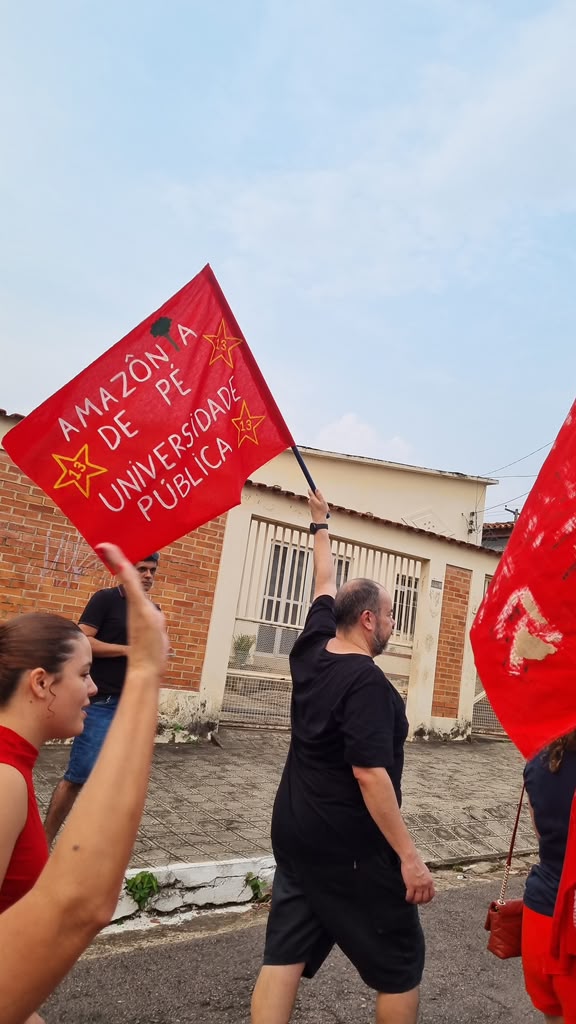
The Lula campaign deployed a deft strategy that left-wing movements around the world should take note of to overcome the top-down disinformation campaign through grassroots organizing. Much attention has already been paid to the Exército do Lula (Lula’s Army) the Whatsapp group organized by federal deputy André Luis Gaspar Janones which organized over ten million Brazilians digitally.[3] More important than the digital organizing, however, was the group’s on the ground efforts. Voting is mandatory in Brazil for those between the ages of eighteen and seventy years old, with options to register one’s vote as null or in abstention. Janones implored participants to flip at least one Bolsonaro or null voter from the first round to Lula via face-to-face conversation, as well as participate in community efforts to provide access to polling stations for voters over the age of seventy. The second round of the election saw the lowest number of abstentions since 2006.[4] Indigenous and ribeirinho (river-side peasant communities) also mobilized to reach often-distant polling locations.[5] Meta’s offices in São Paulo were the site of a massive, sustained protest, which demanded media attention. The mobilization of the people against US imperialism made the election meddling effects undeniable, while reaching many individuals who may have not otherwise been plugged in to the manipulation.
PN: During the elections, what were some of the electoral challenges?
OM: As I mentioned above, the main strategies of the Bolsonaro campaign and its global right wing allies were misinformation campaigns on social media and the suppression of the vote. Fake news and the suppression of Lula campaign materials shaped the digital landscape of the election between the two rounds of voting. The US and Australian Embassies contributed to an atmosphere of fear by closing all services, citing amorphous “security concerns” as a way to directly influence election results. Trump’s government, at the behest of the Bolsonaro family, re-classified organized crime groups like the Comando Vermelho and Primeiro Comando da Capital as terrorist organizations to lay the groundwork for US military intervention in the country, even raising the possibility of extracting Lula as they did with Venezuelan president Nicolas Maduro, though Lula’s diplomatic standing among the liberal order makes this less likely.[6] He is a respected figure among G20 leadership, maintains close ties to European leadership, and has been recognized as the rightfully elected president by most of the right-wing leadership of neighboring South American countries.[7]
On the weekend of the election a coalition of right-wing local officials and big businesses conspired to suppress the working-class vote, especially in the Worker’s Party stronghold of the Northeast region. The first sign was Gol Airlines cancelling without explanation flights from the South to the Northeast Region, though they deny this was an intentional or organized effort.[8] On the day of the election private bus companies working with local officials illegally cut bus services to poor neighborhoods. This affected communities in urban São Paulo in the southeast, and several communities in the northeast, most notably Salvador da Bahia. Both campaigns called for a two-hour extension of the voting window, but only about 35,000 voted in this last segment. Workers who planned to vote before beginning their shift probably were unable to vote in this election, but nonetheless election day saw a massive electoral victory for Lula. My suspicion is that internal polling numbers showed the Bolsonaro campaign that a loss was all but inevitable, and this coup-attempt was as much about sowing confusion about the election’s legitimacy as it was about stopping poor, mostly African-descendant workers from voting. Flávio Bolsonaro and Donald Trump have both cited the extended window of democratic participation as drawing into question the legitimacy of the results.[9]
PN: We are aware of the interests of capitalist extraction in the Amazon, Brazil’s leading role in BRICS, etc. In your view, what was at stake for this election?
OM: The stakes of the election were incredibly high. As I mentioned above, the two biggest aspects in my estimation are the chance for further organized action in defense of the Amazon in the face of US, elite Brazilian, and global imperialist interests and the protection of Brazilian sovereignty in the face of a reactionary tide of elections in South America aimed at extracting rare earth minerals.
Additionally, the overtly anti-Black, anti-Indigenous, and anti-woman policies of the Bolsonaro family, supported by the Zionist evangelical movement, threatened to exacerbate the social problems caused by Brazilian capitalism with roots in the colonial project. Jair Bolsonaro’s government saw the return of Brazil to the global hunger map, an increased militarization of the police who terrorize poor, non-white communities across Brazil, and the normalization of sexist language which led to an increase in domestic violence and curtailing of resources for survivors.[10] Flávio also promised to reevaluate Brazil’s participation in BRICS, currently presided over by anti-dictatorship militant, economist, and illegally impeached former Brazilian president Dilma Rouseff. Brazil is a leader in the global majority movement towards de-dollarization of the world economy, and a Bolsonaro presidency would have been catastrophic for countries like Palestine, Cuba, and Iran, already facing down the barrel of the gun of US imperialism. Benjamin Netanyahu recorded a message in support of Flávio Bolsonaro during the campaign.[11] The relationship between the Zionist leaders was cemented when Jair Bolsonaro pledged to move the Brazilian Embassy to Jerusalem during his presidency, though he never followed through on it. Though Lula’s refusal to send oil shipments to Cuba frustrates me endlessly, he has sent rations to the revolutionary country amid the tightening of the tentacles of the US-led blockade.[12] Lula’s government has already been in talks with Iranian foreign minister Abbas Araghchi since Sunday, and the hope is that the two countries can continue to collaborate in the struggle against dollar hegemony amidst the ongoing US-led war of aggression.[13]
PN: Pambazuka News views the struggle of the Brazilian people as part of the larger struggle of Global Africans – a term used by Pan-Africanists to connect Africans on the continent and Afro-decendants elsewhere as a wholesome unit which faces the same imperialism and strives for the same principles of Pan-African liberation and unity. While mainstream media might call them a minority, Afro-Brazilians constitute more than 55% of the population. Explain how this majority became minoritized in Brazilian society? And what impact do these elections have on them?
OM: The efforts to minoritize the African descendant majority population of Brazil has been part of an ongoing project with continuities across every form of government since Brazilian independence from Portugal in the first part of the nineteenth century. For nearly four-hundred years Brazil’s economy was rooted in plantation slavery, which was made possible through the near extermination of coastal indigenous populations and importation of enslaved Africans. For just as long, African peoples in Brazil have been refusing and resisting these conditions of bondage, oppression, and exploitation. Successive rebellions inspired by the quilombo communities of Brazil, the successes of the Haitian Revolution, and general uprising of enslaved Black people in the US that won their freedom alongside a transforming global economy forced Brazilian elites to implement a gradual abolition process across the last part of the nineteenth century until slavery was finally formally abolished in 1888. From the middle of the nineteenth century onward, but especially accelerating as the Brazilian First Republic, established in 1889, sought to transform the economy along “modern”, industrial capitalist principles while retaining the racialized hierarchy of power in the country. From 1880 to 1930, efforts to “whiten” Latin America and make it a white continent were undertaken in countries like Argentina, Uruguay, Brazil and Cuba as immigration policies favoring white immigrants and “urban reforms” pushing blacks out of good neighborhoods took place.[14] The Brazilian state, particularly, subsidized European immigration in an effort to “whiten” the country through demographic shifts and miscegenation. In 1920, the republican government eliminated race from the Brazilian census, obfuscating the relationship between race and class.
While the strokes of the policy remained the same, the language for this process changed under populist president Getúlio Vargas during the 1930s. In an effort to preserve social peace alongside a negotiated welfare capitalist consensus, Vargas made Afro-Brazilian culture the national culture of Brazil. African Brazilian cultural staples like capoeira, feijoada, and samba were made symbols of a unified Brazilian nation under the myth of “racial democracy.” Brazilian elites highlighted the explicit racism and segregation of the United States as a cover for the more covert forms of racial hierarchy embedded in Brazilian class society.
Brazil flirted with land reform and other explicitly left-wing politics during the late-1950s before the takeover of a US backed right-wing military dictatorship in 1964. This process further marginalized the Black majority. Afro-Brazilian revolutionary Carlos Marighella advocated for a Marxist-Leninist approach to the issues facing the Brazilian majority, while the Afro-Indigenous population of the Brazilian north struggled with a Maoist orientation in a guerilla campaign against the military government during the War of Araguaia at the beginning of the 1970s. Both were brutally crushed by CIA trained dictatorship leaders. The Black Movement in Brazil took inspiration from the Black Power movement of the United States and began organizing across the country for greater recognition of the intertwined effects of racism and capitalist exploitation on Black populations. However, the reactionary dictatorship used the language of the left to discredit this movement. Black consciousness, it argued, was a manifestation of US cultural imperialism in the “racial democracy” of Brazil.
The end of the dictatorship in 1988, brought about in part by a massive strike movement led by Lula, saw a renewed possibility of Black self-determination in Brazil. Exiled leaders like the Pan-Africanist Abdias do Nascimento advocated for quilombismo, an Afro-centric political project that took influence from the revolutionary anti-slavery communities across Brazil like Palmares. He was also influenced by meetings in Rio de Janeiro with Ghanaian intellectual Nana Kobina Nketsia IV.[15] Lélia Gonzalez, daughter of an Indigenous mother and Black railroad worker father, forwarded her theory of Amefricanidade. She recognized how gender was another category of power intertwined with the colonial-racist-capitalist project that must be accounted for, and advocated for an intertwining of Black and Indigenous struggle in Brazil. Among other grassroots organizing, these figures helped establish constitutionally guaranteed land rights for Maroon and Indigenous communities across Brazil.
These gains were threatened by the neoliberal consensus that has governed Brazil since the 1990s. Lula’s presidencies saw more protections for these groups and social democratic policies like direct cash transfers to poor populations and increased access to higher education for historically minoritized communities, but the project of racial democracy and capitalist growth have remained central to all Brazilian governments in the democratic era. The mass mobilizations of the most recent election represent an opportunity for sustained popular action to demand a truly left-wing agenda that addresses the historical project of minoritization of African and Indigenous Brazilians. Lula has promised to regulate the Zionist and US-backed tech giants that threaten such grassroots movements. Lula is not the solution to Brazil’s historically constructed problems, but his election provides space for true democratic decision making in this Afro-Indigenous majority country.
PN: Who is Lula and how has he changed over time?
OM: Lula is the most successful politician in Brazilian, and potentially, global history. He was a steelworker from a young age and got involved in organizing the labor movement in the ABC region of São Paulo. Beginning in the late-1970s, Lula led a series of strikes that contributed to the fall of the Brazilian military dictatorship. After redemocratization, he ran unsuccessfully for president several times in the 1990s as a leftist candidate. He was elected on a more moderate platform in 2002, where he nonetheless transformed the role of the Brazilian state in serving the needs of the working-class population of Brazil. Racialized income inequality decreased, he rejected the IMF’s dictating of the Brazilian economy, Black and Indigenous students were guaranteed spots in federal universities, poor families received direct cash transfers, and infrastructure in rural and urban poor communities improved immensely. He did this through compromise with the imperialist global power structure, also overseeing massive growth in the wealth of the top portions of Brazilian society, continued deforestation of the Amazon, and the participation of Brazil in the occupation of Haiti in 2004 after the US-backed right wing military coup.[16] Nearly half of the occupying troops were Brazilians sent by Lula.[17]
After the impeachment of his chosen successor Dilma Rousseff and his own imprisonment, Lula returned to power in a monumental rejection of Bolsonarism in 2022. His latest term has been constricted by a right-wing majority legislature and a more conciliatory political position. Still, his victory represents the opportunity for mass movements of working-class Brazilians to make their voices heard.
In the most recent election, he was able to flip the results through a massive grass-roots political campaign which targeted the interference of the US and big tech in Brazilian sovereignty. He was able to build a coalition of left, center-left, and center-right in defense of Brazilian institutional norms. The largest factor was a popular movement on and offline which mobilized non-voters and flipped some Bolsonaro voters. He saw gains in every state of the country thanks to these efforts.
PN: What is the meaning of the election victory for the working class?
OM: The victory is an opportunity for the working class to continue mobilizing to demand action in defense of the environment, sovereignty, and the needs of the Black and Indigenous majority of the Brazilian population. The Brazilian majority proved that they will determine the future of their own country, not the elite, white, Brazilian minority, not the Zionist and CIA backed evangelical churches, and not the alliance of figures like Donald Trump, Elon Musk, and Mark Zuckerberg. This victory was a win for the global working-class, but as Brazilian activists say, “a luta continua.”
Owen MacDonald is an anti-imperialist labor historian who believes in the transformative potential of radical teaching and scholarship. Born in the United States, and though in the academy but not of the academy, MacDonald has spent considerable time living in Brazil, mostly in the Amazonian state of Rondônia.
End Notes
[2] https://www.gazetadopovo.com.br/eleicoes/2026/tre-ba-manda-prender-secretario-que-reteve-onibus-com-adesivos-do-pt-em-salvador/
[3] https://www.aljazeera.com/news/2026/10/27/the-whatsapp-general-behind-lulas-election-comeback-in-brazil
[5] https://grist.org/indigenous/for-indigenous-peoples-in-brazil-the-election-results-offer-a-reprieve-not-a-resolution/ ; https://www.instagram.com/p/DePkfuZo4L2/
[7] https://www.rfi.fr/en/international/20261026-france-s-macron-leads-congratulations-for-bolsonaro-s-presidential-win-in-brazil; https://apnews.com/article/brazil-election-lula-bolsonaro-reaction-48a6cc3d030ba2c5c52c757447a9e704
[9] https://www.reuters.com/world/americas/flavio-bolsonaro-expected-land-miami-shortly-after-trump-offers-brazil-exit-2026-10-28/
[10] https://ipes-food.org/brazil-beats-hunger/; https://www1.folha.uol.com.br/internacional/en/brazil/2022/09/bolsonaro-cuts-budget-to-fight-violence-against-women-by-90.shtml
[11] https://www.reuters.com/business/media-telecom/flavio-bolsonaro-launches-brazil-presidential-campaign-touts-support-milei-2026-07-25/
[14] Andrews, G. R. (2004). Afro-Latin America, 1800–2000. Oxford University Press.
[15] Gyamfi, B. (2021). “From Nkrumah’s Black Star to the African Diaspora: Ghanaian Intellectual Activists and the Development of Black Studies in the Americas,” The Journal of African American History 106:4, https://doi.org/10.1086/716492.