


I Bring You All My Love from Wherever I Have Been: Kwesi Owusu - poet/writer/filmmaker/academic/cultural visionary/arts consultant
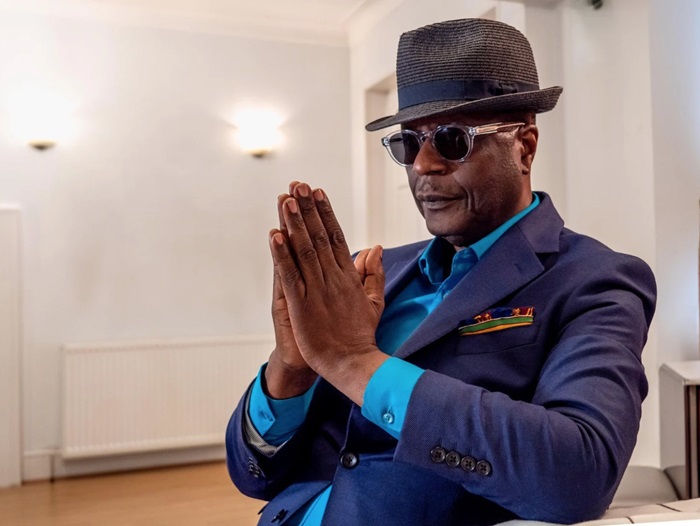
Eugene Skeef eulogises Kwesi Owusu, the famous multitalented Ghanaian-British musician and academic who joined the ancestors in March 2025
Born - 24 October 1954; died - 22 March 2025
Imagine a young propulsively inspired Kwesi Owusu arriving in England in the late 1970s. He hears a reassuringly distinctive natural sound like the persistent keynote in the symphony of urban cacophony. Despite its gentle timbre, it somehow manages to perforate the industrial din. This sound is the essential congruence the young man has grown to always attune to in his concomitant creative vision as an artist and activist. He is hearing doves cooing in the familiar Ghanaian eight-beat percussive bell timeline. His eyes light up. His face melts into his signature wry smile. This experience of having arrived home from home is a cultural initiation that brings him finally to see the continuous circle of his journey clearly mapped out. He sees it as a poetically emboldening affirmation of his purpose in life.
At Kwesi’s funeral on the 9th of May 2025, his Kenyan comrade/sister in arts Wangui wa Goro remembered her compatriot Wanjiru Kihoro describing him as “a born Pan-Africanist”. She smiled eruditely as she recalled her saying it was natural for him to be a Pan-Africanist, having been born and raised during the revolutionary years of Kwame Nkrumah’s premiership. She remarked that he brought this consciousness into Wazalendo Players, the mixed African cultural group she absorbed him into. This insightful gesture developed into Wanjiru promoting the much-needed ideology of Pan-Africanism among the rest of the African artists and cultural activists in the diaspora and on the continent.
Among the many voices that paid tributes to Owusu, was Nigerian journalist/filmmaker/author/cultural consultant Onyekachi Wambu who worked closely with him over the years. Wambu brought his vast experience as the editor of The Voice newspaper as well as his position as co-founder of African Remembrance Day into their collaborative projects. Principal among these were members of the Black Triangle Consortium that acquired the Electric Cinema in Portobello Road, London in 1993. This amalgam also included Choice FM and co-leaders Paul Bucknor and Mark Mantock. The Electric was the first Black-owned cinema in Europe and became a cultural hub for Black independent cinema in the UK.
Kwesi exuded the likeable charm of a precocious apprentice challenging the master to a healthy intellectual joust. His brand of fearlessness was not of the aggressive variety; he employed a creative form of sleight that always disarmed the contender. To this end, he was readily recommended to others by great literary and publishing icons such as John La Rose, Gus John, and Margaret Busby.
In the early 1980s, Owusu co-founded African Dawn, the pioneering poetry-and-music group that changed the landscape of performance poetry in the UK and Europe. Over the decades that it was active, the members of the group included Ahmed Sheikh, Wanjiku Wa Kiarie, Wala Danga, Torera Mpedzisi, Louis Mhlanga, Merle Collins, Eduardo Pereira, and Victor Mensah. The personnel reflected Kwesi’s unwavering commitment to Pan-Africanism. The group released four albums in their time: Besiege The Night (1983); Conversation (1984); Chimurenga (1987); Jali (1989). The final album is a compilation of some of the group’s most engaging tracks titled African Dawn, which was released in 2022 by Ad Records.
The Ugandan essayist Mary Serumaga described the group as "modern-day griots". The acclaimed revolutionary Kenyan writer/political activist/academic/public speaker Ngũgĩ wa Thiong'o endorsed them as "restoring poetry to its origins in music and drama in an exciting fusion of revolutionary harmony”. He had special praise for Kwesi following African Dawn’s role in the Wazalendo Players’ 1984 Africa Centre stage production of his play The Trial Of Dedan Kimathi, written jointly with Micere Githae Mugo: ‘For Owusu, the fusion of art forms characteristic of orature is what gives to black artists an international character as artists and cultural workers defying formal definitions of the geopolitical to connect with centres of inspiration in Africa, Asia, and the Caribbean without relinquishing their claims to their legitimate space within Britain and Europe. Orature so conceived is against the ghetto and the margin.’
With Kwesi at the helm as informal artistic director, African Dawn became the de facto resident performance outfit at the Africa Centre, the cultural hub for local Africans, which was centrally situated in Covent Garden, London.
Ruhi Hamid, the British filmmaker, born in Tanzania and of South Asian heritage, has worked with Kwesi since the late 1970s through her award-winning documentaries on the BBC, Channel 4, and Jazeera International. She remembers the infamous bars at the Africa Centre and SOAS (The School of Oriental and African Studies) serving as twin rendezvous for many African artists and activists who would meet to discuss African and Latin American struggles. She says, ‘It was the start of a special Pan-Africanist creative collaboration on many projects including his spiritual film AMA, which I art directed, and the design of Storms of the Heart: Anthology of Black Arts and Culture’.
Through the revolutionary portal of liberation icons Steve Biko and Robert Sobukwe, Kwesi’s relationship with South African exiles in London and the rest of the UK led to some of his most engaging creative cultural interventions. Among these luminaries were the sculptor and poet Pitika Ntuli, Molefe Pheto with his Pula Arts Kommune music-and-poetry group, percussionist Thebe Lipere, actor and writer John Matshikiza, dancer, choreographer, and educator Elliot Ngubane with his Uthingo dance ensemble, dancer and choreographer Julia Mathunjwa with her Shikisha dance ensemble, and this writer.
In the early 1980s, Kwesi was in the leadership of the coalition of African artists and cultural activists who campaigned to transform the Arts Council of England’s compartmentalised funding policies. African and Asian arts projects particularly suffered from the negative impact of this racist neocolonial agenda.
Kwesi, the polymath, was driven by the principle of vigorously opposing the false boundaries that Western conceptual categorisation systematically imposes on African creative expression. His conviction swelled with the recognition that this compartmentalisation constitutes an alien cultural construct that is born out of the colonial need to contain and control those under European hegemonic dominion. The arrowhead of this campaign was dipped in African cultural holism.
In a 2022 interview with South African journalist Simphiwe Ncongwane on SABC News TV about his upcoming African Dawn podcast, Kwesi spoke about the recently passed Queen Elizabeth II in the context of her role in managing the colonial narrative:
“I was looking at some of the photographs of the royal visit in 1961 in Ghana and she was the most photographed, very young, very charming and she made a great impact. But of course, the narrative, of which she was a part, in which she played a critical role, was a colonial project in many ways, and that project, of course, was more interested in the British interest, if you like British Empire building than giving opportunity or spaces for real African voices; and that, I think, is the critical component that we really need to be discussing now, especially as her reign has more-or-less come to an end. It gives us a great opportunity to look back and see what we can do about all the silences which became almost functional, institutionalized during her reign. There are so many stories about, for example, Ghana’s independence, which were never told to the world because we've had ways of telling our stories from the sidelines; but I think it's a long time since 1953, when she was crowned Queen, and this is a time, a good opportunity, to have a space where Africans can also tell their real stories to the mainstream of the global media.”
Kwesi strongly proposed the disintegration and reconfiguration of the Western media megalith as an essential part of Africans telling their own stories. Later in his life, he decided to act on this commitment by relocating to Ghana to work on consciousness-raising projects that strongly advocated the symbiotic relationship between the environment, personal and community health, and social conscience.
In keeping with his philosophy of empowerment, he enlisted the skills of several younger Ghanaians working in media to help him tell pertinent stories about the trials of so-called ordinary people. One of these was multimedia journalist and content creator Ivy Prosper. She recently posted on Instagram: “He took a chance bringing me on board as the Host/Roving Reporter on the Maternal Health Channel TV Series thirteen years ago. When nobody else in Ghana would give me an opportunity in media, he did”. Hard to believe so much time has passed since he created such an impactful project that made an impact in Ghana. “Kwesi had many dreams when it comes to storytelling from the African continent. He was working on ideas to document the history and significance of highlife in Ghana. A creative talent full of ideas and he's now gone.”
Kwesi’s groundbreaking film, Ama, was chosen by the British Film Institute (BFI) to open their celebration of sixty years of the best of African cinema. In an interview on Princess Akua’s Blakofe TV & Podcast in London, he told her that he would have preferred for such a historic honour to have been bestowed on him in Accra, capital of Ghana; but he acknowledged the history of Africans being used to others telling them what they have, “because the blinkers are still there as to what we can recognise for ourselves”.
Kwesi questioned the image of traditional African culture being frozen in museums. He spoke at numerous conferences in Africa and around the world debating the thorny issue of cultural policy. He would confront African states on what he regarded as their ill-conceived contemporary solutions to the timeless conundrum of ancestral recognition. He laughed at the notion of modern African states formulating policies designed to deal with the issue by “preserving” African culture. He found it ludicrous that profoundly powerful cultures should be placed in cold storage.
Kwesi’s legacy will live on in the massive body of work he left for us and in our memories. He achieved a lot but still left a long to-do list of unfinished business for his loyal comrades to attend to. The baton can be found in one of his last projects, the African Dawn podcast, that will undoubtedly have a lasting impact.
Eugene Skeef is a South African percussionist, composer, poet, educationalist and workshop leader and has lived in London since 1980, and orchestrates in the United Kingdom. He is a Fellow of the Royal Society of Arts and has served on the board of directors of the London Philharmonic Orchestra (LPO). He was recently appointed Professor of Practice at the Centre for Education Rights and Transformation (CERT) in the Faculty of Education at the University of Johannesburg.