


Public Morality: Nigeria's War On its Marginalised Groups
As a fresh wave of anti-LGBTQ+ legislation sweeps across western and eastern Africa, increased profiling of persons identifying with different sexualities in Nigeria exposes these persons to mob violence and exploitation.
Over the last decade, international recognition and institutional support for LGBTQIA+ rights have expanded, though significant regression has occurred in specific regions. Africa remains a deeply challenging landscape for queer communities, as 33 out of 55 countries actively criminalize same-sex intimacy.[1]
In the past two years, a fresh wave of anti-LGBTQ+ legislation has swept across western and eastern Africa. Niger, Burkina Faso, and Mali criminalized same-sex relations for the first time, while Ghana's parliament passed a bill increasing prison sentences for identifying as LGBTQ+ or advocating for queer rights.
In April 2024, Uganda's Constitutional Court struck down specific provisions of the Anti-Homosexuality Act that criminalized landlords for renting premises to LGBTQ+ individuals and restricted healthcare access, even as it upheld its maximum penalty of life imprisonment, alongside the death penalty for 'aggravated' homosexual offenses.[2] In Kenya, landmark High Court rulings have granted transgender individuals the right to legally change their gender markers on official IDs. Yet, the nation simultaneously maintains colonial-era penal codes that criminalize same-sex relationships with up to 14 years in prison.[3]
Nigeria maintains some of the most severe legal penalties for homosexuality in Africa, and the government has continued to double down on these penalties. Nigeria's Same-Sex Marriage (Prohibition) Act (SSMPA) was signed into law by President Goodluck Jonathan on January 7, 2014. Section 5(1) sets 14 years for entering a same-sex marriage or civil union, while Section 5(2) sets 10 years for registering or operating gay clubs and societies, or for any public display of a same-sex relationship.[4]
On December 16, 2024, Nigerian President Bola Tinubu signed the revised Harmonised Armed Forces Terms and Conditions of Service (HAFCTCS) 2024. According to HAFCTCS, "An officer must not engage in homosexuality, lesbianism, and bestiality. He/she is not to belong to, or engage in activities of the Lesbian, Gay, Bisexual, Transgender, Queer or Questioning, Intersex, Asexual or Agender, Two-Spirit (LGBTQIA2S+) group and cross-dressing, amongst others."[5]
Where the original prohibition targeted acts, this revision criminalises asexuality, which is defined by an absence of attraction and involves no conduct at all. The state has gone so far as to penalise the mere absence of performing a sexual role, revealing just how rigidly gender and sexual conformity are being enforced.
Colonial Origins of Homophobia
The Nigerian government defends its criminalization of homosexuality on the ground that homosexuality is a western import that threatens Nigeria's Nationality, but a review of Nigeria’s historic society and laws proves that this is untrue.
Before colonialism, many African societies, including those in Nigeria, embraced diverse understandings of gender and sexuality. Among the Igbo, female-husband traditions existed where prominent women could marry other women to secure lineages and wealth.[6] As Nigerian anthropologist Ifi Amadiume has argued in her 1987 study of Igbo society, gender and biological sex were not rigidly bound together in precolonial Nigeria — a woman could occupy a socially 'male' role, such as becoming a female-husband, without this being treated as a violation of custom.[7] Amadiume contends that this flexibility was substantially eroded by the economic and religious disruptions of colonialism, which imposed a far more rigid, binary understanding of gender.
Among the Hausa, long before the strict imposition of Sharia, culture recognized the 'yan daudu — men who dressed, spoke, and acted like women, occupying a recognized and accepted social niche, often as intermediaries in marketplaces. Yoruba cosmological and traditional religious practices, meanwhile, focused heavily on fertility, lineage, and spiritual balance rather than the moral criminalization of same-sex attraction.
Although the available literature shows little evidence of precolonial Nigerian traditions being favourable to queer sexualities, such individuals were mostly not criminalised. These traditions were, however, flexible regarding gender roles, and did not enforce the strict, binary gender norms now used to justify criminalising LGBTQ+ Nigerians today.
The laws that criminalize these identities today were themselves imported from western rule. Anti-sodomy laws originated in ancient religious codes and medieval European legal systems, growing from theological doctrine into secular criminal law; King Henry VIII passed the first major secular version in England in 1533, the Buggery Act, punishable by hanging.[8] European empires later spread these penal codes worldwide through colonization.
In 1904, having secured British control north of the Niger (which became Nigeria), Frederick Lugard proclaimed a Criminal Code modelled on an 1899 version then in use in the Queensland colony, Australia. In 1914, the Southern and Northern protectorates were merged under one administration, extending this code across the country; Although this legal union would not last long, as the Muslim population agitated for a criminal law system that reflected their values. And in 1959, a year before Nigeria’s independence, a separate Penal Code was enacted for Northern Nigeria, modelled on the code in use in Sudan[9] which limited its criminal scope to cross-dressing and non-consensual unnatural acts. However, the final 1959 Nigerian Penal Code was a deliberate blend of English & Islamic Customs, which penalised cross-dressing, non-consensual, as well as consensual homosexual acts.
After Nigeria’s independence from the British in 1960, the two Codes – the Penal Code in the north and the Criminal Code in the south – continued to govern criminal justice administration across the country.
These colonial-era statutes have never been meaningfully reviewed or repealed. They have remained as the colonial legislators wrote them, and it is this inherited constitution that laid the legal foundation for the SSMPA and every homophobic policy that followed.
Effects of the Law on LGBTQ+ Nigerians
In a 2022 social perception survey by The Initiative for Equal Rights (TIERS), 59% of Nigerians said they would not accept a family member who is LGBTQ+, and nearly half — 48.5% — believe gay and lesbian people should be punished for their sexuality. 83.5% of respondents said they judge someone to be gay based on appearance alone — how they dress, walk, or carry themselves.[10] This profiling empowers mobs to drag suspected gay men from their homes, and police to stop and search anyone who looks "suspicious."
This suspicion has forced many LGBTQ+ Nigerians into deeper concealment rather than out of it. A representative of an LBT organization in Abuja told Human Rights Watch that the passage of the SSMPA led many women who were previously out to retreat "into the closet out of fear for their safety and security."
This isolation, born of legal criminalization and social hostility, creates a vacuum in which predatory violence thrives. The criminalization of LGBTQ+ clubs and societies has dismantled the community's ability to build visible, trusted safety networks, forcing queer Nigerians to navigate connection and intimacy in near-total isolation. It is this isolation that fuels "Kito" violence — a scheme that explicitly targets LGBTQ+ individuals, in which criminals use dating apps, social media, or false identities to lure them to private locations under the pretence of a romantic meeting, only to kidnap, violently assault, and extort them.
Hillary Todson's Case
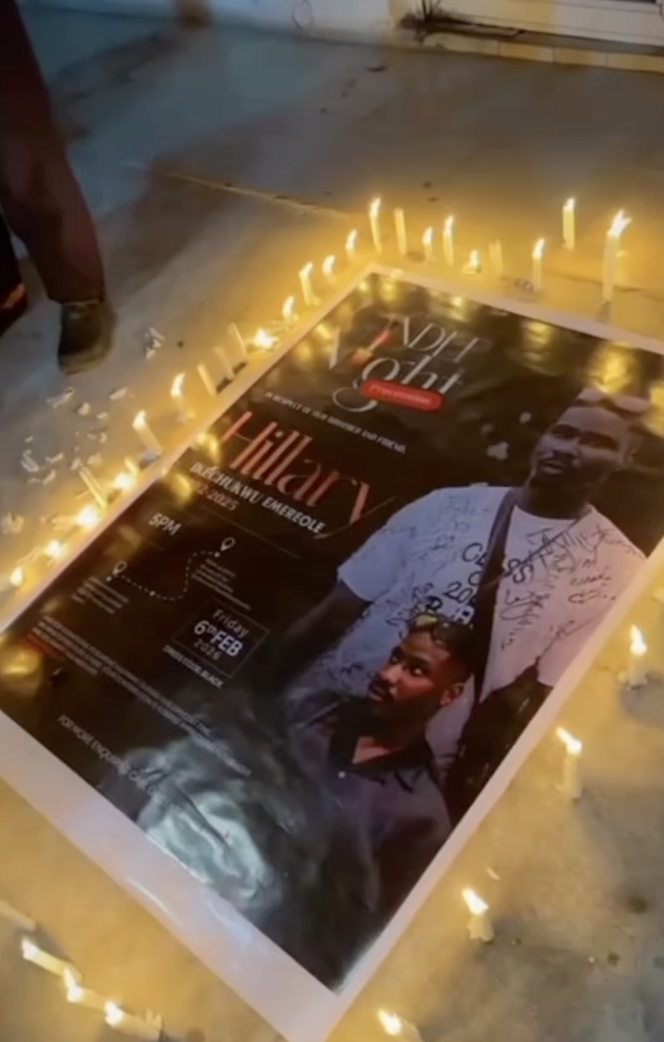
Consider the tragedy of Hillary Todson. He was a 23-year-old graduate lured from Owerri to Port Harcourt in a kito entrapment scheme, then brutally beaten, extorted, and pushed from a two-storey building, sustaining spinal cord injuries that led to his death. Amnesty International Nigeria confirmed Hilary was "yet another victim of rampant Kito,"[11] while House of Rainbow founder Rev. Jide Macaulay noted his death was "the second reported kito-related death in Nigeria in just two weeks."[12]
Despite Hillary never acknowledging his homosexuality, mere speculation about the circumstances surrounding his death was enough to stir up waves of unhinged hostility from the public.
When Hillary was laid to rest on Saturday, February 7, 2026, videos and eyewitness accounts shared online showed groups of people — described by some as youths and kinsmen — dancing, singing, and chanting outside the family home, expressing joy over his death.[13] To these revellers, Hillary's horrific murder was an appropriate send-off for someone deemed a threat to the moral fabric of the nation.
Mob and Police Injustice
Chizelu Emejulu, a lawyer with the NGO Minority Watch, described the defence's strategy in one such ongoing Kito case: 'His line of questioning was to establish that the survivors are gay, and if you are gay, you went there willingly, and if you went there willingly, then whatever happened to you is justified.' As Emejulu put it, 'this is the kind of mindset that is fueling this kind of “attack.” [14]
In one case documented by Human Rights Watch, twenty-one young men were arrested at a birthday party in Ibadan after neighbours reported that gay men were gathered together; police found a bag of condoms belonging to an HIV peer educator and arrested everyone present. None of them were charged. They were held in custody for four days and released only after paying bribes ranging from 10,000 to 25,000 Naira.[15] All of them said they had never been questioned, arrested, or detained prior to the enactment of the SSMPA.
Although police exploitation of criminalized status is not unique to LGBTQ+ Nigerians, for queer Nigerians specifically, this exploitation compounds an already precarious position: reporting an assault means risking self-incrimination, and this has led a lot of victims to stay silent leaving perpetrators to go unpunished—continuing the cycle of such violence.
Public Morality and Legal Discrimination
Human rights activists have argued that the SSMPA is unconstitutional, and a study published in the Lawrit Journal of Law described the act as "illegitimate."[16] This study highlights that the legislation violates privacy rights by intruding into the private lives of adults who engage in consensual intimacy, and restricts the rights to peaceful assembly and association by prohibiting the registration and organisation of gay societies and groups, even including support and advocacy for this community. It also infringes on other fundamental rights guaranteed by the Constitution of the Federal Republic of Nigeria, 1999 (as amended), for all citizens regardless of sexual orientation.
In response, the government defends this anti-human rights legislation by invoking Section 45—the limitation clause. This section allows the restriction of Sections 37 (right to privacy), 38 (freedom of thought, conscience, and religion), 39 (freedom of expression), 40 (right to peaceful assembly and association), and 41 (freedom of movement) of the Constitution:
(a) in the interest of defence, public safety, public order, public morality, or public health; or
(b) for the purpose of protecting the rights and freedoms of other persons.
Section 45 does not apply to the anti-discrimination protections under Section 42 or to any of the fundamental rights the Act violates, but the government uses it regardless. They argue that prohibition is necessary to uphold public morality and the traditional family unit.
Public morality has become a justification for the majority to legally discriminate against and control marginalised groups. When legislation is enacted to coerce a marginalised group into conforming to the beliefs of the majority, it undermines the democratic system designed to protect minorities from majority rule, empowering the majority to enforce its will over the minority. It also grants the majority license to normalise mob violence against anyone who refuses to conform, treating vigilante "justice" as a natural extension of the law rather than a crime against it.
This has led to a series of mob violence against members of marginalised groups that has gone unpunished:
In December 2023, a video emerged showing two men tied up and badly beaten after being caught engaging in intimacy. Visibly bleeding, they were forced to "confess" their sexual orientation while being interrogated and ridiculed by a self-righteous crowd,[17] who believed these men deserved to be stripped of their dignity for defying the culture of the majority.
LGBTQ+ Nigerians are this loophole's clearest current target, but they are far from its only one.
Grace Ushang was killed in 2009 for an offence against public "decency" — raped and murdered in Maiduguri after men reportedly took issue with her wearing her National Youth Service Corps uniform trousers.[18] Rather than condemn the crime, the NYSC's director-general advised other corps members to be more "security-conscious."
More recently, in March 2026, women and girls — including university students — were chased, stripped, and sexually assaulted during the Alue-Do fertility festival in Ozoro, Delta State, after being told to remain indoors during the ritual period. Traditional leaders and state officials described the violence as a "misinterpretation" of the tradition by "hoodlums,"[19] but this was a crowd of citizens who believed members of a marginalised group deserved to be stripped of their dignity and violently abused for defying the rules of a tradition they likely didn't even believe in themselves.
Women in Nigeria are already subjected to this violence at alarming rates for failing to conform to majority "morality." Had Senator Ufot Ekaette's Indecent Dressing Bill[20] passed, granting police and private citizens the power to arrest any woman they personally judged immodestly dressed, that rate would only have climbed higher.
LGBTQ+ persons in Nigeria already have a high risk of abuse, and the laws criminalising their sexuality only make it difficult or near impossible to get justice, while legalizing the crimes of their attackers.
A Call to Justice
Nigeria must decide whether a law enacted in the name of public morality, but used to coerce LGBTQ+ persons and women, is genuinely justifiable in a democratic society, or whether it is simply a mechanism for persecuting a minority under the guise of tradition.
Hillary Todson was a young man of only 23 when he was robbed of his future; Grace Ushang was 25. The young men who were tortured for being homosexual, and the women abused in Ozoro for defying tradition, had committed no crime beyond existing outside the majority's comfort crafted by Western laws and interpretations of gender and sexuality. In 2024 alone, the Initiative for Equal Rights (TIERS) documented over 500 human rights violations against LGBTQ individuals in Nigeria.[21] Yet that number does not account for the vast pool of unreported cases — the ones that never reach any official record because the victims fear that reporting an assault means implicating themselves under the Same-Sex Marriage (Prohibition) Act.
These numbers will continue to rise until the legal loopholes used to justify attacks on marginalised groups are closed, and genuine justice is served for their victims. Achieving this justice will require ordinary Nigerians, regardless of their identity or beliefs, to choose to oppose a system that punishes freedom of expression when it diverges from the norm, often through violence.
If you believe in basic human rights, this is your fight too. The question was never whether you personally agree with homosexuality. The question is whether you believe any government has the right to let its citizens be abused and murdered for holding beliefs, or identities, not shared by the majority and do absolutely nothing.
Mistus Elordie is an investigative journalist, essayist, and poet based in Nigeria, whose work focuses on structural critiques of legislation, gender bias, and systemic discrimination.
Endnote
[1] Institute for Security Studies (ISS Africa), "Anti-gay laws: Africa's human rights regression," https://issafrica.org/iss-today/anti-gay-laws-africas-human-rights-regr…
[2] Human Rights Watch, "Uganda: Court Upholds Anti-Homosexuality Act," April 4, 2024, https://www.hrw.org/news/2024/04/04/uganda-court-upholds-anti-homosexua…
[3] Kenya: High Court Rules Constitutional Right to Legal Gender Recognition," https://gate.ngo/knowledge-portal/article/kenya-high-court-rules-consti…
[4] Same-Sex Marriage (Prohibition) Act, 2013 (Nigeria), Refworld, https://www.refworld.org/legal/legislation/natlegbod/2013/19556
[5] Aleke, Linus. "Tinubu Approves Revised Military Conduct Rules, Bans LGBTQ+ Activities and Cross-Dressing." Arise News, 13 Jan. 2025, https://www.arise.tv/tinubu-approves-revised-military-conduct-rules-ban…
[6] Female Husbands in Igbo Land: Southeast Nigeria." The Journal of Pan African Studies 5, no. 1 (2012): 69–82, https://ikengajournal.com.ng/admin/img/paper/24_3-6.pdf; Woman-to-Woman Marriage in West Africa: A Vanishing Tradition of Power and Agency," The Conversation, https://theconversation.com/woman-to-woman-marriage-in-west-africa-a-va…
[7] Amadiume, Ifi. Male Daughters, Female Husbands: Gender and Sex in an African Society. London: Zed Books, 1987.
[8] Human Rights Watch, This Alien Legacy: The Origins of "Sodomy" Laws in British Colonialism, December 2008, https://www.hrw.org/reports/lgbt1208web.pdf
[9] Human Rights Watch, This Alien Legacy: The Origins of "Sodomy" Laws in British Colonialism, December 2008, https://www.hrw.org/reports/lgbt1208web.pdf
[10] The Initiative for Equal Rights (TIERS), Social Perception Survey on Lesbian, Gay, Bisexual, and Transgender Persons' Rights in Nigeria, conducted by Silverchip Fox Consulting, 2022, https://theinitiativeforequalrights.org/wp-content/uploads/2024/10/SOCI…
[11] Amnesty International Nigeria (@AmnestyNigeria), statement on Hillary Todson, X, 26 Oct. 2025, https://x.com/AmnestyNigeria/status/1982558773794254922
[12] Nigerian Gay Man Dies Following Brutal Homophobic Attack." Scene Magazine, 26 Oct. 2025, https://scenemag.co.uk/nigerian-gay-man-dies-following-brutal-homophobi…
[13] Kinsmen Celebrate Death of Alleged Gay Man." Nairaland, https://www.nairaland.com/8615563/kinsmen-celebrate-death-alleged-gay
[14] Survivor of 'Kito' Attack in Nigeria Speaks Out as Homophobic Violence Rises." YouTube, uploaded by DW News, 5 Mar. 2024, timestamp 06:39–07:28, https://youtu.be/r5Aw5vJyTgw
[15] Human Rights Watch, "Tell Me Where I Can Be Safe": The Impact of Nigeria's Same-Sex Marriage (Prohibition) Act, October 20, 2016, https://www.hrw.org/report/2016/10/20/tell-me-where-i-can-be-safe/impac…
[16] Onwuka, Ezinwanne Mary. "A Constitutional Review of the Illegitimacy of Nigeria's Same-Sex Marriage (Prohibition) Act." Lawrit Journal of Law V, no. II (Dec. 2025), https://lawritjournal.org.ng/wp-content/uploads/2025/12/A-Constitutiona…
[17] Oversight Board, "Homophobic Violence in West Africa," Case Decision, October 15, 2024, https://www.oversightboard.com/decision/fb-ouuwkhko/
[18] Joda, Asma'u, and Iheoma Obibi. "Grace Ushang's Death and the Indecent Dressing Bill." Pambazuka News, 8 Oct. 2009, https://pambazuka.org/index.php/grace-ushang%E2%80%99s-death-and-indece…
[19] Over 500 Rights Groups Condemn Alleged 'Festival' Of Sexual Violence, Assault On Women In Delta Community." Sahara Reporters, 20 Mar. 2026, https://saharareporters.com/2026/03/20/over-500-rights-groups-condemn-a…
[20] In Memory of Grace Ushang," African Feminist Forum, https://www.africanfeministforum.com/p-120/
[21] The Initiative for Equal Rights (TIERS), 2024 Human Rights Violations Report, Jan. 2025, p. 25, https://theinitiativeforequalrights.org/wp-content/uploads/2025/01/Huma…