



In the US – and throughout the capitalist world - the value of Black people is declining, as the economic system no longer relies on cheap labour. Lack of jobs for Black people means a lack of need for Black people, which means the wholesale devaluation of Black life. And anything without value in the capitalist system is disposable.
Of all the African political leaders none have made more profound theoretical and strategic contributions to the advancement of the black liberation movement than Amilcar Cabral. As long as capitalism, colonialism, white supremacy, patriarchy, imperialism, and neo-colonialism exist as forces that exploit and oppress African (and all) people, Cabral’s insights and analysis will always have relevance
Demand Obama institute a National Plan of Action for Racial Justice to end the epidemic of Black murders.
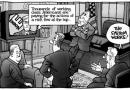
As the power struggle between capital and the working class intensifies over whom and how the economic crisis will be resolved, the working class would do well to recall the lessons of 2011 and build on them.
'We are trying to get as many organizations as possible to sign onto this appeal letter by Thursday, October 20th,' writes Kali Akuno. Please email all endorsements to kakuno[AT]ushrnetwork.org.

Fiercely critical of the US's role and continued presence in Haiti in the wake of the country's earthquake, Kali Akuno highlights the dangers of the supposedly neutral term 'humanitarian intervention' and calls for solidarity with the Haitian people in the face of the 'militarisation of the relief and reconstruction effort'.
 cc The US terms of engagement for participation in the Durban Review Conference (DRC), a follow-up to the 2001 World Conference against Racism, Racial Discrimination, Xenophobia, and Related Intolerances (WCAR), constitute 'a major setback to the international movement to eliminate racism, xenophobia, colonialism, and imperialism' says activist Kali Akuno. He argues that the Obama administration's revisions to clauses on issues including reparations for the trans-Atlantic slave trade and the genocide of indigenous people in the western hemisphere will simply preserve the status quo ante of race, power and exploitation on a global scale.
 cc. In response to Israel’s continued action over Gaza, Kali Akuno argues for the intensification of the international Boycott, Divestment, and Sanctions (BDS) campaign. In a bid to properly contextualise the current developments, the author contends that events must been seen as part of a longer history of assault on the Palestinian people, a history that will only begin to be put to bed through an international solidarity movement aimed at restoring Palestinian rights.
http://www.pambazuka.org/images/articles/380/48713obama.jpgKali Akuno looks at the limits and contradictions of Obama and argues that the progressives have to use a "combined “outside-inside” strategy that seeks to advance a coherent set of principle demands and push him and the forces he has mobilized sharply to the left."
====
Since the stunning Iowa victory of Senator Barack Obama in January, a great deal has been said and written about the declining or ongoing significance of “race” and “racial prejudice” in US society and the prospect of a person of Afrikan descent being its President as proof of its substantive social transformation. While this discussion must be regarded as an advance over the conservative moralistic and race-coded discussions that have dominated political debate in the US since the 1980’s, we must acknowledge its critical limitations.
In the main, these discussions individualize the issues and only engage the behavioral and subjective aspects of inequality and oppression. What is fundamentally missing is a critical discussion of the structural and systemic nature of oppression and exploitation within the US and how the Obama campaign “phenomenon” relates to these structures and dynamics.
This essay seeks to investigate the strategic relationship of the Obama campaign to the structural dynamics of oppression and exploitation within the US. In particular, it will focus on the question of New Afrikan [1] or Black national oppression within the US and how the Obama campaign addresses this oppression. It also seeks to address certain strategic questions that progressive forces within the national liberation and multi-national working class movements must struggle with over the course of the next six months in order to ensure that our demands and interests are advanced – regardless of whether Obama wins or loses the Presidential election in November.
Some of the strategic questions this paper seeks to address are:
- What is Obama’s organic relationship to the New Afrikan or Black nation?
- What class position, alignment and program does Obama represent?
- How does Obama’s campaign strategy and program relate to the historic interests and demands of the Black nation?
WHAT IS THE “NATIONAL QUESTION”?
In summary, from a dialectical materialist framework, the “national question” refers to a) the unequal structural relationship of colonized and oppressed peoples to international capital, oppressor nations, imperialism, and white supremacy and b) to the historic struggles of colonized and oppressed peoples to liberate themselves from these oppressive systems and forces, either in whole or in part (as not all of these “peoples” or “national liberation” struggles have sought to remove themselves from capitalist relations of production).
The inequalities between peoples produced by capitalism are historic. They are rooted in the development of the capitalist world system through the colonization and/or subjugation of the globe and its non-European peoples by the ruling classes of the western European states (i.e. Portugal, Spain, France, England, the Netherlands, Germany, Belgium, and Italy) beginning in the 15th century.
In order to facilitate the process of capital accumulation they initiated on a world scale, the ruling classes of Europe developed a social system and ideology that divided world production along several lines, some of which predated capitalism, some of which developed specifically to suite capitals historic needs. The pre-capitalist social divisions that were exploited were religion, ethnicity, nationality and patriarchy. The new and fundamentally principal divisions developed by and with capitalism are race and state-bound nationality.
The purpose of exploiting and/or developing these inequalities is a) to facilitate the control of the land, labor, and (material and immaterial) resources of the subject and oppressed peoples and b) to foster competition between and amongst these peoples for the material and social rewards conferred by this exploitative and alienating system.
In the United States the “national question” specifically addresses the structural relationship of colonized, oppressed, and subject peoples to the European settler-colonial project and the imperial national-state apparatus that reinforces it. This project is premised on the genocide and dispossession of indigenous peoples (the First Nations); the enslavement and colonial subjugation of Afrikan peoples and their descendents; and the dispossession and colonial subjugation of Xicanas/os.
THE NEW AFRIKAN NATIONAL QUESTION
Throughout the history of the US settler-colonial project New Afrikans have fundamentally been concentrated in the southeastern portion of the projects possessions. The foundation of this concentration was historically premised on the utilization of enslaved Afrikan labor to produce cash-crops like tobacco, cotton, rice, dyes, and sugar, for international consumption. During the early mercantile stages of capitalist development the climatic conditions, soil quality, and strategic location of these possessions facilitated them being incorporated into the world-capitalist system as a zone of mono-crop commodity production. This population concentration and the relations of production exercised in this zone facilitated the formation of the New Afrikan people as a colonized diasporic Afrikan nation subject to will of the European settler-colonial project and its capitalist-imperialist regime between 1619 and 1865.
The mechanization of agriculture in the Southeastern portion of the settler-colonial state in the late 19th and early 20th centuries, combined with an intense program of labor control and repression during this period, displaced millions of New Afrikans. In the search for refuge and jobs, displaced New Afrikans re-concentrated in the urban industrial centers of the East Coast, Mid-West, and West Coast between the 1910’s – 1960’s. In the process of this resettlement, millions of New Afrikans joined the ranks of the industrial working class. However, they did so fundamentally on an unequal structural basis. Exploiting the subject status of New Afrikan people, capital, the labor bureaucracy, and the various European settler communities relegated New Afrikans to the lowest strata’s of the working class, where they were concentrated in the lowest paid and most hazardous occupations that restricted their ability to earn and accumulate. This process of development established the social and economic terms of New Afrikan national oppression throughout the entire expanse of the US settler-colonial project.
Simultaneously, the vast majority of New Afrikans who remained in the New Afrikan national territory (i.e. the Southeastern portion of the settler-colonial project) became subject to a new regime of accumulation and distorted national development. Reacting to the gains made in the industrial “north” by the multi-national working class movement between the 1930’s – 50’s, industrial capital “outsourced” production to New Afrika to exploit the subjugated status of the New Afrikan working class. Although the New Afrikan working class was kept from effectively organizing itself into labor unions, this development did expand the overall circuit of capital within the New Afrikan nation, which helped stimulate the rise of the civil rights movement and its petit bourgeois program of civil inclusion within the legalistic confines of the settler-colonial project.
The limited social and economic gains of the Civil Rights and Black Power movements set the present terms of national development for the New Afrikan nation. New Afrika, like all nations and nationalities, is a class stratified social formation. Like all the peoples and nations subjugated and colonized by the European colonial powers, capital and capitalist social relations have articulated New Afrika’s social development. Throughout it’s nearly 400 years of development, the overwhelming majority of New Afrikans have been and are members of the working classes (either as chattel slaves, peasants, or proletarians). However, a very limited New Afrikan bourgeoisie has existed since at least the mid-19th century. Throughout much of New Afrikan history, this extremely small, typically service based petit-bourgeoisie has tended politically to be more progressive than reactionary in its political outlook and program. In the main this bourgeois class has provided leadership to and support for the primary historical demands of the New Afrikan national liberation movement. In summary these demands have been and are:
- Land for self-determining or autonomous development and accumulation
- Equal treatment before the law of the settler-colonial state
- Equitable distribution of the social surplus distributed throughout the settler-colonial state
- Self-determining political power
- Self-reliant and self-sustaining economic development
- Reparations
However, the accumulation gains (meager as they were) of the Civil Rights and Black Power movements combined with major shifts in the relations of production on a worldwide scale, transformed the relationship of the New Afrikan bourgeoisie to the whole of the New Afrikan nation from the 1970’s to the present. The two dominant features of this process of transformation are a) the phenomenal rise of the comprador bourgeoisie in the 1970’s and 80’s, and b) the rapid transformation of this comprador bourgeoisie into a trans-national bourgeoisie from the 1980’s to the present. As will be argued throughout this paper, this transformation not only changed the overall structural composition of the New Afrikan bourgeoisie, it has forever altered its political worldview and program
INTERROGATING THE “NATIONAL” QUESTION
Barack Obama has asserted on several occasions a) that race doesn’t matter and b) that there is only “one” America.
The implication of these statements, even if only stated for strategic affect, is that the national contradictions within the US settler-colonial project have been negated and resolved. Even a cursory glance at the socio-economic inequalities between the various nationalities in the US reveals that these assertions are blatantly false. However, the unprecedented success of Obama’s campaign and the ground it has broke as it relates to a “Black” candidate appealing to white voters on a national level revels that something qualitative has changed in this country. The question is what is it?
I argue that the source of the qualitative change lies in the changing composition of class throughout the US settler-colonial project. The advance of global capital and its transformation of production and accumulation throughout the capitalist world-system generated this compositional shift. I posit that the process of transformation popularly called “globalization” has created a trans-national bourgeoisie and growing multi-national or “cosmopolitan” trans-national service and working classes. It is my position that Barack Obama is a member of and represents the political and economic interests of the trans-national bourgeoisie and the social interests of the growing trans-national classes. More specifically, Barack Obama is a product of the New Afrikan trans-national bourgeoisie, which emerged in the main from the comprador or neo-colonial sector of the New Afrikan bourgeois class between the 1970’s to the present.
The fundamental question regarding this new class composition for progressive and revolutionary forces within the New Afrikan national liberation movement is how to strategically relate to Barack Obama and this trans-national bourgeois class? Is this class (or class fraction) a friend or a foe of the New Afrikan national liberation movement? I argue three things:
- That the material basis for the traditional class collaboration theory of the united and/or national liberation front strategy of oppressed peoples and nations in general, and of its historic application to the New Afrikan national liberation movement in particular, no longer applies.
- That the left has not developed a general or particular theory of how to strategically relate to these new class forces.
- As a result, we are presently ill equipped theoretically and programmatically to address the Obama phenomenon and seize the historic opportunities it presents to advance the interests of the national liberation and multi-national working class movements.
How does the trans-national bourgeoisie differ from other bourgeoisie classes, particularly amongst oppressed nations like the New Afrikan nation? The general theory of national liberation maintains that there are two primary fractions of the capitalist or bourgeois class (that is the class that owns and controls the means of production). These are 1) the national, progressive, or “anti-imperialist” bourgeoisie and 2) the comprador or “sell-out”, “Uncle Tom”, or neo-colonial bourgeoisie.
The national or anti-imperialist bourgeoisie is theoretically a progressive force drawn from the organic, inner driven life of the oppressed nation that is materially compelled to promote the development of the productive forces of the nation for its own self-interests and to resist the incursion of imperialism and its suppression of this autonomous national development for these self-same interests.
The comprador or sell-out bourgeoisie is theoretically a reactionary force also drawn from the organic, inner driven life of the oppressed nation, which is conversely compelled to collaborate with imperialism to retard the autonomous or self-determining development of the oppressed nation.
The fundamental difference between these two bourgeois fractions and the transnational fraction is their organic relationship to the oppressed nation. The national and comprador bourgeoisies are dependent upon relations of production within the social and political life of the oppressed nation. Meaning they are both dependent on the working masses of the oppressed nation for their very existence, and hence can be held accountable to the working classes within it in various ways. The trans-national bourgeoisie on the other hand, even though it emerged primarily from the comprador fraction in New Afrika and elsewhere, is not dependent for its existence upon the oppressed nation and its relations of production. The trans-national bourgeoisie, as its name implies, is not a national or national-state bound entity. Its basis for existence lies in exploiting the peoples and working classes of the globe, and it is generally only accountable to or held in check by its fractional partners and rivals (largely through their financial control of various capital markets as exhibited by their deflation of various national-state markets like Mexico in the early-1990’s; Thailand, Indonesia, Malaysia, and South Korea in the late 1990’s; and Brazil and Argentina at the turn of this century).
Now, while I posit that this understanding of Obama’s positioning helps us to understand his relationship with the New Afrikan nation and its historic demands, I argue that we still do not completely understand at this point, how it relates to his mass appeal to white voters in many instances who are not part of this trans-national formation. This I argue, we as progressives and revolutionaries, have to interrogate further to gain a deeper understanding of its strategic potential.
INTERROGATING THE CAMPAIGN
Despite what one may personally think of Obama and the principle merits of his campaign, what we have to acknowledge is that his actions and his campaign are deeply rooted in a particular analysis of how to address national oppression in the US. This analysis is rooted in the “integrationist” and “beloved community” narratives of the New Afrikan petit bourgeois leadership of the Civil Rights Movement and its white liberal bourgeois patrons. The strategy behind this narrative appeal is to highlight the commonalities between the oppressor and oppressed peoples, rather than address their contradictions and differences.
This strategy is rooted in the reality that the road to victory goes through the white electorate and its sheer numerical strength. Based on this reality, I argue there are two historical dynamics that have fundamentally shaped the Obama campaign and its strategy:
1) No Democratic candidate has won a majority of white voters since 1964. For a Democratic candidate to win, they are going to have to win a sizeable portion of, if not the majority of, the white settler vote.
2) The Jesse Jackson campaigns of 1984 and 1988. These two campaigns serve as the primary negative examples for the Obama campaign. They illustrate what NOT to do as an Afrikan candidate running for President, which has determined key aspects of his strategy, particularly his methods of appeal to white and Jewish voters in particular.
Based on these realities, the Obama campaign made a deliberate and strategic choice NOT to base his candidacy in the institutions (like the Black church, civic organizations, unions, and the media) or historic demands (see demands) of the New Afrikan nation. In order to give himself the opportunity to win, Obama must avoid being viewed as a “Black” candidate buy any and all means. This explains in part, why he has distanced himself from the likes of Jesse Jackson, Louis Farrakhan, and Jeremiah Wright – the “traditional” representatives of the “progressive” New Afrikan bourgeoisie.
However, his campaign has also relied upon the staunch support of the Democratic Party by New Afrikan people. New Afrikans have been the most consistent base of support for the Democratic Party since the 1964 election of Lydon B. Johnson. In fact, New Afrikans have voted consistently for Democratic Presidential candidates in the range of 80 – 90% since 1956. This fact however, should not be surprising. Democratic candidates can and do take the New Afrikan vote for granted because in the main, New Afrikans have no other genuine political option to represent their interests. Knowing this, Obama and his campaign know that they have to make few special appeals to New Afrikans and most of the other oppressed peoples within the “traditional” Democratic Party coalition to garner their votes (certain “Latino” populations it can be argued might constitute exceptions).
INTERROGATING THE POPULAR FORCES
Regardless of how marginalized New Afrikan demands and institutions are to the Obama campaign, the fact is that since Obama’s Iowa victory in January, New Afrikans have turned out in near record numbers to support his campaign for the Democratic nomination. How do we explain this outpouring of support despite his lack of engagement with New Afrikan demands and institutions?
Further, how do we explain his victories in states like Iowa, Kansas, Oregon, Colorado, Connecticut, Nebraska, Vermont, and Wyoming where the vast majority of the electorate are white settlers who are not substantively incorporated into the trans-national nexus of production?
Part of the answer I believe lies in the trans-national class developments spoken of earlier. The other part of the answer I believe lies in the popular response to the last 7 years of the Bush regime. As a direct result of the failed occupations of Iraq and Afghanistan, the accumulation of unprecedented debt, the partisan management of the economy, the exposed lies and deceit, and the hostile, belligerent, and dictatorial “style” of management, this election is in many ways serving as a popular anti-Bush referendum.
The popular, multi-national, multi-class forces engaging the Obama campaign are clearly clamoring for a change of management. This was first evidenced in the elections of 2006 and has been further illustrated in several off-term Congressional elections in Illinois, Louisiana, and Mississippi where Democrats took elections in long-held Republican districts. Barack Obama, for reasons of personal history (including his newness to Capital Hill), style (particularly his cultivated charisma and flair for the optimal, however programmatically empty it may be), and strategy (including a tacit exploitation of cultural stereotypes about New Afrikan people being good listeners and empathizers) has thus far demonstrated that he would be a profoundly different manager than either of his remaining Democrat or Republican rivals.
What I think progressives and revolutionaries have to be clear on in relating to these popular forces is that a clamoring for a change of management does not equate to a clamoring for a fundamental change of program. It is on the question of program that I would argue that the national question strongly reenters the fry and could perhaps fracture the broad multi-national, multi-class alliance thus far mobilized by the Obama campaign.
For instance, the historic demands of New Afrikan people are not going to go away without a revolutionary transformation of the US settler-colonial state. In fact, as the mortgage crisis deepens over the course of the next 2 to 4 years, some of the demands, like economic development and reparations perhaps, are only going to become stronger.
Likewise, the trans-national capital interests supporting Obama’s campaign have no intentions of stopping their accumulation mission. Rather, they are trying to expand it through the application of a friendlier management approach of their primary regulating instruments – namely the US military, treasury, and Federal Reserve Bank. And further, many of the white service and working class voters who are supporting Obama are not demanding an end to imperialism and globalization, but a return to the high standards of living they are accustomed and feel entitled to as settlers, i.e. “Americans”.
INTERROGATING THE MOMENT
This is an extremely unique moment in human history, one that should not be slept on by progressives and revolutionaries anywhere, let alone in the US.
There are three general things that make this moment particularly unique:
- The rapid collapse of the ecological systems that support human civilization as a direct consequence of the capitalist world-systems need for constant growth and expansion and its dependence on a petro-chemical driven system of mass industrial production to stimulate and sustain this growth.
- The declining hegemony (in both its geo-political and Gramscian connotations) of the US imperial state and the shift to a multi-polar geo-political world order.
- The comparative weakening of the US national economy and the deepening of trans-national production and accumulation.
In order to be properly contextualized, the Obama campaign and corresponding “phenomenon” must be situated as a direct response to this unique moment in history. As has been argued earlier, his campaign is clearly a factional response, one fundamentally serving the interests of the trans-national bourgeoisie and its means and instruments of accumulation and rule. The two fundamental questions stemming from this assessment are: is this class and the alliance of forces it has amassed strong enough to contain the contradictions it has unleashed AND can it continue its accumulation program and political project without a major transformation away from petro-chemical dependent production?
I argue that the answer to both questions is emphatically, NO. Returning to our focus of analyzing the Obama campaign in relation to the New Afrikan national question, there are several examples that clearly illustrate why.
The trans-national program of accumulation is fundamentally driven by a finance driven post-Fordist, intelligence dominated system of production. The intense mechanization of this production regime is rapidly dislocating millions, if not billions, of workers, worldwide. The New Afrikan working class was one of the first and most devastated sectors of the international proletariat hit by this accumulation regime. Since the 1970’s, millions of New Afrikans have been economically dislocated and physically displaced by this transformation, which is only set to worsen with the crisis of finance (witnessed with the mortgage crisis that robbed millions of New Afrikans of their merge capital equity) and the deepening of global production. What is also clear is that the options of absorbing this surplus labor into the low-wage service economy or warehousing (i.e. incarcerating) it, is reaching its political and financial limits. The likely outcomes of the escalating crisis are:
- More intense economic dislocation
- More intense physical displacement and forced relocation (New Orleans being a clear precedent)
- More intense and concentrated New Afrikan resistance
An escalation of the demands made on the state and capital by New Afrikans
As a representative of the trans-national bourgeoisie, its production regime, and the US imperial state, how would Obama be compelled to address these contradictions? I argue that he would fundamentally have to exercise the Nixon option as it related to the New Afrikan nation (and other oppressed nations within and beyond US national-state boarders). Plainly stated the Nixon option is the calculated employment of “carrot and the stick” stratagems. Obama’s carrot would be to ameliorate or buy off a sectors of the New Afrikan bourgeoisie and working class by offering a set of concessions, primarily in the realm of loan forgiveness (for the mortgage crisis) and job training programs (more than likely for “Green Jobs” and the like). The stick would be the strategic application of state repression against resistant and non-compliant forces within the New Afrikan working class. The purpose of the Nixon option now, as during his Presidency in the late 60’s and early 70’s, would be to fracture the political unity of the New Afrikan nation against the trans-national bourgeoisie and its program.
Staying with our analysis, it is also clear that the Green transformation option is a dead end for the trans-national bourgeoisie and its program. Although elements of the trans-national bourgeoisie are clearly leading the charge for the development of “green” capitalism, it is not, and in fact cannot, advocate for the transformation of scale needed to curb the production of greenhouse gases to stall or reverse climate change without bankrupting itself. As a result, it cannot and will not generate enough “Green Jobs” to reincorporate the millions of New Afrikans that have been economically dislocated by trans-national production.
Yet in still, what we can posit with confidence at this moment is that capital is going to go to extreme lengths to extend its life and barbaric domination over human civilization. Conversely, as the events of the last 7 years have illustrated, we should also expect to see an escalation and diversification of resistance.
OUTLINING A FRAMEWORK TO SEIZE THE MOMENT
So, how should the New Afrikan and multi-national liberation and working class movements strategically engage this historic campaign and critical moment?
One of the first priorities of engagement is theoretical development. One of the principle things the New Afrikan and multi-national left movements must figure out is how to engage to the trans-national bourgeoisie. As stated earlier, as of now, our movements do not have a general, let alone united, perspective on this question. In fact, I would argue that most of our forces are still utilizing the traditional united or national liberation front theory to determine their positions and courses of action.
I argue that because the trans-national bourgeoisie cannot be easily pressured by the national liberation and working class movements within the US setter-colonial project, these movements should not invest the majority of their time and energy engaging an “inside” strategy of critical engagement with the Obama campaign. I argue that thinking strategically, these forces should concentrate their energy on building autonomous political movements and institutions (like the Reconstruction Party) within the US national-state that seek to build a broad multi-national united front of oppressed peoples and workers that makes a principle of building strategic links and alliances with the autonomous national liberation, international working class, global justice, and environmental movements throughout the world. As the trans-national bourgeoisie thinks and acts globally, we must also think and act globally to advance our own interests.
However, as the vast majority of our peoples and forces are going to support the Obama campaign and potential Presidency, in the short-term we tactically have to invest a critical degree of time and energy engaging them, if only to try an win a considerable portion of these forces to a left perspective and program. And it is here that we need theoretical clarity. How do we offer a radical critic of Obama, his class position, interests, and program without alienating ourselves from the popular masses? How do we move these forces to engage in autonomous self-determining action outside of the Democratic Party? How do we educate and move the white settler forces mobilized by Obama to actively engage an anti-racist, anti-imperialist perspective and program?
To these ends, a hard-pressed counter campaign against Obama I would argue is not the most effective or productive way to engage these popular forces from this point forward. Rather, I think the multi-national left must seek to highlight the contradictions of Obama’s campaign and program through a combined “outside-inside” strategy that seeks to advance a coherent set of principle demands and push him and the forces he has mobilized sharply to the left. Again, I think the formation of an autonomous “outside” political force should be primary. However, what is perhaps most tactically critical is that both the “outside” and “inside” forces aggressively promote and propagate these common demands; vigorously dialogue and debate in a principled, non-sectarian manner; and openly communicate and collaborate whenever and wherever possible.
Some of the primary strategic demands that must be raised are drawn from the historic demands of oppressed peoples, particularly New Afrikans, combined with the demands of the multi-national working class, women’s, and environmental justice movements. The combination of these demands will expose not only the limits of the trans-national bourgeoisie and its production regime, but of US imperialism itself and its inability to make good on its democratic promises, either at “home” or abroad. Some of the most critical of these demands include [2]:
1. The full and immediately ending of the occupations of Iraq and Afghanistan.
2. The full and unqualified support for Palestinian self-determination and the Right to Return.
3. The full and immediate Right of Return for the more than 250,000 New Afrikans displaced from their homelands in New Orleans and the Mississippi Gulf Coast.
4. The repeal of the “war on drugs” and mandatory minimum sentencing that has resulted in the imprisonment of more than 2.5 million people, the vast majority of whom are New Afrikans.
5. The full support for the rights of women and the LGBTQ communities, including full support for initiatives like the Equal Rights Amendment and “gay” marriage.
6. The full and immediate repeal of the various Patriot Acts and other undemocratic anti-terror laws and Executive Orders.
7. The full, complete, and unconditional amnesty for the millions of migrant and displaced workers in the US.
8. The full and unqualified commitment to reduce the carbon imprint of the US by 80% or more by 2016 to stem the production of climate changing greenhouse gases.
9. The commitment to the public financing of alternative solar, wind, aquatic, and organic energy to sustain the economy, and the elimination of all nuclear energy and hard metal extraction.
10. Reparations for Indigenous, New Afrikan, Xicano, Puerto Rican, Hawaiian and other peoples and nations colonized by the US (including Guam, Alaskan natives, etc.).
BY WAY OF CONCLUSION
Although the road ahead may not be clear, and the outcome of our actions far from certain, the New Afrikan national liberation movement, and the movements of all oppressed and exploited peoples, must seize this critical moment. The survival of humanity demands that we must act, and act in our own interests. Barack Obama nor any other bourgeois messiah is not going to liberate us. We must liberate ourselves.
*Kali Akuno is an organizer with the Malcolm X Grassroots Movement (MXGM). He wrote this essay to honor the 83rd Birthday of Malcolm X and the clarity he brought to the New Afrikan revolutionary movement.
*Please send comments to or comment online at http://www.pambazuka.org/
*For further notes please follow this link:
In August, 2005, Hurricane Katrina hit New Orleans leaving unparalleled devastation in its wake. The Black communities bore its full weight. More than 1,000,000 people, mainly poor Blacks, were forcibly dispersed across the US. The US government had neither prepared nor mobilised to evacuate thousands of people displaced from their homes. Two years on, if the US government had its way, it would bury the issue. But a coalition of grassroots Gulf Coast organisations and their supporters throughout the world have organised an international tribunal to try the US government for human rights violations and crimes against humanity.
Why a tribunal is necessary
On August 29, 2005, Hurricane Katrina hit New Orleans and the Gulf Coast leaving death and unparalleled devastation in its wake. The poor Black communities of New Orleans, Mississippi, and Alabama bore the full weight of the storms and floods. Local, state and federal governments had at least four days advance notice that the levees did not have the capacity to contain mass flooding expected from a category three hurricane. Yet, despite these warnings, the US government had neither prepared for evacuation, nor mobilised to evacuate thousands of people displaced from their homes and left to die on their roofs and in the rubble of the devastation.
In the face of this abandonment, the population of New Orleans took their survival into their own hands and neighbour-to-neighbour attempted to save lives and reach secure ground. In the chaos of their own incompetence and racist rumors, local, state and federal governments sent military and mercenary personnel to New Orleans. They launched a military invasion aimed at removing the Black population and containing a potential rebellion, rather than sending a relief effort. New Orleans became a battle zone between government and mercenary forces seeking to 'protect' the white neighbourhoods of the city and the surrounding suburbs from the Black mass fleeing the floods and seeking refuge from the disaster and race induced neglect. Dozens were murdered and arrested by various government forces and mercenaries as the media fuelled and justified human rights abuses by their unfounded, later to be found completely untrue, reports of mass looting and rape.
To this day, the government has produced no accurate count of the number of people killed. What is known is that some 1,000,000, mainly poor Black people, were forcibly dispersed to over 44 states across the US. They herded people onto buses and trains at gunpoint, separating mothers, children, grandmothers and cousins. They uprooted and separated families, friends, neighbours and support networks, and violently ripped apart the social fabric of peoples lives in order to transform the ethnic and racial make up of New Orleans and the region forever.
Over the past two years, the US government has fundamentally ignored the plight of the more than 1,000,000 people directly impacted and displaced by Hurricanes Katrina and Rita. When the government has been pressed to answer for its actions, it has ducked and dodged and basically washed its hands of any responsibility or liability. While the Army Corp of Engineers acknowledged its responsibility for the faulty and racially discriminatory design and maintenance of the New Orleans levee system, the government has not corrected its errors, nor provided restitution or recourse for its fatal policies. The net result of the systematic policies of intentional neglect and depraved indifference being executed in New Orleans and the Gulf Coast is ethnic cleansing of the historic and politically strategic Black communities in the region.
This ethnic cleansing is being conducted through a deliberate and strategic collusion of government and multinational corporations, particularly real estate developers. In complete violation of the human right to return and the statutes on internal displacement adopted by the US government as outlined in its USAID policies, the government has made no policy, or financial provisions, to return displaced people to their homes and communities. Delays in rehabilitating and refortifying the region's infrastructure, including the levees and the provision of utilities like water and power, and services like health care and education have, by design, prevented people from exercising their right to return.
Then there is the diversion, mismanagement, profiteering by disaster capitalists and delay of relief and restorative aid by agencies like FEMA and the Red Cross. These are compounded by a ruthless application of neoliberal free-market logic and policy and systemic racism in the insurance, mortgage, and other money lending industries that deny financial resources to Black and working class families to repair their homes, purchase new ones, or make down-payments on rentals. Add to this skyrocketing and super-exploitative rents, the hyper-promotion of gentrification, the demonisation and criminalisation of Black youth and the homelessness, and an oppressive military occupation in New Orleans. The results are the massive depopulation of the Black community in New Orleans, Biloxi, Gulf Port and other devastated cities and regions in the Gulf Coast with concentrated Black populations. In New Orleans a mere 35 per cent of its pre-Katrina Black population has returned and resettled over the course of two years.
This ethnic cleansing cannot be allowed to go unchallenged. If they get away with it in New Orleans - after the tragic consequences of deeply entrenched racism horrified both national and international audiences - the gentrification and ethnic cleansing of other communities will accelerate. Where the US government refuses to hold itself accountable or allow itself to be tried for its repressive policies and human rights violations within its own courts, its victims have a responsibility to seek justice themselves. As an expression of the will of the peoples of New Orleans and the Gulf Coast for justice, the People's Hurricane Relief Fund (PHRF) and the Mississippi Disaster Relief Coalition (MDRC) have organised the International Tribunal and called on the international community for solidarity and an impartial hearing. It is only by thoroughly exposing the human rights abuses and inhumane policies of the US government before the world, and isolating it on this basis, that the displaced and dispossessed peoples of the Gulf Coast will attain the recognition, restitution, and justice they so deserve.
What human rights abuses and crimes are the US government being demanded to account for at the tribunal?
To expose the US government and bring it to account, there are several critical questions that must and will be posed at the tribunal to reveal the true depth of the crimes committed and the utter disdain exhibited for Black life. A sampling of these questions include:
1. Why did it take five days for the US government to implement an evacuation in New Orleans? Who where the individuals and institutions responsible for this delay in humanitarian relief?
2. Why were no ready response evacuation and medical teams in place to deal with the calculated damage of Hurricane Katrina? Who was responsible for the organisation and deployment of these teams and resources? Why weren't they prepared and deployed?
3. Why was no independent investigation of the Industrial Canal and its levee system permitted?
4. Why were survivors forcibly removed and dispersed from New Orleans to over 44 states in the US? Who determined who went where and why?
5. Why were 'shoot to kill orders' given in New Orleans? What authority did Governor Blanco have to issue these orders?
6. Why were Black survivors forcibly denied safe escape entry into the city of Gretna and the suburbs surrounding New Orleans?
7. Why were white survivors often separated and removed from Black survivors during the evacuation and relief operations? Who mandated this policy and treatment? What purpose did this policy serve?
8. Why were mercenary and foreign soldiers operating in New Orleans during and after the flood? Who authorised their use? By what authority and under what jurisdiction were they employed?
9. Why were curfews and quarantines implemented at evacuation centres throughout the US? Who were the authorities and institutions responsible for these orders?
10. Why was the Davis-Bacon Act suspended? Why were no bid contracts awarded during the first phase of the reconstruction process?
Similar questions can and must be raised regarding the treatment of women, youth, the elderly, the infirm, migrants and other vulnerable groups, and as regards the rights of oppressed nationalities, indigenous peoples, the right to vote and to freely assemble, the right to food, housing, health care, and education - all of which have been systematically violated by the US government.
What is the tribunal seeking to accomplish?
Appeals to the international community of peoples and nations for justice against the racism, national oppression, and tyranny of the US government have a long and rich history within the Black Liberation Movement going back more than 200 years. Black freedom fighters in the 19th century appealed to Haiti and many European nations against enslavement and for repatriation or national independence. In the 20th century, efforts were made by the likes of Callie House, W.E.B. DuBois, William Patterson, Paul Robeson, Queen Mother Moore, Malcolm X and organisations like the Republic of New Afrika (RNA), the National Black Human Rights Coalition, and the National Coalition of Blacks for Reparations in America (N'COBRA).
The International Tribunal on Hurricanes Katrina and Rita stands squarely within this tradition, and builds on the precedent and foundations laid by these initiatives. It also draws inspiration and lessons from the 1993 International Tribunal on Hawaiian sovereignty, the 1984 Permanent Peoples Tribunal on Nicaragua, and recent tribunals and human rights commissions on the impact of the Tsunami in various parts of Southeast Asia.
There are five fundamental objectives of the tribunal:
1. To fully expose to the world the human rights abuses committed by the US government and its agencies and operatives in the aftermath of Hurricanes Katrina and Rita.
2. To attain national and international recognition as Internally Displaced Persons (IDPs) for the all the survivors of hurricanes Katrina and Rita.
3. To attain comprehensive financial restitution and reparations for all Gulf Coast IDPs (including migrant workers and communities).
4. To strengthen the Gulf Coast Reconstruction Movement and build a broad national and international movement in support of its aims and demands.
5. To hold the rogue US government accountable for its human rights abuses and crimes against Gulf Coast IDPs.
But yet, the tribunal is in itself only a tactic to further the development of a mass Gulf Coast Reconstruction Movement, the ultimate aim of which should be self-determination for the oppressed Black Nation in the US South. The findings, verdict, and corrective remedies mandated by the Tribunal will be used to help frame the agenda and programme of the Second Survivors or Reconstruction Assembly and the initiative to create a Reconstruction Party.
The Second Survivors Assembly will be held December 8 and 9, 2007, in New Orleans. The Survivors Assembly is a constituent body of the peoples most affected by hurricanes Katrina and Rita. The main purpose of the Survivors Assembly is to create a collective vision, platform, programme and coalition to guide the Gulf Coast Self-Determination and Reconstruction Movement.
The Reconstruction Party is a proposal for the creation of a strategic instrument that will enable the Gulf Coast Self-Determination and Reconstruction Movement to implement the restorative measures called for by the tribunal through the institution of the state.
It is through these initiatives that PHRF and MDRC aim to build relationships of solidarity with justice loving peoples and nations throughout the world and campaign within the international arena through organisations and institutions to expose the US government and attain justice and restitution for the survivors of Hurricanes Katrina and Rita.
For more information on the International Tribunal on Hurricanes Katrina and Rita visit or www.peopleshurricane.org
* The opinions expressed do not represent the views of the International Tribunal planning committee, PHRF, or MXGM. The views are solely the opinion of the author. Assistance for this article was provided by Hakima Abbas and Arlene Eisen.
* Executive Director, People's Hurricane Relief Fund, National Organiser, Malcolm X Grassroots Movement
* Please send comments to [email protected] or comment online at http://www.pambazuka.org/
http://www.pambazuka.org/images/articles/297/07march_slavery.jpgIn marking the abolition of slavery, Kali Akuno calls for reparations from Britain, the US and 'numerous corporate enterprises'. He asks that the world recognises the role played by Afrikans in liberating themselves from slavery and in particular the Haitian revolution, 'the seminal historic process that ended the slave trade'.
Much is being made in England and throughout the English speaking or so-called anglophone world about the 200th anniversary of the abolition of the slave trade in the British empire and its breakaway colony, the United States of America.
Hollywood and the monopoly sector of entertainment capital have marked this anniversary with a major feature film, Amazing Grace, about the life and works of William Wilberforce.
What should Afrikan peoples throughout the world make of this fanfare? While commemorations, public discussion, and the issuance of statements of 'regret' - not formal apologies, all must note the difference morally and legally - are being offered for the monumental crime against humanity are positive, they are by no means an adequate response to this crime.
In the 200 years since the cessation of the slave trade within the English speaking empires, suffering and exploitation of Afrikan people within these territories have not abated, only changed in form.
Where slavery once structured the ruthless exploitation of Afrikan people, neo-colonialism is now the order of the day. The central question underlining these commemorative activities is what forms of restitution, redress, and reparations should be offered to Afrikan peoples throughout the world by the governments of the United Kingdom, the United States, and the numerous corporate enterprises built by the capital accumulated from the slave trade sanctioned by these states?
Reparations are just a starting point, the necessary first step, towards the elimination of the ongoing legacies of the slave trade and slavery for Afrikan peoples. If Afrikan peoples do not press the demand of reparations at these commemorative events, then we will allow them to serve as justifications for their ongoing denial.
The legacy of Afrikans liberating themselves from slavery must also be redressed. Specifically, the Haitian revolution, and the seminal role this played in ending the slave trade. The moral appeals of Quaker and Methodist abolitionists aside, it was the success and spreading appeal of the Haitian revolution throughout the Afrikan diaspora that forced British and American colonisers and capitalists to end the slave trade in order to stop fuelling the fire for liberation fanned by the Haitian people.
The denial of this fact perpetuates the dehumanising white supremacist myth that Afrikan people did not, and could not, play a decisive role in their own liberation. Its denial also serves to distort our understanding of historic processes, particularly those of revolutionary transformation.
The determinant force in the liberation of Afrikan people, then as now, is the self-organisation of Afrikan peoples themselves. It is not the efforts of liberal do-gooders or those non-Afrikans that stand in genuine and concrete solidarity with our cause.
Distortions of this logic lead to aid initiatives with the premise that Afrikan peoples must be saved from themselves, not that imperialism and neo-colonialism have to be totally and utterly destroyed.
The conclusion therefore is that Afrikans and genuine revolutionaries everywhere must seize the opportunity being provided by the 200th anniversary commemorative events to address the ongoing legacies of slavery, the slave trade, colonialism, imperialism, and neo-colonialism and to fight, without compromise, for reparations for the heinous crimes committed against our people to build the fortresses of the British and American empires.
*Kali Akuno is the national organiser of Malcolm X Grassroots Movement. He can be reached at [email][email protected]
* Please send comments to [email protected] or comment online at http://www.pambazuka.org