


UK: War, Slavery, and Profound Misunderstanding
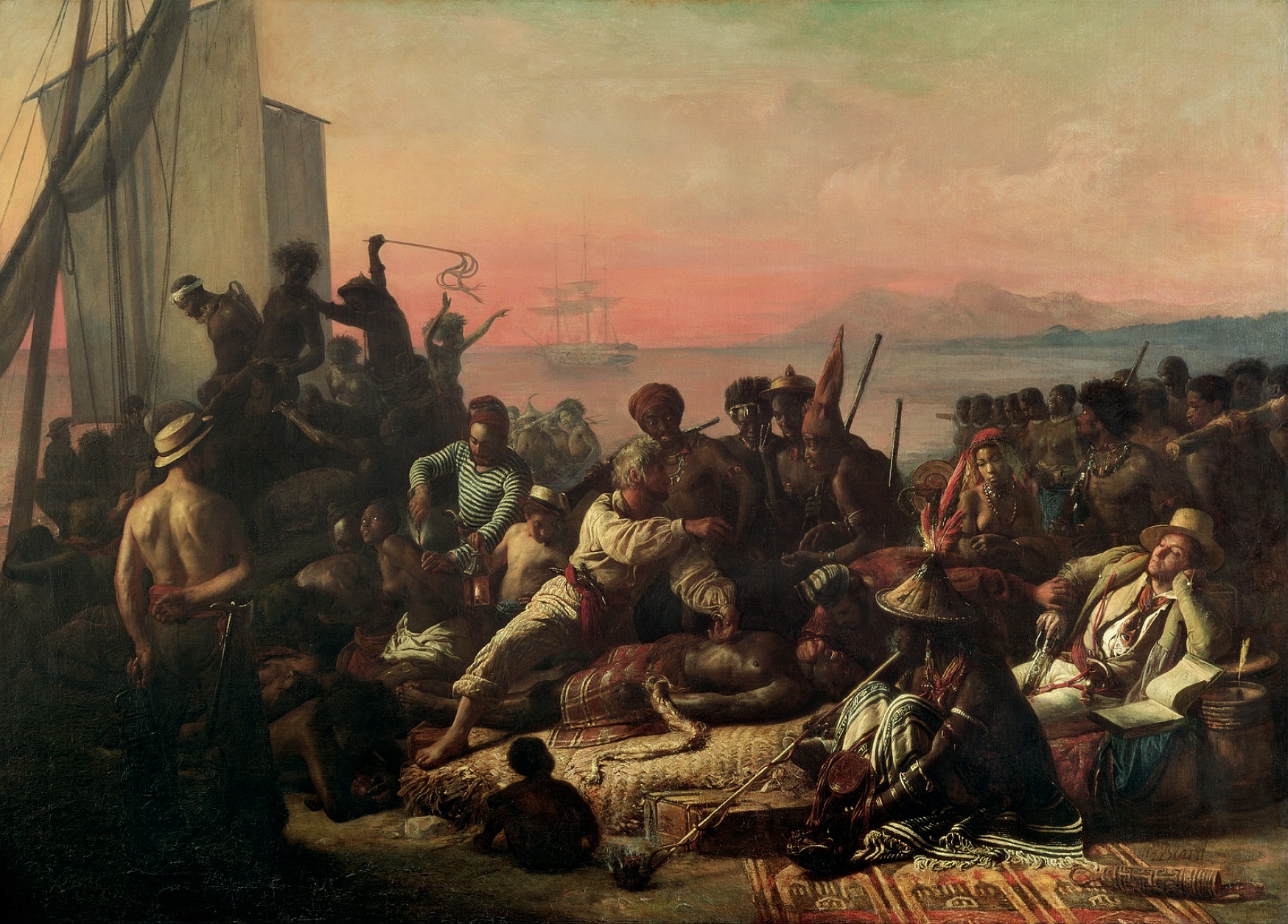

Moro argues the UK's 2026 abstention on a UN resolution condemning the transatlantic slave trade, and its support for the war in Ukraine, reflects a system that continues to prioritize elite wealth over public accountability. Reflecting on Britain's 1833 slavery-abolition loan — which compensated slave owners rather than enslaved people, and wasn't paid off until 2015 — as a historical case, the critique extends to modern examples like David Cameron's Jamaica prison-funding deal.
On 22 June 2026, Keir Starmer resigned as Prime Minister of the United Kingdom and as leader of the Labour Party.[1] Barely a month later, on 20 July, Andy Burnham—also a Labour politician—took over as the country's new Prime Minister.
No major changes are expected in either domestic or foreign policy. In his final speech as Prime Minister, Starmer boasted about a number of achievements, including the fact that “immigration is down significantly." He also praised the perceived moral and civilisational superiority of the British people, implicitly portraying Russia as barbaric and an enemy without naming it directly, while commending Ukraine:
“We face a world now where our enemies will stop at nothing to divide us because of our values, our freedom, our decency, and frankly, because of our unflinching resolve towards the brave people of Ukraine.”[2]
For his part, Andy Burnham declared in his inaugural speech on 20 July that he wanted to change politics and make it more “problem solving than point scoring.” Yet there appears to be little prospect of any significant shift. His first international phone calls as PM were to Volodymyr Zelensky[3] and Ursula von der Leyen,[4] assuring them that the UK would continue its unconditional support for the government in Kyiv and signalling his intention to strengthen ties with the European Union.
Despite the country's serious domestic challenges, by June 2026, the UK government had already provided the government in Kyiv with a total of £21.8 billion (US$28.9 billion).[5] Considering every official commitment made so far, that kind of support is set to continue.
A decade earlier, in 2016, the Brexit referendum took place. Fifty-two per cent of voters chose to leave the European Union, while 48 per cent voted to remain. Many analysts identify Brexit as the beginning of Britain's decline:[6] seven prime ministers in ten years and a dramatic rise in the cost of living. Who is to blame? Some point to Brexit, others to immigration, others to COVID-19, and others to Russia—citing soaring energy prices. Analysts have produced endless explanations in which all of these factors are presented as contributing to the United Kingdom's decline.
My Theory: The Crisis Began Closer to 1833
Call me crazy, but I have a different theory about the origins of Britain's crisis—and, indeed, that of old Europe as a whole.
Its decline began when its peoples chose to accept uncritically the official narratives instilled by their governing elites through education, culture, and the media. They have spent centuries immersed in propaganda without questioning or challenging it, and as a result they are no longer capable of fully apprehending the reality in which they live.
On 9 February 2018, the Twitter account of HM Treasury, the UK's finance ministry, published the following message as part of its weekly #FridayFact series:
Did you know? In 1833, Britain used £20 million, 40% of its national budget, to buy the freedom of all slaves in the Empire. The amount borrowed for the Slavery Abolition Act was so large that it was not paid off until 2015. This means that living British citizens helped to end the slave trade.
The tweet was deleted in the early hours of 10 February following the public outrage it provoked. Those who drafted the message—or those who authorised its publication—appeared either not to know, or not to consider important, that those £20 million (an amount whose economic weight would be equivalent to roughly £100 billion today) were not used to compensate enslaved people. Instead, the money was paid to 46.000 slave owners as compensation for the loss of what the law regarded as their "human property." In effect, the British state bought enslaved people from their owners. Not a single penny was paid to any enslaved man, woman, or child.
The British way of abolishing slavery consisted of making already wealthy slave owners even richer, consolidating fortunes whose influence can still be traced today through families such as that of former minister Douglas Hogg, writers including Graham Greene and George Orwell, and institutions such as Lloyds, Baring Brothers, P&O, and Barclays. And, of course, the country's largest slave-owning family—the British royal family—also benefited.
Yet perhaps the greatest beneficiary of all was Nathan Mayer Rothschild, whose family bank lent the money to the British government, securing in return a lucrative stream of interest payments that British taxpayers would continue servicing for generations.
The Bank of England was entrusted with administering compensation payments to slave owners on behalf of the “benevolent” British government. In this way, an enormous transfer of public wealth into private hands took place—one that lasted from 1833 until 2015.
I agree with historian David Olusoga, who wrote during the 2018 controversy "The real question is: why did anyone think this was okay?"[7] He argued that reducing the complex history of abolition to a simple #FridayFact reflected a profound “misunderstanding”[8] of the history.
A Special Mention Goes To...
Former Prime Minister David Cameron deserves a special mention. His family was among the slave-owning families that received enormous sums in compensation for the loss of their "human property." Cameron held positions of political responsibility virtually from birth and served as Prime Minister from 2010 to 2016. While British citizens had not yet finished repaying the Rothschild loan from which his family and thousands of others had benefited, Cameron paid an official visit to Jamaica.
There, demonstrating precisely the profound misunderstanding described by Olusoga, he told the Jamaican people that he hoped: “As friends who have gone through so much together since those darkest days, we can move on from this painful legacy and continue building the future.”[9] In other words, a descendant of those enriched by slavery was asking the descendants of those impoverished by it to “move on.” As a gesture of goodwill, he offered the Jamaican government £38 million of British public money to build a prison.
The prison project formed part of British migration policy, which was already beginning to contemplate deporting migrants to third countries. Cameron's plan was to use the facility to hold migrants deported from the United Kingdom after committing criminal offences, whether serious or minor. One might ask how many deportation cases would have been necessary before British taxpayers saw any return on their investment in a prison built in Jamaica?
But that was never really the point. Once again, it represented another transfer of public money into private hands. The management of British prisons and Immigration Removal Centres (IRCs) has been outsourced to private companies such as Serco, Mitie, and G4S, themselves owned by major investment funds whose names are familiar to us all: BlackRock, JPMorgan, Vanguard Group, Goldman Sachs, and others.
Your Money, for Zelensky
People in the United Kingdom make decisions based on instincts and emotions shaped by centuries of propaganda, rather than on information or a genuine understanding of reality.
The European Union has banned 27 media outlets that challenge its official narrative[10], while continuing to present itself as a champion of press freedom and accusing Russia of suppressing free expression. Yet the reality is that Russia banned Western media only in response to Europe's censorship—not beforehand[11]. Europeans, however, have largely proved incapable of resisting the Russophobia that has been so successfully cultivated.
Journalist Glenn Diesen argues that:
“American and British propaganda was more effective than Soviet propaganda during the Cold War as Western propaganda could be disseminated through private corporations and 'non-governmental organisations'. Propaganda used to be considered a normal profession until the Germans gave it negative associations in the First World War. Edward Bernays renamed propaganda 'public relations' to distinguish between 'our' good propaganda and 'their' malicious propaganda.”[12]
Diesen, author of Russophobia: Propaganda in International Politics, insists:
“Portraying Russia as a barbaric other suggests that the West must civilise, contain or destroy Russia to enhance security. Furthermore, a civilising mission or socialising role of the West infers that dominance and hostility are benign and charitable, which reaffirms the West's positive self-identification”.
Blinded by Russophobia, we are unable to recognise that money from our public coffers is being channelled to a corrupt government, led by Volodymyr Zelensky in Kyiv[13] [14] [15] [16]. Our political leaders are not focused on the increasingly difficult living conditions faced by their own citizens. Instead, they are committed to fighting a proxy war against Russia that they cannot win.
Our money is being poured into a war that is already lost, yet one that continues to inflict death and suffering because of the determination of European and American elites to keep it going. Some of those elites are undoubtedly profiting financially from the conflict.
Not only that. Our governments are beginning to shift the Overton window, gradually encouraging us to consent to the possibility that we ourselves could be sent to war. Across Europe's corporate media, reports and commentary increasingly normalise the idea of returning to war as though it were inevitable[17] [18] [19], yet we remain asleep.
That is the problem facing the United Kingdom—and Europe as a whole. We suffer from a profound misunderstanding of reality because of the propaganda we have absorbed for so long. We are no longer capable of waking up.
Rosa Moro is a Spanish independent journalist. She has spent more than two decades working with media outlets, organizations, and projects focused on Africa. In 2012, she founded África en Mente, a blog dedicated to amplifying African perspectives and covering issues often overlooked by western mainstream media. She is the author of ‘El Genocidio que no cesa en el corazón de África. Una historia de desinformación’, and a regular contributor to international media and public forums. In February 2026, she was awarded the Prix Victoire Ingabire Umuhoza pour la Démocratie et la Paix by the Réseau International des Femmes pour la Démocratie et la Paix in recognition of her commitment to freedom of expression, peace, dialogue, and her reporting on the African Great Lakes region. Her profile on X is @africa_en
A different version of this article was published on Antiimperialistas.com on June 06, 2026.
Endnotes
[2] https://www.gov.uk/government/speeches/keir-starmers-final-speech-as-prime-minister-20-july-2026
[5]https://www.gov.uk/government/publications/uk-support-to-ukraine-factsheet/uk-support-to-ukraine-factsheet?utm_source=openai
[6]https://apnews.com/article/brexit-vote-10th-anniversary-broken-uk-politics-e9c14876e5e9a51fb57ba6d67e30582f
[8] https://www.theguardian.com/education/2022/jun/19/british-history-should-not-be-treated-as-a-soft-play-area-says-david-olusoga
[11]https://www.occrp.org/en/news/russia-banned-81-foreign-media-outlets-in-2024-in-retaliation-against-western-restrictions
[14]https://www.pbs.org/newshour/show/corruption-scandal-rocks-ukraine-as-it-fights-for-survival-against-russias-invasion
[16] https://www.theguardian.com/news/2015/feb/04/welcome-to-the-most-corrupt-nation-in-europe-ukraine