


The Digital Treadmill: Three Waves of Extraction Without Consent
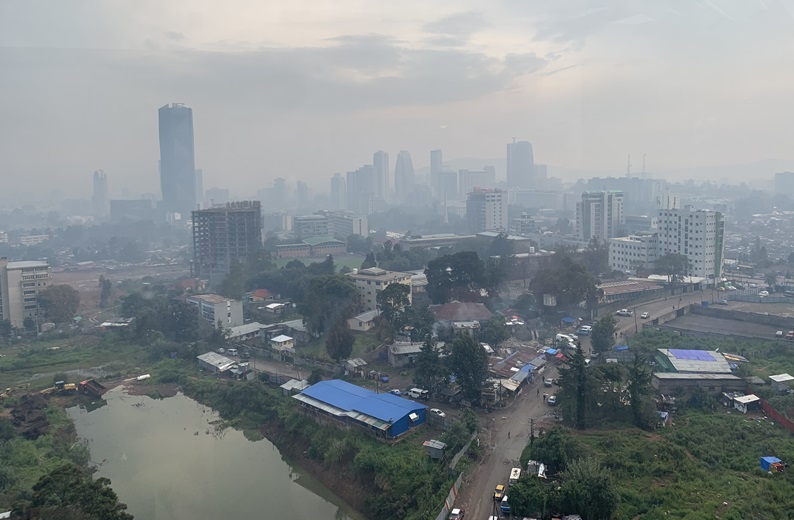

Mohammed links increased personal taxation in Ethiopia to the arc of extraction from slavery to IMF austerity, and highlights a path toward African economic sovereignty.
I am sitting in the local tax office in Addis Ababa, waiting for my turn. The atmosphere inside is heavy, suffocating under a collective panic. As people step out of the inner offices, the reactions are visceral—some are visibly crying, others are entirely frozen, paralyzed by the sheer volume of the new taxes imposed upon them. The International Monetary Fund (IMF) mandates aren't abstract macroeconomic policies debated in Washington anymore; they are a blunt instrument breaking ordinary livelihoods right here on the ground.
When my name is finally called, the officer prints out a compliance sheet. The number staring back at me is staggering: a demand for a sum roughly six times (6×) what I used to pay. In a single, indifferent administrative stroke, the state is demanding years of accumulated profit all at once.
Sitting there, holding a document that threatens to erase years of hard work, the broader geopolitical landscape becomes impossible to ignore. This local tax office is merely a microcosm of a much larger historical pipeline. We are often told that the modern international order is built on state sovereignty and mutual consent. Yet, for Global Africa, history tells an unbroken story of a three-wave extraction machine that has never requested permission.
The Evolution of the Machine
The foundation of Western industrial capital was built on the first wave: the direct extraction of human bodies. During the transatlantic slave trade, millions of African lives were violently commodified and displaced without consent to provide the uncompensated physical labor that cleared the fields and built the baseline wealth of the Global North.[1]
When the industrial age matured and automated machinery eclipsed the economic efficiency of chattel slavery, the empire did not retreat; it evolved. The new machinery required raw input—rubber, cotton, petroleum, and minerals. Because it was no longer logistically practical to transport the labor, the second wave began: the Scramble for Africa, which brought direct colonial occupation to partition and drain the soil itself. Once again, this occurred with zero domestic consent.
Now comes the tech age. By a cruel geological irony, the rare earth elements, tantalum, and lithium required to power global technology sit heavily beneath African soil. But modern hegemony has learned that standing armies and colonial flags are too loud, too expensive, and politically messy to maintain. Instead, the physical chains have been replaced by the subtle, invisible ledger lines of international debt.
The Modern Leverage of the Ledger
Instead of regional governors, institutions like the IMF and the World Bank govern through structural adjustment programs and conditional, high-interest loans. When a developing nation faces external economic shocks, the prescription handed down from the outside is almost always fiscal consolidation, severe public spending cuts, and aggressive domestic revenue mobilization—meaning a brutal squeeze on local taxpayers.
In July 2024, Ethiopia secured a US$3.4 billion Extended Credit Facility from the IMF, a four-year program that has since driven a series of austerity measures—currency devaluation, subsidy removals, and aggressive tax hikes—all presented as necessary corrections for macroeconomic stability.[2] These mandates aren't abstract macroeconomic policies debated in Washington; they are a blunt instrument breaking ordinary livelihoods right here on the ground.
This creates a devastating cycle: citizens work harder, local tax structures are aggressively squeezed to generate immediate liquidity, and raw tech materials continue to be exported. Yet, the liquidity generated from the sweat of the local population is immediately redirected outward to service sovereign liabilities denominated in foreign currencies. The extraction is as total as it was during the colonial era, but it is now executed cleanly via swift bank wires and balance sheets.
The Blueprint for De-linking
To break out of a structural trap this deep, the continent must move past the traditional, failed political rhetoric of requesting market mercy. The solution lies in reclaiming economic sovereignty, forcing technological decoupling, and executing hard resource nationalism.
Hard resource nationalism must manifest through several coordinated instruments. First, absolute bans on the export of unrefined raw tech minerals—a policy already being pursued by Uganda, which has banned unprocessed mineral exports and is attracting investors to build local processing plants.[3] Second, the formation of a unified African mineral cartel—an OPEC for tech minerals—as African leaders have recently explored, to shift the balance of supply chain leverage.[4] The Democratic Republic of the Congo has pledged to process 30% of its cobalt locally by 2030.[5] Zimbabwe is forcing lithium refiners to invest in-country.[6] Restrictions on raw mineral exports have increased across Africa.[7]
The continent must also aggressively transition to local currency settlement mechanisms for intra-African trade, utilizing pan-African payment systems such as the Pan-African Payment and Settlement System (PAPSS) to bypass the systematic reliance on foreign exchange reserves.[8] When African nations decouple internal trade from foreign-denominated currencies, external institutions lose the structural leverage required to dictate domestic tax codes.
Finally, a unified front of resource-rich nations must collectively demand aggressive sovereign debt audits, challenging the legitimacy of odious loan structures designed to be structurally unpayable, while pivoting toward independent, regional development liquidity.
Conclusion
Holding a tax document that demands years of local profit to satisfy an invisible foreign ledger, the path forward becomes blindingly clear. We cannot petition the architectures of our exploitation for our emancipation. To break the digital treadmill, Global Africa must transition from an economy of extraction to an economy of processing and sovereign authority.
The tech age cannot function without the wealth beneath our feet. It is time to turn our geography into our weapon. By enforcing strict resource nationalism, refusing to export unrefined raw materials, and collectively decoupling from the debt structures that dictate our domestic misery, we stop being the engine of global advancement and finally become the authors of our own destiny. The chains were broken by our ancestors; it is up to this generation to erase the ledger.
Mohammed Ahmed Mohammed is an Ethiopian author and essayist based in Addis Ababa. His work explores the intersection of technology, structural adjustment, and African economic sovereignty. He has published in Pambazuka News and other Pan-African outlets, and is the author of multiple books.
Endnotes
[1] For a comprehensive historical account of how enslaved labor powered American capitalism, see Edward E. Baptist, The Half Has Never Been Told: Slavery and the Making of American Capitalism (New York: Basic Books, 2014).
[2] International Monetary Fund, "IMF Executive Board Approves Four-Year US$3.4 billion Extended Credit Facility Arrangement for Ethiopia," Press Release No. 24/291, July 29, 2024. Available at: https://www.imf.org/en/News/Articles/2024/07/29/pr24291-ethiopia-imf-ex…
[3] "Ban on raw minerals export to stay – Govt," Daily Monitor (Uganda), October 12, 2022. Available at: https://www.monitor.co.ug/uganda/news/national/ban-on-raw-minerals-expo…
[4] African Mineral Cartel (OPEC-style). "Will Critical Minerals Get Their Own Opec?" — The Namibian, August 19, 2023. Available at: https://www.namibian.com.na/will-critical-minerals-get-their-own-opec/
See also: "Why we need an OPEC for critical mineral producing countries," — Global Justice Now, August 21, 2024. Available at: https://www.globaljustice.org.uk/blog/2024/08/opec-mineral-producing-co…
[5] "DRC Cobalt Local Processing. "DRC battery minerals and local value addition: what is realistic?" — Congo Mining Network, April 22, 2026. Available at: https://congominingnetwork.com/public/index.php/drc-battery-minerals-and-local-value-addition-what-is-realistic
[6] "Chinese mining company opens $300 mn lithium processing plant in Zimbabwe" — Business Standard, July 6, 2023. Available at: https://www.business-standard.com/world-news/chinese-mining-company-opens-300-mn-lithium-processing-plant-in-zimbabwe-123070501046_1.html
See also: "Zimbabwe commissions Chinese company's lithium processing plants" — Xinhua, November 30, 2023.
Available at: https://english.news.cn/africa/20231130/fb1ced9107dc4d34ab987cbb4b7c578b/c.html
[7] Solomon, Ekanem. February 06, 2026. "As global powers race for Africa’s minerals, more nations are clamping down on raw mineral exports" Business Insider Africa. Available at: https://africa.businessinsider.com/local/markets/as-global-powers-race-for-africas-minerals-more-nations-are-clamping-down-on-raw/ks0zh50
[8] "Pan-African Payment and Settlement System Launched by President Akufo-Addo, Foreseeing $5 Billion Annual Savings for Africa," Afreximbank, January 13, 2022. Available at: https://www.afreximbank.com/pan-african-payment-and-settlement-system-launched-by-president-akufo-addo-foreseeing-5-billion-annual-savings-for-africa/