


Reflections from the Workshop on “(re)Thinking extractive capitalism amidst hyper-imperialism” held at the University of Ghana, Accra
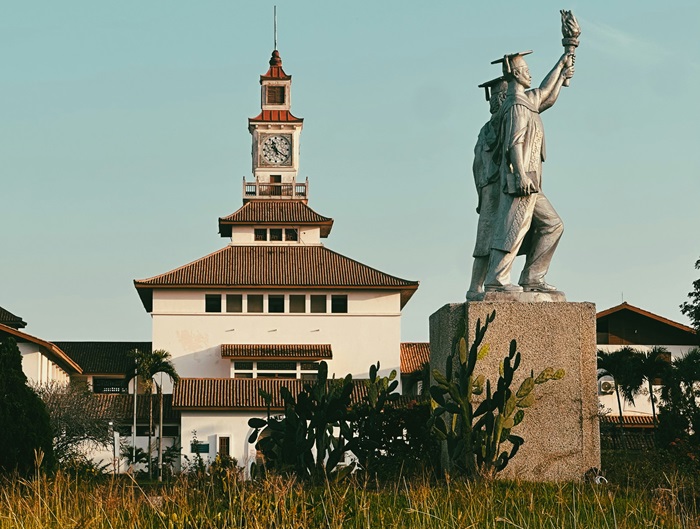
Bembir and Murrey reflect on a recent workshop on extractive capitalism and hyper-imperialism held at the Institute of Statistical, Social and Economic Research (ISSER), University of Ghana, Accra, on 24 April 2026.
At ISSER, the recent workshop '(re)Thinking extractive capitalism amidst hyper-imperialism' on 24 April 2026 staged a bit of an encounter between different schools of social science. One was the institute's long-standing language of measurement, policy relevance and knowledge for development. (Founded in 1962 as the Institute of Statistics and widened in 1969 into a broader social-science institute, ISSER defines itself through policy research, commissioned work and consultancy. This is one of the most durable policy rooms in Ghanaian social science.) The other was a series of harder and more urgent idioms: extraction as total social relation, sovereignty as perforated within global imperialism, infrastructure as coercive by design, and academia as a site of capture.
The collective discussed gold, fertiliser, salt, land leases, carbon offsets, logistics, research funding, peer review and unpaid care; each of which appeared as linked pieces or moments in the long machinery of appropriation in extractive capitalism. Fred Dzanku, Dzifa Gertrude Torvikey, Yaw A. Agyeman Boafo and others insisted that extractive relations are co-produced through alignments between domestic elites, state actors and global capital. There was no easy comfort of attributing blame to an external villain, and in this way, the workshop was situated in live debate with current Ghanaian scholarship. Austin Ablo critiqued the emergence of new private secluded neighbourhoods in Accra, and more.
One of the workshop's strongest points of contention was the notion of 'hyper-imperialism' (taken from the gathering’s title and introductory comments), it was taken to mean a composite of military force, finance, lawfare, digital systems, logistics and ideological management (drawing from the Tricontinental: Institute for Social Research’s 2024 report). The very idea of hyper-imperialism, of a discussion on any of its newness, in the context of Ghana was a bit politically theatrical by design and the participants at ISSER were sceptical (that US-led imperialisms, as historically known in-place, in Accra) could be ‘hyper’ and argued that the concept needs disciplining, to be locally refashioned and historically contingent. The debates were heated. The ‘criminal state’ and 'sovereignty without control' were some of the sharpest phrases of the day, and Ghanaian research gives them weight: scholars argued that when community rights obstruct elite developmental ambition, the state can police dispossession while calling it progress.
The cross-generational conversation between graduate students, early career researchers and senior scholars highlighted continuities, knowledge transfer, exchanges beyond age and experience. The research topics of the graduate students addressed aspects of extraction that would have otherwise not been prominent during the workshop. Nana Aba’s work on salt winning at Ghana’s largest salt production space, the Songhor lagoon at Ada, nearly 2hr drive from Accra, reignited ongoing conversations in the country about the dispossession of artisanal salt miners in Ada. A Songhor salt project by one of Ghana’s investors had secured political support and displaced communities whose culture, livelihood and existence had been defined by salt and related mining activities on the lagoon. The struggle between members of the Ada communities and finance capital had reached a point where violent clashes between residents and security forces had led to the death and injury of members of the salt communities. Bembir’s field visit to the salt-mining communities in February 2022, with colleagues on a separate research project, corroborates Aba’s argument. That research visit revealed a history of brutality that has been symbolized by the memorial of Margaret Kuworno (Maggie), a young pregnant woman who was murdered by a bullet during one of the protests against dispossession and displacement from the Songhor lagoon.
While the Songhor conversation relates to a business firm seeking to extract profit through dispossession, Naomi’s work recentred perennial discussions about communities that were displaced from the construction of Ghana’s Akosombo Dam, the hydroelectric backbone of the country, and the continuing displacements that occur downstream with each flooding of the Dam and the associated Lake. Naomi’s work serves as a continuity of similar research that was done by Dzodzi Tsikata on “Living in the Shadow of the Large Dams: Long Term Responses of Downstream and Lakeside Communities of Ghana’s Volta River Project,” where she examined the effects (“shadow”) of the Dam on the livelihoods of riverine communities in the area.
The most incisive turn comes when the workshop folds the academy into the object of critique. Questions on publishing and the blunt question of whether scholars should work for extractive firms all exposed the political economy of expertise. This matters especially at ISSER, whose official mandate pairs social research with commissioned work, policy advice and consultancy. What they do not resolve is the strategic question that the workshop’s own programme posed: are we—critical social scientists—seeking futures beyond extraction, or just more equitable extraction? These fault lines ran through the event.
The workshop's own infrastructure makes the point sharper still. Anti-extractive critique travels through the same transnational circuits that distribute money, prestige and access—although at the workshop it is done reflexively and knowingly. This aligns the event with calls for scholar-activism.
However, the discussion infrequently lent itself to institutional alternatives, and Pan-African solidarities appeared as a kind of fugitive possibility, through insights from Nene-Lomotey Kuditchar, for example, but perhaps not as design. Chika Mba questioned African solidarity in the face of non-solidaric visa and permit regimes on the continent. Mba extended Kwame Gyekye’s theorising of two-tiered solidarity (metanationality) to argue that ethnic and meta-solidarity (that involves multiethnicities at the national level) should not be necessarily eroded but extended to a third-tier, continental solidarity. Peter Bembir extended the meta-solidarity conversation to the global level, focusing on African peoples on the continent and everywhere, regardless of their colour, class, and other diversities. Bembir offered a history of Pan-African solidarities from the resistance of ethnic groups, enslaved peoples, mobilisations of black peoples in the US and elsewhere, Pan-African congresses, women, and working-class peoples; and the reclamation of the movement through the interventions of the 7th Pan-African Congress and the contributions of Tajudeen Abdul-raheem, in what is best described as Pan-Africanism from below. These diverse groups and forms of people-based solidarity work together with progressive elites toward African unity and anti-extractivist struggles, constituting the basis for contesting what Bembir conceptualised as a five-model extractivism: epistemic, biological/bodily, natural-resource, labour-value, and digital-technological.
The workshop's orienting wager was that social science cannot keep behaving as extraction's accountant, counting outputs while ignoring coercion, care, ecology and the capture of knowledge itself. The event's provocation was institutional - to ask whether universities can continue to produce policy expertise while necessarily becoming places where extractive reason is named, tracked and refused. That question remains and is larger than one workshop.
Peter Bembir (PhD) is a postdoctoral fellow and a multidisciplinary researcher interested in security and development research, healthcare, Africa’s domestic and international politics, among others, at the Institute of African Studies, University of Ghana. He is an Associate Editor at Pambazuka News.
Amber Murrey is a geographer interested in power, global extractive capitalism and neo-imperialism, focusing on domination, resistance, life under duress, and solidarity in Cameroon, Burkina Faso, Ethiopia and elsewhere. She is the editor of A Certain Amount of Madness: The Life, Politics and Legacy of Thomas Sankara and co-author, with Patricia Daley, of Learning Disobedience: Decolonizing Development Studies.