


“We Deserve Respect”: The Bolivarian Revolution, Imperial Aggression on Venezuela, and the Struggle for a Peaceful, Sovereign Global South
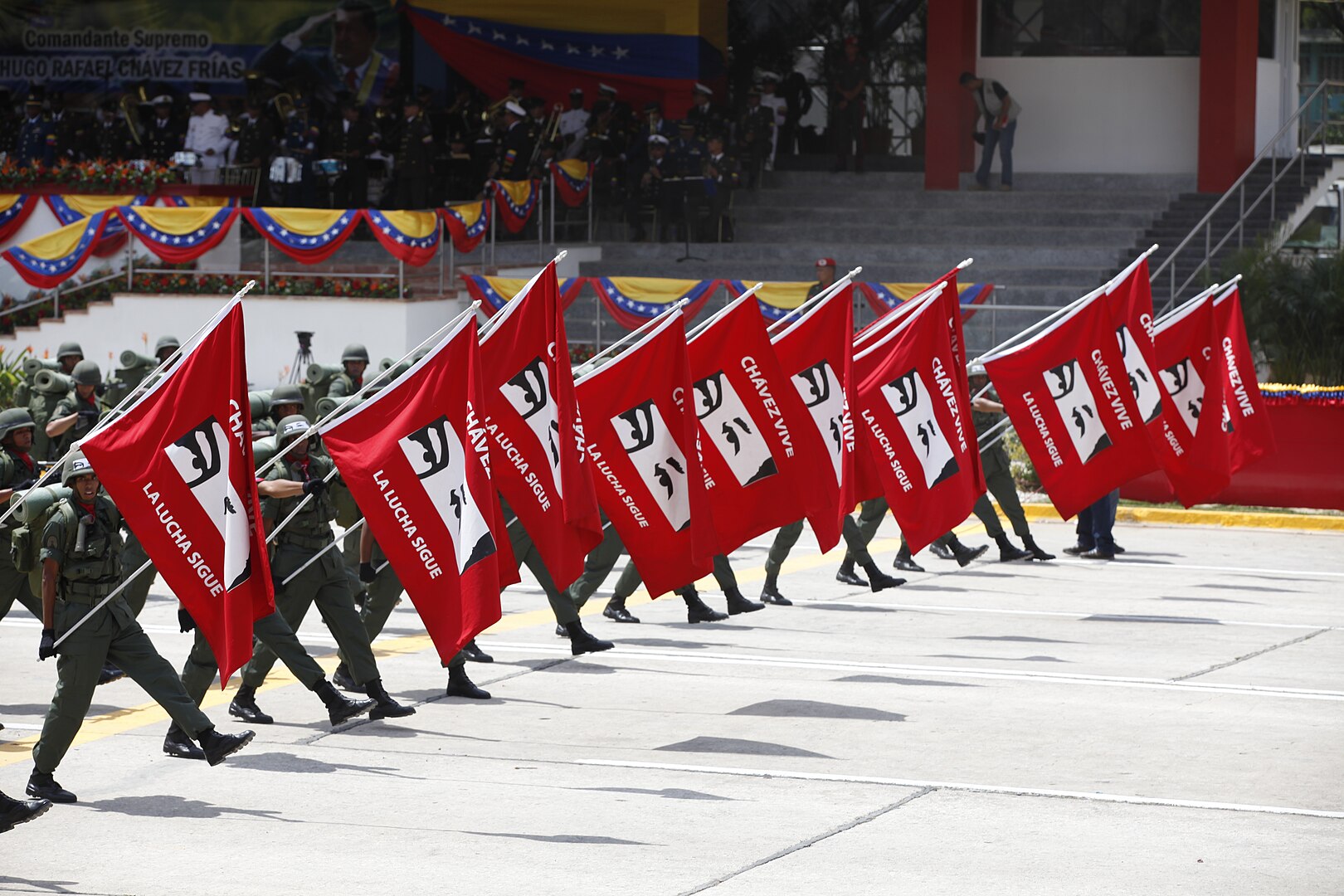
An analysis of geopolitical violence against Venezuela, the imperial actors driving it, and solidaric resistance rooted in the Bolivarian Revolution.
Ojalá, o como dicen los hermanos árabes, ojalá, in sha Allah, Salam Alaikum, ojalá, que algún día, el pueblo del estados unidos tenga un gobierno con el que se pueda conversar. Ojalá, algún día pronto, más pronto que tarde, ese país tenga un gobierno que respete los pueblos y los gobiernos de América Latina. No le pedimos mas nada. Que nos respeten porque nosotros merecemos respeto.
[Hopefully, or as our Arab brothers say, hopefully, inshallah, Salam Alaikum, hopefully one day, the people of the United States will have a government that one can talk to. Hopefully, one day soon, sooner rather than later, that country will have a government that respects the peoples and governments of Latin America. We ask for nothing more. That they respect us because we deserve respect.]
— Commander Hugo Chavez in 2008 following a coup attempt[i]
The US government’s long-standing campaign to isolate and vilify Venezuela—most recently through its designation of the country as a “foreign terrorist organization”—is not merely an attack on the government of Nicolás Maduro. It is an assault on the Bolivarian revolution itself, and on the right of sovereign nations to determine their own path.
This tension is not new. In 2008, following a coup attempt, Commander Hugo Chavez expressed a hope shared by many across the Global South. Addressing the masses of Venezuela, he famously demanded respect from the US. These calls for respect were not confined to US meddling in the internal affairs of the Bolivarian Republic of Venezuela at the time, but it is a string of imperialist design that aims to supplant the path forged by the Venezuelan masses.
The recent escalation of accusations—branding Venezuela as corrupt, authoritarian, anti-democratic, rentier, and most recently a narco-terrorist state—is merely the latest tactic in a decades-long campaign. Its true objective is not the country itself, but the example it sets: the political, economic, and social model of the Bolivarian Revolution, started by Hugo Chavez in 1999, and its resonance across Latin America and the Global South. The ultimate goal is to undermine the principle of sovereign self-determination, punishing any nation that dares to forge an independent path.
As Michael Parenti observed, the fundamental "mistake" of such vilified nations is that they provide for their people, thereby depriving imperial powers of the ability to usurp profits at the people's expense.[ii] This is the cardinal sin of the Bolivarian Revolution. Now, at a critical multipolar juncture marked by diminishing US hegemony and the growing influence of China and other anti-imperialist states in the hemisphere, the empire's response has grown increasingly desperate. Its erratic and barbaric drive toward militarization serves a final, fragile goal: to stabilize its waning influence in the Western Hemisphere.
A Socialist Bolivarian Revolution with Pan-African and Plurinational Characteristics
When Hugo Chávez proclaimed the Bolivarian Revolution's commitment to socialism in the late 1990s and early 2000s, he did so at a time when history was supposedly over. The Berlin Wall had fallen, the Soviet Union had dissolved, and Francis Fukuyama's “end of history” thesis dominated Western intellectual discourse. Capitalism had won; we were told. Socialism was dead. Yet Chávez, defying this narrative, showed the world that socialism was not remotely dead—merely dormant, waiting for its moment of resurgence.
A careful examination of the policies implemented under Venezuela's Bolivarian Revolution reveals several notable structural changes. Economically, the state assumed control of key industries and financial institutions. In agriculture, a land reform program redistributed millions of hectares to peasant farmers, while other initiatives aimed to increase domestic food production. Politically, a new constitution established a framework for participatory democracy. This system supplemented electoral representation with direct community involvement through local communal councils, intending to decentralize political power beyond traditional institutions. These reforms were designed to broaden popular engagement in governance and formally enshrine the rights of women and Indigenous peoples.[iii]
Cuba and Venezuela launched ALBA. The Bolivarian Alliance for the Peoples of Our America (ALBA) was never merely a trading bloc—it was a deliberate counter-hegemonic revolution against the Monroe Doctrine's long shadow. Founded in 2004 by Venezuela and Cuba, ALBA proposed a unique model of integration based on solidarity rather than surplus extraction. Unlike US-dominated free trade agreements that demanded market surrender, ALBA operated on principles of non-reciprocal exchange: poorer members received oil and investment without matching returns, while wealthier members contributed according to capacity. The Sucre currency, launched in 2009, allowed member states to trade without the dollar, insulating them from Washington's financial weaponry. Petrocaribe, embedded within ALBA, delivered oil to Caribbean nations on concessional terms—often with 25-year financing at 1% interest—funding everything from Jamaican hospitals to Dominican schools. But ALBA's revolution was also social: it financed literacy missions that made Bolivia illiteracy-free, funded Operation Miracle that restored vision to millions across the Caribbean basin, and created the International School of Medicine in Havana that trained doctors from across the region.[iv] This was Chávez's specific brand of revolution—anti-imperialist socialism that recognized Caribbean and South American liberation as interdependent, creating not a federation of states but a network of survival outside the empire's chokehold.
Deriving its political consciousness from the weight of Simon Bolivar, the Bolivarian revolution’s anti-racist and internationalist character is rooted in a profound historical connection often erased from Western narratives. Simón Bolívar, the liberator of South America, found himself defeated and exiled in 1815, his dreams of continental liberation seemingly shattered. It was Haiti, the first free Black republic in the Americas, that saved both Bolívar and the liberation project. Haiti provided Bolívar with weapons, ships, and soldiers on one condition: that he abolish slavery in all liberated territories. This historical alliance between the Haitian Revolution and the South American independence struggle represents one of the most powerful examples of intercontinental solidarity in human history.
The modern Bolivarian Revolution has resurrected this sacred alliance, transforming it from historical memory into contemporary practice. Venezuela's declaration of May 10th as Afro-Venezuelan Day every year stands as a testament to this resurrection. This observance is not merely symbolic—it represents the revolution's recognition that the liberation of Venezuela's African-descended population is inseparable from the broader socialist project. Just as Haiti demanded the abolition of slavery as the condition for liberation, the Bolivarian Revolution recognizes that true sovereignty requires the complete liberation of its Afro-Venezuelan masses.
Going beyond methodological nationalism where a revolution is to be confined to the nation and absent of the internationalist dimension, the Bolivarian Revolution extended its support to the African continent by forging a profound alliance with Libyan Arab Jamahiriya, rewarding Qaddafi with the Simon Bolivar award for championing continental liberation, as Venezuela also hosted the Africa-South America summit in 2009. Chavez famously stated:
Africa should never again allow countries to come from across the seas to impose certain political, economic, and social systems. Africa should be of the Africans, and only by way of unity will Africa be free and great.[v]
Understanding the impending imperialist wars on the Global South, the Africa-South America summit announced the plans for the creation of a Southern equivalent to NATO, namely the South Atlantic Treaty Organization, to be launched by 2011.[vi] This was undermined by NATO, which launched a catastrophic bombing campaign on Libya in 2011, thus suppressing this geopolitical development. Further Venezuelan support for Africa was evident by its attendance at the 2024 summit of the Alliance of Sahel States (AES) in Niger. And most significantly, in its sustaining of Cuba, one of Africa's greatest allies. Venezuela’s lifeline to Cuba (which has been blockaded for 60 years) represents indirect solidarity with Africa. Cuba has provided more assistance to Africa than any nation—medical brigades, educators, soldiers who fought apartheid in Angola, and education for thousands of African students. Supporting Venezuela, which supports Cuba, means supporting Africa's most consistent champion. As much as the empire attempts to weaken the link between Venezuela and Cuba, Pan-Africanists should understand that any attack on Venezuela is an attack on Cuba, its revolution, and the massive contributions to humanity, especially in Africa.[vii]
Maximum Pressure: Sanctions, Fascism, and Imperialist Aggression
As we witness the unfolding attacks by the US in the Caribbean, which have killed 99 civilians as of the time of writing, these attacks and blockade on Venezuela did not just start under Trump’s regime. They have been instigated ever since the Bolivarian revolutionary process began. And this war is not a Trumpian thing, but rather a bipartisan war on Venezuela’s revolution that was exacerbated by Barack Obama.
A Crime Against Humanity: Sanctions and Coercive Economic Measures
In 2015, the Obama White House released an Executive Order[viii] declaring Venezuela an "unusual and extraordinary threat to the national security and foreign policy of the United States." This declaration laid the groundwork for a campaign of economic warfare unprecedented in its scope and cruelty. The United Nations Human Rights Rapporteur found that by 2020 more than 100,000 Venezuelans have been killed by US-led sanctions (in 2018 alone, 40,000 were killed by the sanctions). The sanctions don’t just target the leadership of the country, but the state’s ability to finance and provide social services to the masses. Ultimately, the sanctions targeted the access to medicine, where many of the deaths could have been avoided had there been no sanctions.[ix]
The sanctions also strangled the oil industry. Due to the historical developments of the country, Venezuela’s oil infrastructure was built by American engineers and equipment, leaving the country dependent on the technology of the US. The former leaders of Venezuela did not question such dependency because of their proximate relationship with the empire. However, after the Bolivarian revolution took place and the sanctions were in place, the country’s ability to extract, store, and refine oil has been undermined due to that historic dependency. This has created a necessary alliance between Iran, China and Venezuela, where Iran aids in the oil-for-condensate swaps, and Chinareplacing the US as Venezuela’s biggest oil consumer.[x] This shows how prolonged sanctions can create new commercial opportunities, turning abundance of sanctioned goods into a survival tool and economic surplus.[xi]
Fascism, Right-Wing Extremism and Endless Coups
The right-wing opposition leader, María Corina Machado, recently fled Venezuela on a boat. As she arrived in Curaçao, a Dutch colony, she travelled on a private jet to the US and then to Oslo (Norway) to be awarded the Nobel Peace Prize. Machado, who is a supporter of the barbaric strikes on the boats in the Caribbean, was smuggled thanks to US veteran’s Florida-based Grey Bull Rescue Foundation.[xii] During her journey, she hoped that her own boat would not get targeted by the US forces in the Caribbean. Prior to her journey to Oslo, at the America Business Forum, she reiterated many of the talking points of her predecessors, like Guaidó, that Venezuela is being ruled by thugs and that if she is instated, she would:
“We will open Venezuela for foreign investment; a $1.7 trillion opportunity, not only in oil and gas… but also in mining, in gold, in infrastructure, power. … Tourism Venezuela has 2800km of pristine Caribbean coastline ready to be developed… We will bring rule of law. We will open markets. We will have security for foreign investment, and a transparent, massive privatization program that is waiting for you.” She also joined Donald Trump Jr.'s podcast, Triggered, where she said, “We are going to privatize all our industry”, stressing that US companies “are going to make a lot of money”.[xiii]
Notwithstanding her paradoxical Orwellian twist of being awarded Nobel Peace Prize while blessing the airstrikes on civilians (in some cases, survivors were also bombed), Wikileaks filed a lawsuit[xiv] against the Nobel Foundation for awarding Machado the award, since it contradicts the prize’s diktats and that Machado saw the encirclement of Venezuela and the bombing campaign as an “Act of love”.[xv] She also is a supporter of international Zionism and spoke in favor of Netanyahu and the genocide in Palestine.[xvi] But what kind of Venezuelans support such barbarism camouflaged in the figure of Machado?
Since the earlier coup attempts, right-wing factions in Venezuela have been funded by the US. While the Organization of American States has been at the forefront of delegitimizing any electoral process in the country without providing any evidence of electoral errors, the electoral process in the country has been mired with constant foreign intervention.[xvii] The election cycle often followed with racial violence and criminal activities against state authorities.
As in the United States, Venezuela's history is rooted in the enslavement of Africans and the genocide of Indigenous peoples. The ramifications of these historical crimes persist today, with a light-skinned elite inhabiting upper-middle-class areas while darker-skinned Venezuelans live in poor neighborhoods throughout the country. This racial hierarchy is central to understanding the opposition's violence. Supporters of the Bolivarian Revolution, given the contributions of the revolution to the Afro-Venezuelan population, many of the supporters are also Black. They are routinely depicted in opposition media and discourse as uncivilized, uneducated, and inherently violent, with more racist ones portraying them as monkeys, violent, docile and farewell exploiters.[xviii]
Just like in Libya in 2011, with the public lynching of Hesham Alshushan after being tortured alive, while mainstream media claimed that he was an “African mercenary”,[xix] anti-Black violence erupts in Venezuela’s major right-wing hubs, namely rich neighborhoods inhabited by light-skinned Venezuelans. The case of Orlando Figuera is much like Alshushan. During the 2017 electoral violence, opposition forces erected what is called Guarimbas[xx] — barricades and roadblocks. They also strung barbed wire so motorcyclists would get beheaded. When Figuera was in the vicinity of these roadblocks, he was stabbed six times by opposition fascists. The mobs then threw gasoline and set him on fire. Figuera suffered first and second-degree burns on 54 per cent of his body. His crime was being Black and a supporter of the Bolivarian revolution.[xxi] In the recent 2024 elections, similar electoral violence took place, targeting particularly women (Cirila Isabel Gil and Mayauris Silva Vielma) who were brutally assassinated for their grassroots organizing in support of the Bolivarian revolution.[xxii] Yet, this is the opposition that the USAID (United Stated Agency for International Development) and National Endowment for Democracy (now under the auspices of the US State Department) have been funding.[xxiii]
Neighborly Reactionaries and the US’s Narcos
While the US boasts about its unabashed ability to perform the barbaric killings in the Caribbean, it only does so thanks to the succumbing reactionary neighbors of Venezuela, notably the colonized island of Puerto Rico and the neocolonial leaders of Trinidad & Tobago (T&T) heeding national sovereignty to the US’s larger objectives of encircling Venezuela. T & T declared on the 15th of December that it will allow the US military to use its airports for logistical activities in the coming weeks.[xxiv] Clearly, T&T is collaborating with the US in transforming the Caribbean from a Zone of Peace to a hub of imperialist belligerence, by buying in and regurgitating the talking points of the empire. T&T’s Prime Minister, Persad-Bissessar stated, “I clearly said that the new radar system assists with the detection of Venezuelan crude oil sanction-busting activities and traffickers who have been conducting deliveries of narcotics, firearms, ammunition and migrants into our country from Venezuela”.[xxv]
For some years, Latin America has enjoyed what’s been termed the Pink Tide, where leftist governments were consecutively being elected and potentially forging continental unity. However, the reactionary right has been gaining strides in recent years. From the election of Nayib Bukele in El Salvador, who is transforming his state into a crypto dystopia and massive carceral system, to the election of the anarcho-capitalist Javier Milei in Argentina, and most recently José Antonio Kast’s triumph (a Pinochetist) in Chile’s elections.[xxvi] These seismic changes are pro-market, pro-US-led imperialism, and with the expansion of their strongholds, they will be crucial in proliferating the US’ larger objectives of fighting socialism and anti-imperialism in South America.
Take the case of the justification of the current escalation of violence in the Caribbean basin. We are told that Venezuela is largely responsible for the narcotics entering the US, especially Fentanyl, which has been declared by the Trump regime as a Weapon of Mass Destruction.[xxvii] However, if one reads behind the fog of headlines, US intelligence “has assessed that little to none of the fentanyl trafficked to the United States is being produced in Venezuela”, which is also backed by Senator Rand Paul, who similarly noted that “zero fentanyl is produced in Venezuela.”[xxviii] Meanwhile, just recently, the Organized Crime and Corruption Reporting Project has published[xxix] that one of the US’s allies in South America is actually the one that smuggles narcotics, not only to the US but also to the Balkans. The US-backed Ecuadorian president, Daniel Noboa, who runs the banana business in the country under the Noboa Trading Co., was implicated in major cocaine shipments from Ecuador to another US ally, Panama, which then transferred it to Croatia’s ports (535 kg, street value of 26 million Euros). But given the hypocrisy of the US, Noboa’s complicity is completely ignored.
Ultimately, the US is likely to back Noboa, just like it did recently with the former right-wing narco-dictator Honduran president, Juan Orlando Hernández. Hernández was extradited to the US in 2022 and eventually sentenced to 45 years in prison. But the US President Donald Trump gave “full and complete pardon” to Hernández, “who has been, according to many people that I greatly respect, treated very harshly and unfairly”.[xxx] The irony is that convicted right-wing narco dictators are pardoned, while innocent Venezuelans and Caribbean people are punished by drawn up claims of their narco-terrorism. Arguably, the "war on drugs" serves as a pretext for US military presence and intervention throughout the region, while actual drug traffickers operate with impunity in countries aligned with Washington.
Conclusion: Warmongering of the Mainstream Media vs Peace of the Masses
One should not neglect the role of mainstream media, both centrist and right wing, in legitimizing the geopolitical violence being unleashed on the Caribbean people. The former furtively wants a regime change, while the latter voyeuristically enjoys the streamed violence unleashed on civilians in the Caribbean Sea. Outlets like New York Times and CNN constantly criticize Donald Trump just because he represents the erratic opposition, but they share with him the larger objectives of the US, and that is to put their hands on the world’s largest oil reserves, and this is solely done by maximum pressure that leads to regime change. This was also evident in the US House’s vote in granting the Administration the power to continue the attacks in the Western Hemisphere, bringing the two parties together.[xxxi]
As the US increases its warmongering rhetoric, the Defense Secretary Pete Hegseth of the Department of War told attendees of the Ronald Reagan Foundation event on 6 December, “We are asking American taxpayers to fund the world's greatest military, we're asking mothers and fathers across America to trust us with their most precious resource, their sons and daughters, and we will honor their trust and their sacrifice.”[xxxii] But this is being met with anti-war protests.[xxxiii] As the US intensified its attacks and plans to seize Venezuelan oil tankers, mass protests erupted in 60 locations across the US demanding that the voice of peace triumphs over the trivialization of warmongering. These protests saw anti-war veterans, students, elders, and people from different walks of life protest the war on Venezuela.
If the US thinks that invading Venezuela will be easy, they should be aware that Venezuela is not like Libya or Iraq. One aspect of the revolution that those who don’t follow the revolutionary process in Venezuela will not understand is how the revolutionary spirit and zeitgeist is interpellated by the masses. They benefited from the revolution, and they aspire to defend it. The Constitution, in which street parliaments are seen in major and smaller cities, uplifts the masses and makes them controllers of their own fates. Something that Libya’s popular democracy aspired to achieve, but the political project was undermined by internal and external factors.[xxxiv] Venezuela is different. Recently, as President Maduro insisted on peace, his political and military leadership began preparing for war. This began in October, with many civilian cadres graduating from the program The Tactical Method of Revolutionary Resistance (Método Táctico de Resistencia Revolucionaria, MTRR). The training has been diffused among unions, peasants, and many others, who are all prepared for urban and guerrilla warfare.
And as the US has experienced with a people’s war, be it in Vietnam or through its support to the counter-revolutionary forces in Cuba, the renowned historian Vijay Prashad provided five hypothetical scenarios for the US in Venezuela:
-
The Brother Sam Option: Unlike the imposing of a figure like Brazil’s Castelo Branco, Venezuela’s army has political education in the military academies, and people close to the leadership are loyal (including Maduro’s pilot who was bribed to kidnap Maduro to the US, but the pilot refused).[xxxv]
-
The Panama Option: Sending special troops and installing US-backed politicians. Yet, Venezuela’s military is far stronger than Panama and the population is much larger.
-
The Iraq Option: Shock and Awe is limited. The critical flaw in this plan is the profound depth of Bolivarian leadership. Its defense is anchored in the working-class barrios and a military prepared for protracted struggle, ensuring it would not crumble as Iraq's did.
-
The Gulf of Tonkin: The Venezuelan authorities are aware of false flag operations and warned that they will not fall prey to provocations.
-
The Qasem Suleimani Option: Assassination like how the US killed Qasem Suleimani (Iran’s head of Quds Force) is shortsighted. The Bolivarian revolution continues despite the death of Hugo Chavez thirteen years ago.[xxxvi]
While the masses in the US and Venezuela hope that none of these scenarios unfold, progressive and peace-loving organizations in the reactionary neighboring countries, in Venezuela, and in the US must continue to mobilize for peace.
Essam Abdelrasul Bubaker Elkorghli is a Libyan doctoral researcher at the University of Illinois at Urbana-Champaign, researching imperialism, ideology and education with a primary focus on Libya. He serves on the International Advisory Board of Pambazuka News, assistant editor to the Middle East Critique Journal, and member of the Global Pan-African Movement. He writes frequently for the Black Agenda Report.
Endnotes
[viii] https://o bamawhitehouse.archives.gov/the-press-office/2015/03/09/fact-sheet-venezuela-executive-order
[xi] Arslanian, Ferdinand. 2025. “US Sanctions and Cooperation among Targets: The Case of Cooperation between Iran and Venezuela.” Middle East Critique 34 (4): 703–24. doi:10.1080/19436149.2025.2520645.
[xvii] Vijay Prashad. 2020. Washington Bullets. Monthly Review
[xx] Right-wing opposition views the term as pejorative
[xxi] Justin Podur & Joe Emersberger. 2020. Extraordinary Threat: The US Empire, the Media, and Twenty Years of Coup Attempts in Venezuela. Monthly Review.
[xxxiii] https://therealnews.com/thousands-march-against-trump-war-venezuela; https://new.finalcall.com/2025/12/08/no-war-in-venezuela-protests-sweep…
[xxxiv] Matteo Capasso. 2023. Everyday Politics in the Libyan Arab Jamahiriya. Syracuse University Press.