


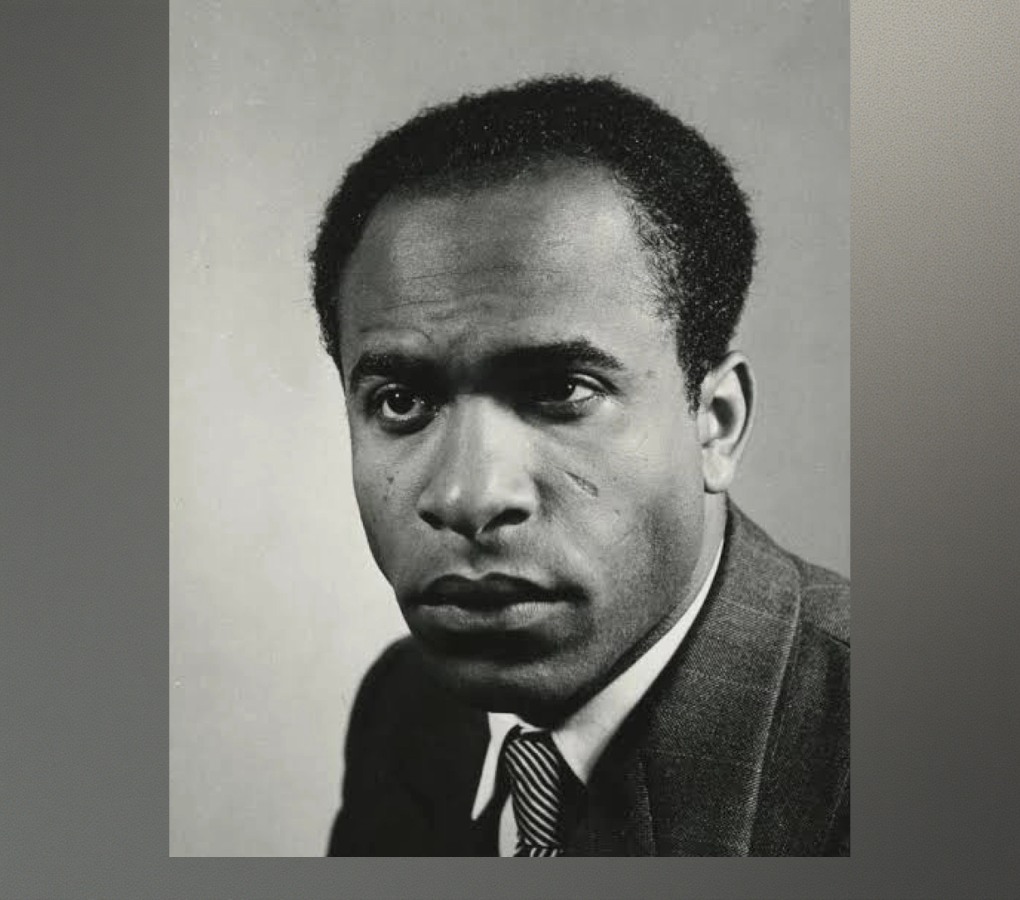
Remembering Frantz Fanon, the Unbound Revolutionary Prometheus for his Words: ‘A Black Person Strives to be a White Man but White Man Slaves to be a Human Being’
_dust_jacket.webp)
An examination of language, sexuality and capitalism questions in the Anthropocene through the lens of revolutionary consciousness in the life and literary works of Frantz Fanon.
This essay is about the dangers of self-colonization through loyalty to the colonialists’ language, racial based sexual fear as a post-colonial experience and contemporary capitalocene also known as capitalism of Anthropocene, through the eyes of Frantz Fanon. But before I delve into the depth of the theme, I wish to observe that the last century was an epoch of great thinking in Africa and beyond. Especially in the area of thought and action needed for liberation. It was the century that blessed the world with liberation thought giants in the likes of; Antonio Gramsci, Mao Tse Tung, V.S. Naipaul, Derek Walcott, Jewarlal Nehru, Che que Vera, Pablo Neruda, Aimé Césaire, Richard Wright, Kwame Nkurumah, Julius Nyerere, James Baldwin, Amilcar Cabral, Walter Rodney, Andimba Toyivo ya Toyivo, Nelson Mandela, Elijah Masinde of Dini ya Musambwa, Paulo Freire, Fidel Castro, C. L. R James, Leon Trotsky, Spivak Gayatri, Edward Said, Samir Amin, Sam Moyo, and above all else Frantz Omar Fanon. Perhaps, some amount of musing space can make one to aver that it was a century of nature, culture and writing in the global revolutionary space as it was observed in the Grammatology of Derrida in an English translation by Spivak Gayatri.
Specifically, I admire Frantz Fanon for his thoughts and actions, a phenomenon I want to call Fanonian revolutionary Praxis. Fanon’s actions of revolutionary commitment are historically evident in his self-less participation in the Algerian war of liberation. The thoughts are palpably spread in his speeches and books. Fanon’s books are powerful literary instruments of revolutionary communication. They range from; Black Skin, White Masks, Wretched of the Earth, Dying Colonialism, Facts of Blackness, Towards African Revolution, and finally A Letter to French Man (Fanon’s letter of resignation from formal employment as a psychiatrist at the government hospital). Personally, I admire Fanon more for writing Black Skin, White Masks, and also the Letter to A Frenchman, the two books in which Fanon displayed unmatched iconoclastic literary-cum-philosophical prowess necessary for building revolutionary consciousness needed for human liberation across ages, geographies and diversities.
Fanon wrote Black Skin, White Masks when he was only at the age of twenty-five years. The Black Skin, White Masks, was written as a research thesis for Bachelor degree requirements but it was rejected by the professor on the basis of arguments that it had no value in terms of academic knowledge. Two years later the Black Skin, White Masks was published as a book only to become a universal spell-binder and a compulsory read for any serious education in both natural sciences and social sciences.
Fanon on Black Persons and Language
In the Black Skin, White Masks, there are chapters on the Negro and Language, Psychopathology of the Negro as a colonial victim, Facts of Blackness, and the way of conclusion all of them crystalizing into a forceful literary communication on the colonial experience of black persons regarding language, psychology of fear and capitalism of Anthropocene. In the chapter on the Negro and the Language, Fanon argued directly and by connotation that mastery of the colonizer’s language is a situation of self-colonization propagated by colonial syndrome that has made a black person admire being like a white person and a white person slaving to be a human being. An observation that has persisted till now in the praxis or empirical evidence in the post-colonial syndrome of self-organization that was recently observed in Africa when selecting the new head of African Union. An episode I want to explain in detail.
Imagine, it is clear that all European political leaders for all generations have never been influenced by African languages whenever they are choosing the chairperson of the European Union (EU). All European citizens and political leaders are usually influenced by their domestic and geopolitical parameters as well as locally informed social-technological issues that have consequences on European strengths in global relations whenever it comes to choosing a new chairperson of the European Union or making any other Pan-European governance decision. However, there is a very shameful post-colonially instigated contrast to the above domestic ownership of Pan-European governance process recurrently observable in Africa. It is saddening that for every other time, overt cosmetic loyalty to European languages among African communities influences fundamental decisions about governance of Pan-African Institutions. Just as once faulted by Ali A. Mazrui in the observation that Africa discusses useless things in their mother tongue but important things in exotic languages, especially the European languages. And hence, very important decisions ranging from choices about technology, governance, policy and development in Africa are discussed in foreign languages. The psychological reason behind this is what Fanon called self-colonization through the death of the native language and imposition of the colonizer’s language. This is also an issue that has been identified as negative Post-Coloniality by several social thinkers, including Mazizi Kunene, Grace Ogot, Okot B'Pitek and Alamin Mazrui. Thus, in light of Fanon’s intellectual position, those of us who subscribe to revolutionary consciousness are all challenged to deeply engage with the voice of Frantz Fanon and, in the style of Thomas Carlyle, to shout a resounding “NO!” to the post-colonial syndrome of self-colonialism through self-enslavement to colonialists’ language. It is a social weakness that African leaders must not allow to persist.
More poignant was the experience where African states were in the process of choosing the chairperson for African Union Commission through expected state votes by the qualified African states in February 2025. Just some months before the elections were to be held in Ethiopia, experts on regional diplomacy and international relations reported in the pages of the East African and the African Report (the two main political weekly newspapers in Africa) showing that already African states had indicated that they were going to vote as linguistic blocs based on European languages and other voting blocs based on non-African heritages.
Both the East African and the African Report averred that the voting blocs were to be the African English-speaking bloc in Eastern, Southern, and Western Africa; the African French-speaking bloc from central Africa, the horn of Africa, North and Western Africa; the Portuguese-speaking bloc in South west Africa and then the Arabic-speaking bloc in North and the Horn of Africa.
The main reason behind the emergence of all these voting blocs is that the two main competitors for the African Union Commission chairperson position came from different colonial language blocs. Raila Odinga, a Kenyan and hence by connotation came from the English-speaking bloc, whereas Mahmoud Ali Youssouf came from Djibouti, an Islamic state that uses French and Arabic as the main languages. This means that Youssouf Ali had three cultural heritages: Islamic religious heritage, French linguistic heritage and Arabic linguistic heritage. Youssouf Ali was a post-colonial cultural contrast to Raila Odinga in the sense that Raila only had English linguistic heritage without noticeable religious identity, but Youssouf Ali had strong identity harvested from his three exotic triple identities of Islamic Identity, Francophone Identity and Strong Arabic Identity. The African Report also presented an expert analysis which indicated that English-speaking countries are already angling to vote for Raila Odinga, but the Arabic and French-speaking as well as Islam professing countries were earmarking themselves for Youssouf Ali.
Interestingly, English, Portuguese, French and Arabic are not African languages. Similarly, Christianity and Islam are Abrahamic heritages; they are not indigenous African religious heritages. A point at which any person conscious about Africa’s cultural image can pause and ask; What is Africa? What is Pan-Africanism? Does Pan – African governance make any sense if indigenous linguistic cultures of Africa don’t have any significant impact on critical decisions? How comes indigeneity determines governance of Pan-Europeanism, but exoticism determines governance of pan-Africanism?
Good answers to the above questions can help in guiding our decisions about governance of Pan–African institutions. However, responsible thinking and choices about governance of Pan-African institutions should not be manipulated based on exotic heritages like Islam, Christianity, Arabic or European languages. Instead Pan-African governance decisions need to be influenced by effectiveness in candidate’s due diligence about intergovernmental policy leadership; effective ideology; candidate’s mettle in formulation and implementation of effective policy on indigenous knowledge systems; candidate’s prowess in policy and strategy leadership in relation to diffusion of science and technology; a knack in planning as well as managing economic development; candidate’s intellectual qualification in leadership of geo-political strategy in relation to security, manufacturing, mining, energy economy, ecology, penetration of global markets, and as well as effectiveness in policy leadership about social protection of the powerless through gender and minority mainstreaming.
It is a critical mistake for any African to fail to appreciate the values inherent in any good policy because it is communicated in French, yet he or she is an African who speaks English. For example, it can be deeply fallacious for the English-speaking Africans to refuse to appreciate policy positions informed by the research conducted by Cheikh Anta Diop on the basis that Diop was a French-speaking Senegalese. The same analogy applies to any French-speaking African who fails to see economic logic in the Dead Aid because it was written in English by the Anglophonic Dambisa Moyo. More importantly, Frantz Fanon would have dismissed the above behavior by modern leaders of Africa as pitfalls of cosmetic nationalism by pointing out that in any situation, African revolutionary consciousness must be allowed to illuminate and direct critical choices about governance of pan-African Institutions, but not continued overt displaying of self-colonization and self-enslavement to oppressor’s language.
Fanon on Colonially Instigated Fear and the Eroticization of Blackness
In the same Black Skin, White Masks, Fanon discoursed in depth the question of colonially instigated fear among the colonized and post-colonized people. Here, I will comment on Fanon’s logical value in dealing with the psychology of fear among the post-colonies by using an example from the current world of sports and athletics in the phenomenology of Usain Bolt. For decades the son of Jamaica, Usain Bolt shined as an athletic phenomenon. He shone with stellar performance in Olympiad running, football, dancing and general self-confidence in athletics. But when the 2016 Olympics were about to end, a substantial portion of the Western Media houses carried pejorative news in the form of a story about Usain Bolt. The Daily Mail, The Telegraph, The International Business Times, The Mirror, The Sun, and The New York Times just but to mention a few, were circulating this destructive story about Usain Bolt in the same measure and dint; these media houses had to spread the news through all their outlets of print, digital and You-Tube media platforms. The story was that Usain Bolt, the three times medalist of short races, was seen at a Night Club in Rio de Janeiro twerking with un identified black woman and then some few hours later at 7 am, by the local time in Rio, Bolt was filmed naked in the bed with a 20 years old white student.
The name of the white student was Jardy Duarte. One of the Papers also commented that Jardy was a widow, having been a wife to the late drug lord. The news was trending in social media like a bush fire in the harmattan wind. The main concern of all these Papers was not the black woman who was seen twerking with Bolt, but the concern was on the exclusive moral implications of how Bolt was in bed with the white student. It made some of us with literary minds to muse within ourselves: whose mistake was it? It was not the mistake of Usain Bolt to sleep with a white student in Rio. A question that can also take us to Chapter Three of Black Skin, White Masks, dealing with the question of The Man of Color and The White Woman, in which Fanon observes that:
“There is one expression that through time has become singularly eroticized: the black athlete. There is something in the mere idea, one young woman confided to me, that makes the heart skip a beat. A prostitute told me that in her early days the mere thought of going to bed with a Negro brought on an orgasm. She went in search of Negroes and never asked them for money. But, she added, going to bed with them was no more remarkable…”
Thus, any correct social thinking and media objectivity, was out-rightly supposed to look at Usain Bolt as a young person at the age of thirty years, as it also considers the age of the white girl being at twenty. These were sexually hyper-active ages. The critics were also supposed to understand the fact that the social, physical and economic station of Bolt at that time had the effect of attracting almost all sexually active women and male homosexuals, not only Jardy Duarte. Bolt’s fame, biceps, physical stamina, crude face and athletic agility was fit enough to blend into extra-masculine qualities that forcefully poised him as a center of sexual attraction.
Literary and psychological analyses of the situation would easily help us to point out Fanon’s observations and premises that there would have also been the possibility of fear on both sides. Fear of losing sexual opportunity with a white girl on the side of Bolt and fear of losing sexual chance that will lead to fame, money and even maximum sensual satisfaction on the side of Jardy Duarte. This is only one of the premises on which floats Bolt’s phenomenal, disruptive illumination of the age-old psychology of the colonizers and enslavers on the generations of black people that came from the formerly enslaved and colonized. But, some bit of deep delving into this traditionally held social dis-logic would give us many and diverse understandings of Bolt as a symbol of anti-thesis to the race as an ideology of exploitation.
Some research and reading of European classical Literature shows that European literature just like any other open-minded literary civilization has a lot of stories that can work for us as useful benchmarks on which we can base our way of looking at Usain Bolt. For example, Greek literature has already taught mankind that great conquerors are cheaply conquered. Homer, Euripides, Shakespeare and Cervantes have narrated testimonies about psycho-neurotic limitations of military heroes and other journeymen of different capacities. Was it not Odyssey the killer of the Cyclopes and all other enemies of Athens who became cheaply held hostage by the sexually elusive Calypso? Was it not the mighty warrior Aphrodite who was held captive by the beauty of Sappho on the island of Lesbos? What about Napoleon and Josephine, Antony and Cleopatra, or even Diana and Afawyed? Wisdom of the moment was to have only one lesson for us; even the wise and the mighty bent but out of fear when subjected to force of love. Lynden Orr in his book, Famous Affinities notes that Karl Marx with his vintage intellectual brilliance dropped out of the University in the second year to pursue love with Jenny Westphalia, a girl older than him. Achebe presented the theme of conquerors being cheaply counter-conquered by charm and mental fettering that go with love in his No Longer at Ease love episode between Isaac Obi Okonkwo and an Osu girl. It was a type of love which the elders of Igbo community held in open distaste.
The usual vice in this situation is concealed venom in the heart of a woman. Sappho a lesbian poet, had her malicious intention for holding Aphrodite in romantic captivity, the same thing to Calypso’s impairment of Odyssey’s military judgment, as did Delilah with Samson. By logic of extension, we have to enjoy all latitude in coming up with an analogy that this must be the same venom that was seen in the quick penetrative love between Usain Bolt and Jardy Duarte.
Some of the papers listed above hinted that maybe Jardy Duarte was a sex worker. May be yes or no, but under normal circumstances, a sex-worker or any woman in bed willfully making love to a man of whatsoever fame cannot take a selfie to share it on the social media platforms like Instagram, Facebook, WhatsApp and so forth for the conventional media houses to use against the man in question. Any female sex worker can only do this when she is directed by superior forces in terms of politics, ideology, diplomacy or conflictive racial relations. She does as a spy, a mouchard, or as a social stunt to induce one into an act of self-deprecation or a mistake so that one can fall into a compromised social position in the society. Such persons are known as agent provocateurs in the argot of politics and literature. However, the baseline is that all these happen out of fear not love.
The story of Usain Bolt, a black man and Jardy Duarte, a white woman reminds me of Mike Tyson and how he used to be regularly imprisoned. He was often accused of rape, in fact raping a white woman inside a hotel room in which they have entered together as lovers in arms. This is how the white world employed the tricks of racism to bring Tyson down from stardom of boxing. It is usually out of fitful reasonless fear for the black skin, black muscles, black penis, black people and several other types of fears that make a white man go psychopathological in such situations. Thus, Bolt’s athletic superiority does not generate a single, universal emotional response. While many regard him with admiration and love, others react with resentment, fear, or racialized hostility, sometimes escalating into chaotic and disproportionate emotional outbursts. This is so given the apparent social reality that Rio is not only the city of athletics; it is also the city of literature, politics, music, commerce as well as intense racial conflict between the Brazilian white and Blacks.
Such experiences like the one of Usain Bolt and the white student is the best literary moment to remember Richard Nathaniel Wright for his literary brilliance and the manner in which he structured his book The Native Son into three parts as fear, flight and tragedy. A simple analogy will give us a picture of Usain Bolt as Bigger Thomas, Duarte is a white girl killed by Bigger Thomas, which made Bigger Thomas to be tried for murder and later on hanged on charges that let to capital punishment, while the un-identified black woman that was twerking with Usain Bolt at a club is a simulacrum of the black girlfriend also murdered by Bigger Thomas, however, the white judicial system in America of that time did not prosecute Bigger Thomas for murdering a black woman because black lives never mattered by then.
African and Caribbean literature as any other liberal literature is full of stories about fear as a driving engine behind antagonistic racial relations between black men and white- or red-men. Thomas Clarkson attributes cruel treatment of the black slaves by white slave-masters to fear among the white slave-drivers. They feared the uprising by the black slaves. Hence the pre-emptive violence on the emaciated and emasculated black slaves packaged as cargoes on the slave ships.
It is also a perspective of inter-racial fear that catapulted a French woman beyond her sense of right and wrong to maliciously purloin Sembene Ouasman’s manuscript of God’s Bits of Wood for no other reason but racial based fear. Fortunately, the manuscript was recovered in time and then presented to the publisher.
Similarly, Doris Lessing in her Grass is Singing beautifully presented the ugly side of anarcho-capitalism as perpetrated by the colonial culture in South Africa and how it generated fear that was expressed as themes of extra-marital sex between the female white masters and male black subjects. This is also the theme that is tactfully discussed by David Maillu in the Broken Drum as an overtone of gross and base civilization inherent in the political culture of colonialism.
More professionally, Frantz Fanon in The Black Skins, White Masks employed tools of psychology to give a very informative discourse on fear as a psychological condition produced by inter-racial relations between black and white. Fanon discusses how colonialism affects sexual desire and imagination, noting that some black men may fantasize about sexual relations with white women. Similarly, among white women, very strong sexual anxieties emerge whenever they think of black men. In fact, Fanon observed that, white women expect more from an experience of going to bed with a Blackman. Fanon goes ahead to point out that Whiteman’s hatred of Blackman is an expression of fear based on this self-defeating mentality among the white women often expressed as a neurotic fit for sexual craving for black men. It is a common fear among the members of the White American and white European communities that the Jews will take away our money as the blacks take away our women. And hence the political culture of racial exclusion among the communities of North America and Europe.
Social eventualities of white women chasing black men are very many in history, just as poetically recounted by Mbela Sone Dipoko in the Black and White in Love. Social history of relations between black people and white people is nothing else other than a palpable repertoire of practical cases of emotional and rational readiness among white women for sexual pairing with black-men and vis-à-vis, only that irrational fear among the patriarchy in the white culture has never given the white daughters gender freedom to make sexual choices out of their own volition. This is one of the social forces that lead to commonplace social vices like fear and hatred of a black person based on the color of the skin.
It is this kind of fear that also guides the overt behavior of reactionary Western comments about Africa and the Caribbean world in any eventuality of the Anthropocene challenge.
Fear and Blaming of Black People in the Anthropocene
The Western world has openly blamed black people in the Caribbean and Africa for failing to behave correctly to avoid HIV infection. In the Masque of Africa, V.S. Naipaul blamed black Africans for wishfully contracting Ebola virus through eating fruit bats. Understandably, V. S. Naipaul was writing but on the budget funded by Bourgeois Capital in the Western World and hence his word was as good as the Western position on Ebola in Africa, this is also the kind of narrative the Western Powers held as Africa and the Caribbean world was languishing under the yoke of HIV.
The Western world blamed Africa for widow inheritance, multiple sexual partners and many other kinds of accusations to stigmatize Africa and the Caribbean as the HIV positive geographies. When Covid-19 broke out, some Western scientists predicted with a lot of confidence that the outbreak had come to finish Africans in Africa and in the Caribbean world. This prediction was not made on the basis of facts but out of disguised fear. Regular observation of the Western institutions and professionals soothsaying of mass deaths in Africa in case of a pandemic is only driven by shame, sense of guilty, sadism, ignorance, professional dilettantism and traditional pedantry that always accompany fear-based, racially induced bourgeoisie intellectualism, especially when the Afro-Caribbean welfare question is under discussion. Basically, the correct approach is to look at any pandemic as a universal challenge. In case of any Anthropocene caused pandemic in Africa we will always have both the victims in Africa and racism fueled sadists in Europe and America to be equally buckled, given the dialectic logic that oppression frustrates both the oppressor and the oppressed.
It is this psycho-culture of ontogenic, biogenic and sociogenic fear, as Fanon would put it, that also permeated the structures of World Health Organization to be tempted into its tradition of humiliating Afro-Caribbean by justifying the prediction that Africa is going to have its people die in millions when COVID-19 is at its peak in the region. Yes, it is on record that the Afro-Caribbean world has always been left in the lurch to undergo the shameful experience of mass deaths from HIV, Ebola, Cancer, Malaria, Snake-bites and the outbreaks of diseases of the digestive system. Africa has been abandoned to such medical related calamities in spite of huge riches, capital and technological resources being idle in America, Europe and in the custody of most of the Western funded inter-governmental organizations. Throughout the previous decades of tyranny of HIV and Ebola virus, Afro-Caribbean countries were reduced to defenseless borrowers of medical services from the Western World. Africa and Caribbean islands became a market for medical supplies by the scientifically developed economies under the clear bite of vaccine Apartheid. So, when COVID-19 emerged, those who were addicted to seeing Africa and the Caribbean Islands in shame did not wait to predict that obviously, Africa and the Caribbean Islands were to be the victims.
Giving a current touch to this question is the public conversation about fear as the mental force that inspires development of the artificial Anthropocene. The Monthly Review characterizes Anthropocene as, “when human beings are carrying in their bodies death causing viruses in their bodies so that they transfer or spread those viruses to the fellow human beings they interact with.” The transfer of virus can be intentional or unintentional, the origin of the virus can be from nature, or through the hand of a man with arsenal-like intentions, or through the hand of man as an act of inadvertence. Thus, the concept of Anthropocene is when human beings carry death-causing viruses in their bodies. A HIV positive person is an example of Anthropocene, same to the Ebola positive and Covid-19 positive persons. The same Monthly Review argued that Anthropocene are created by bourgeoisie scientists in service to patrimonial capitalism. Unfortunately, the current commercial world is only made up of patrimonial capitalists and the current world of science is made up of bourgeoisie scientists. This is a clear denotation that there is currently no moral obligation among Bourgeois scientists to resist the temptation to create the Anthropocene. What is going to happen can easily be predicted as a nationalized race for manufacture of superior Anthropocene between the bourgeoisie nations in the style of the armament race that preceded the Second World War. If Frantz Fanon were alive today, what would he have said about Fear and Anthropocene? It is a question we can answer by only reading or re-reading Frantz Fanon the revolutionary Prometheus unbound in Black Skin, White Masks. This is one book that would have made Karl Marx nickname Frantz Fanon a knight of noble consciousness.
By-Alexander Opicho is a corporate Trainer and Capacity Building Facilitator in Project Leadership, Resources Mobilization, Monitoring and Evaluation at RCMRD, Nairobi, Kenya.
List of References
The Monthly Review. Capitalism in the Anthropocene on 23rd August 2022
Fanon, F: Black Skin, White Masks
Wright, R: The Native Son
Derrida, J: The Grammatology
Orr, L: Famous Affinities of the World
Marx, K: A Knight of Noble Consciousness
The East African on 15 February 2025
The African Report For January 2025
The Daily Mail on 22nd August 2016
The Telegraph on 22nd August 2016
The International Business Times on 22nd August 2016
, The Mirror on 22nd August 2016
The Sun on 22nd August 2016
The New York Times on 22nd August 2016
The New York Post on 1st November 2016