


The People’s Summit for Korea: Korea’s Struggle in the Global Fight Against Imperialism
Highlights of the organising that has been underway for the unification of the Korean peninsula.
The Korean Struggle: Historical Context and Resistance
For decades, US imperialism has blocked Korea’s path to peace, reunification, and self-determination. After World War II, while Koreans celebrated the end of Japanese colonial rule, the US drew a border at the 38th parallel without any Korean input.[1] Just weeks later, the US military arrived to assert control over the southern half of the peninsula.
Koreans had started to organize People’s Committees, local organizations distributed resources and maintained order, which also served as the foundation for an independent Korean state. But rather than recognizing Korean sovereignty, the US military occupation outlawed and repressed these committees, repurposed Japanese colonial police and military infrastructure, and installed a right-wing regime that violently suppressed the Korean people.[2] By forcibly dividing the peninsula and embedding militarization, the US set the stage for the Korean War and created conditions for its permanent military presence that continues to fuel conflict in the region.
In the decades that followed, US sanctions, military escalation, and political interference constrained the Korean people’s ability to chart their own future. Yet resistance continued across generations: from anti-colonial fighters during Japanese rule to student organizers, labor unions, and diaspora communities who struggled for sovereignty and reunification. The struggle for Korea’s national liberation remains a long-standing and ongoing tradition.
The People’s Summit for Korea: Towards National Liberation
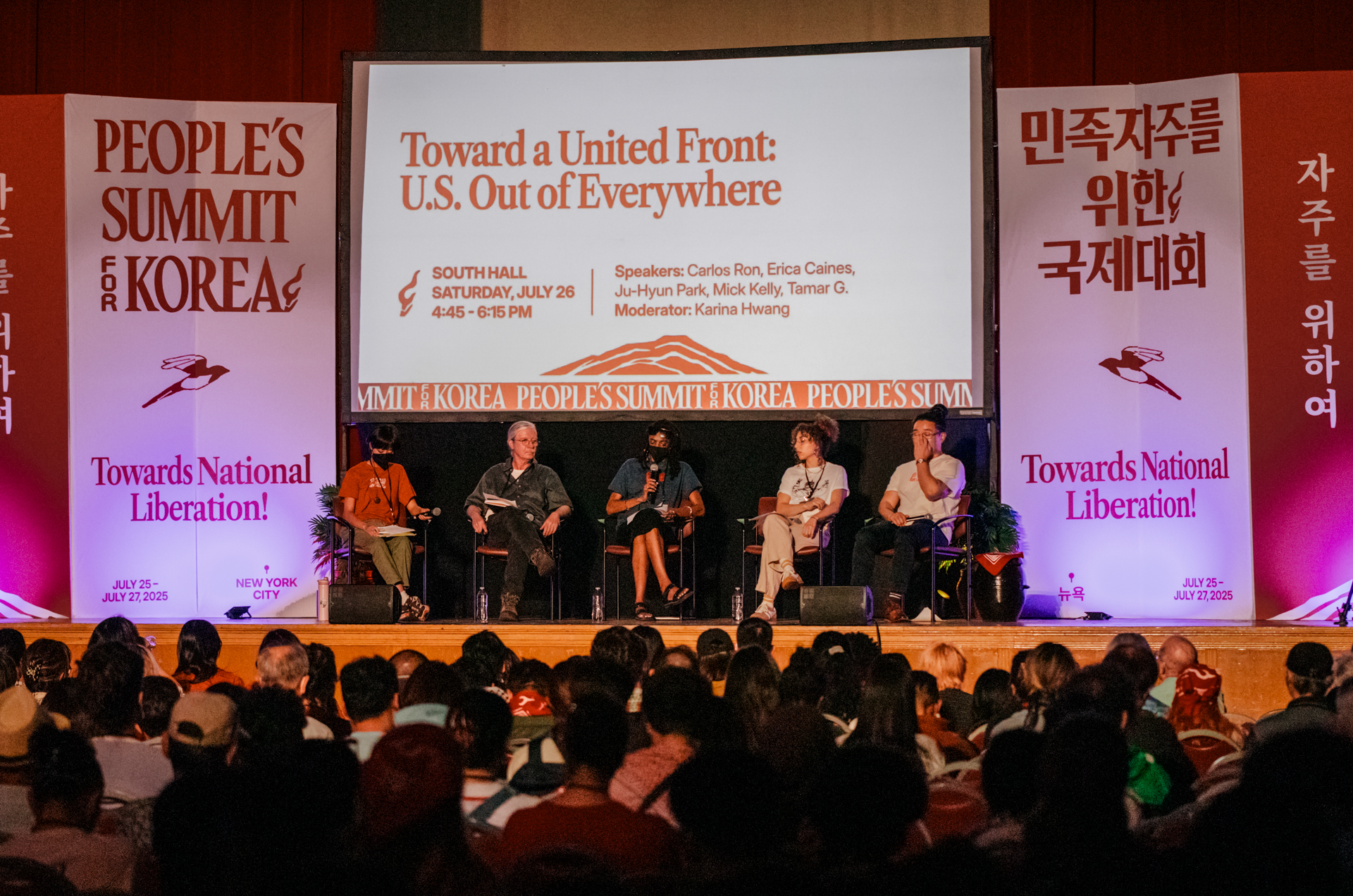
This historical context underpinned the People’s Summit for Korea, held from July 25 to July 27, 2025, in New York City under the theme Towards National Liberation. Convened by Nodutdol for Korean Community Development alongside a coalition of nine other organizations from the Korea solidarity and broader anti-war movement in the US; the summit brought together activists, scholars, students, and organizers across the US and South Korea to analyze, strategize, and mobilize for Korea’s national liberation.[3]
The first two days took place at Riverside Church, a historic site of peace and justice, where Martin Luther King Jr. delivered his 1967 “Beyond Vietnam” speech, linking struggles for justice at home with anti-imperialist movements abroad.[4] Building on that legacy, the summit featured panels, workshops, and cultural performances – including traditional Korean drumming (pungmul) and singing of movement songs honoring martyrs. The programming explored the ongoing impact of US imperialism in Korea, as well as the resistance against this repression. From start to finish, the event framed Korea’s national liberation not only as a struggle for Koreans, but as a call to action for all progressive and anti-imperialist forces worldwide.
Strategizing Liberation: Summit Discussions and Rally
The summit connected Korea’s struggle to global anti-imperialist movements, emphasizing that US imperialism operates in a coordinated way. In the panel “Solidarity and Sovereignty: Anti-Imperialism in the Indo-Pacific,” speakers highlighted US military operations in Korea, in the Philippines, and in Hawaii as instruments of regional dominance targeting China and enforcing global imperialism.[5] Kawena’ulaokala Kapahua from Hawaii explained that the US Indo-Pacific Command (INDOPACOM) is headquartered on the islands, making them a strategic hub for the US empire. Ella Delgado of BAYAN USA detailed how US bases in the Philippines are used to project military power across Asia. Speakers linked these operations to the summit’s central demand: “US Out of Korea, US Out of Everywhere,” highlighting the importance of standing in solidarity across struggles for national sovereignty.
The panel “Towards a United Front: US Out of Everywhere” expanded the perspective, connecting Korea’s struggle to oppression in Africa, Palestine, and other regions under US imperialism.[6] Erica Caines of the Black Alliance for Peace explained that AFRICOM and INDOPACOM enforce global domination, with companies like Lockheed Martin and Raytheon profiting from conflict. She stated: “The same system that murders Africans in the US and on the continent with impunity threatens Korea with nuclear drills.”
Caines further argued that mass incarceration in the US and Korea’s forced partition operate as parallel mechanisms to fracture collective power, showing how African liberation and Korean reunification are intertwined struggles against the same imperial system. Africa’s resources and Korea’s strategic position as a wedge against China are exploited to maintain Western capitalist domination, underscoring the global stakes of these anti-imperialist fights.
Workshops further reinforced these lessons. In “Surviving Sanctions: Resisting the Imperialist Agenda,” participants examined how nations like North Korea, Iran, and Zimbabwe endure the harsh effects of US-imposed sanctions while sustaining their populations and demonstrating resilience under imperialist pressure. The workshop highlighted the direct human consequences of economic coercion and the importance of building transnational solidarity.
The summit culminated in a public demonstration in Times Square under the banner “Armistice Then, Liberation Now,” with thousands of participants joining the action.[7] Held on the 77th anniversary of the signing of the Korean Armistice – a ceasefire agreement that ended active fighting in the Korean War without a formal peace treaty – the rally underscored that Korea remains divided, occupied, and under threat of renewed war. Participants chanted “US Out of Korea!” and connected the demand to broader anti-imperialist campaigns, as well as calls to redirect US war spending toward infrastructure and social services. The rally made clear that liberation is not abstract but a tangible goal, linking the summit’s panels, workshops, and strategy sessions directly to public action.
Conclusion: Organizing for Liberation
Korea’s division and militarization are not historical accidents—they result from decades of US intervention. The US continues to occupy South Korea, maintaining tens of thousands of troops and dozens of bases, while nearly daily joint military exercises and nuclear drills heighten the risk of war.
The People’s Summit for Korea revealed how anti-imperialist struggle must operate on multiple fronts simultaneously. By connecting the occupation of Korea to US imperialism in Africa, the Philippines, Palestine, and beyond, panels highlighted the systemic and global nature of the empire. Workshops demonstrated that even under sanctions and economic pressure, countries can resist and sustain their people, offering strategic lessons for organizing and solidarity worldwide. The Times Square rally transformed these analyses into collective action, showing that public mobilization enacts the principles of resistance and international solidarity discussed throughout the summit.
By linking historical oppression with contemporary struggle, the summit underscored that liberation is neither abstract nor inevitable. It is achieved through sustained collective resistance, strategic coordination, and principled international solidarity.
Towards National Liberation!
US Out of Korea, US Out of Africa, US Out of Everywhere!
Jia Hong is a member of Nodutdol for Korean Community Development.
Endnotes
[1]https://www.nationalgeographic.com/science/article/130805-korean-war-dmz-armistice-38-parallel-geography
[3] The other convening organizations include Koreans for Anti-Imperialism and Sovereignty, Korea Peace Now Grassroots Network, Koreans 4 Decolonization, Korea Policy Institute, the People’s Forum, ANSWER Coalition, the Anti-War Action Network, Dissenters, and the United National Anti-War Coalition. https://peoplessummitforkorea.org/partners