


Expropriation Without Compensation: Deception By the Ruling Elite In South Africa
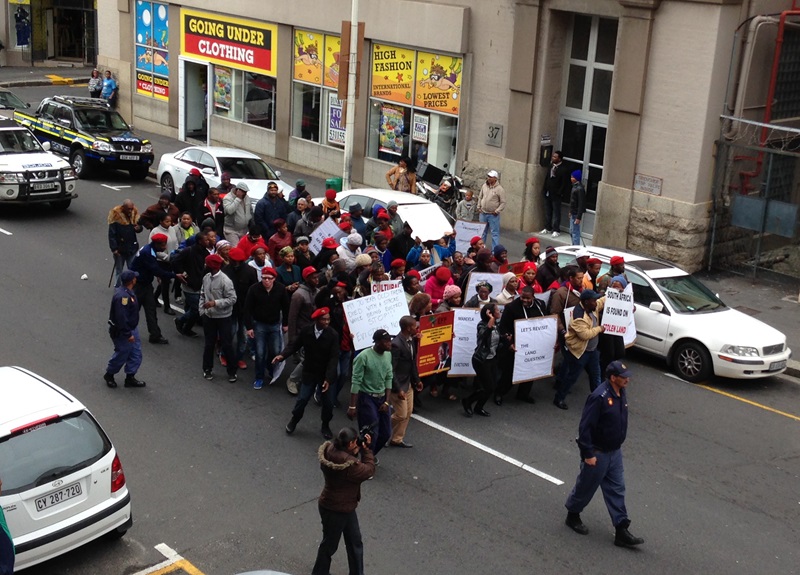

Land reform in South Africa remains a major challenge for the post-apartheid state. Letsoalo explores the various attempts, deceptions and elitist interests that frustrate policy framing and implementation beneficial to dispossessed South Africans.
There are many reasons why the subject under focus in this paper is both difficult and painful. Whereas it is not known how the participants in the drafting of the Property Clause, Section 25 of the Constitution, were selected, it is common knowledge that various senior members of the judiciary and the African National Congress have boastfully claimed that role. But, let it not be forgotten that this clause mirrors the Property Clause of Kenya, drafted and imposed by the British in the 1960s.
There is no doubt that the Property Clause in South Africa’s 1996 Constitution provided for compensation for land in the hands of the colonial settlers. Compensation is one thread that runs among former British colonies. Notable examples of ‘negotiated’ controversial Property Clauses include Kenya, Zimbabwe, Namibia and South Africa. The results can only be summed up by recalling Oginga Odinga’s “Not Yet Uhuru”.
‘With or without compensation’ had been in the post-apartheid debate long before the final 1996 Constitution was adopted. As a long-term scholar of land reform, I concluded in 1994 that confiscation and compensation are the least of the problems that will be faced in the redistribution of land by the future majority government. One issue that will have to be resolved is how to transfer the land to the landless majority population, that is, what social production relations would be chosen by the people.
By 1996, I concluded that the negotiated political settlement in South Africa precluded any confiscation of land, but that this was no excuse for the provision that on expropriation, compensation shall be at the market value; That only land rights lost after 1913 shall be restored; and that beneficiaries of land reform shall buy land from the state and private owners.
In 1995, the then Minister of Land Affairs presided over the landmark National Conference on Land Policy. The venue was the World Trade Centre in Kempton Park, the same venue for the Convention for a Democratic South Africa (CODESA) 1 in 1991. The significance of the conference was the participation of the landless majority. Their representatives eloquently articulated their fears and expectations. The report of the conference spelt out their reasons for the scrapping of the Property Clause in the Interim Constitution; The Terms of Land Expropriation for Land Reform; No Compensation for the white landowners; and No payment for land by the beneficiaries of land reform.
Needless to say, the above resolutions were predictably not taken seriously. In 1996 the government not only endorsed the Property Clause to Compensate white people for land ‘fairly and justifiably’, but also to have a 1913 cut-off date for restitution. Thus, only about four million people who formed the victims of forced removals qualified for restitution. All of us South Africans who were victims of military and legal dispossession were excluded.
To date, the African National Congress (ANC) maintains that the Party is not about revenge, but about reconciliation. This lends credence to the secret deals that were made between the liberation movement, capital and the apartheid government as revealed by Prof Sampie Terreblanche. Reconciliation with the whites has proved to be at the expense of the dispossessed majority. Only the whites and the few black middle class have benefitted. However, the call for the Property Clause to be scrapped, especially the compensation and the 1913 cut-off date, continues to be made at every opportunity.
The less frequently stated fact is that the so-called beneficiaries of land reform have to purchase the land from their former colonisers. Yes, the compensation for whites is paid for by blacks, with government subsidies or bank loans. This is done under the ‘Redistribution’ programme. It can be said, on authority, that the slow progress of land reform is to some extent due to landowners insisting on even more than the market value for land.
The government kept having Land Summits, 2005 and 2014, pretending to adhere to democracy and consultations. None of the resolutions ever gets acted upon. Ultimately, the government got what it wanted when the Motlanthe Panel, established in 2016, recommended that there was no need to amend the Constitution. Few, if any, know all the outcomes of that Panel. Few, if any, have not heard that the Panel recommended that there was no need to amend the Constitution because it is not the reason why the government failed to deliver on land reform as spelt in the Property Clause. A new slogan was introduced: “Implementation is the Problem!” Key members of the Panel were academics who drafted the Land Policies.
The Land Expropriation Politics
It is important to state that the ANC last had a two-thirds majority necessary to amend the Property Clause, during the Mbeki administration. The Economic Freedom Fighters Party (EFF) managed to have a motion to amend the constitution to have Expropriation Without Compensation (EWC) passed by Parliament. The African National Congress Party (ANC) grudgingly supported the motion with amendments. The Pan Africanist Congress (PAC) Party, which is known for ‘Land First and all other things will follow’, surprised some and disappointed others by not supporting EWC for the reason that there were other means to get back the land. The party leader continues to voice this position from a powerful platform as the Minister responsible for land reform in the 2024 Government of National Unity. The other Parties which voted against the motion included the Democratic Alliance and the Freedom Front Plus.
A Parliamentary Committee was established to consider oral and written submissions. The 2018/19 emotional consultations, held at about thirty-four venues across the nine Provinces, were televised. The question was whether the Constitution should be amended to introduce EWC. Let it be noted that the period between the 1995 National Land Policy Conference and 2018 meant that the participants were more than twenty years younger. The enthusiastic participation was even more bitter because of the perceived neglect by a majority black government. Unfortunately, the twenty years had also meant an increased number of the black elite, who joined the landowning class and felt threatened by EWC.
The majority of those who spoke at the public hearings supported the motion, clearly articulating their reasons, mainly the barbaric dispossession, and the continued landlessness and poverty of the majority population against the continued enrichment of the white beneficiaries of the land dispossession.
Those who opposed the motion were equally clear about the question when arguing that they could not be held responsible for the sins of their forebears, that they have bank mortgage loans and that the motion is a deviation from the ‘reconciliation’ they signed for in 1994.
The above emotional hearings were followed by conspicuous manipulations, deceptions and blatant lies. Selected written submissions were presented to the Committee. This group represented the elite middle class. Unlike the unambiguous support for no compensation by the masses, this group was disappointing in deception.
From the Labour Union, Congress of South African Trade Union (COSATU) to the predominantly former white only universities, from the Land NGOs to the Banking Institutions, from the Helen Suzman to the FW de Klerk Foundations, from the Institute of Race Relations to the Market Foundation, from the Roelf Meyer in Transformation Initiative to AgriSA, the chorus was No to the amendment of the Constitution because EWC was already provided for in the Property Clause. These, obviously not so ignorant bodies, then continued to warn that amending the Property Clause would cause foreign capital flight, food insecurity, poverty and unemployment. The same Clause that they claimed already provided for EWC.
All the above high-profile bodies could never have been expected to be on the side of the landless masses. However, even the following entities had ‘excuses’: The Southern African Bishops Conference stated that the motion was justifiable but not advisable. Then, continued to accuse the proponents of the motion as populist and sloganeering. The Foundation for Human Rights of the brothers Adv. and Prof. Ntsebeza, left one wondering. Lastly, the John L. Dube Institute’s performance moved then MP Themba Godi of the African People’s Convention Party to rhetorically ask about the “Intellectual Timidity” of African academics.
The Parliamentary process to finalise the report of the consultations can only be described as torturous. A joint Constitutional Review Committee invited what chairperson Motshekga referred to as “the best brains” to make presentations. They all opposed the motion to amend the Constitution. However, they pleaded for clarity to be made that EWC was already included in the Property Clause. The Committee’s report presented to Parliament was therefore, to amend the constitution to make EWC more explicit.
Section 25 (2b) reads: “subject to compensation....” (3) reads: “The amount, timing and manner of compensation must be just and equitable....”
It is difficult to believe that all the literate people find the above provisions not clear or explicit. Do they believe that government land reform implementers, including Adv Geoff Budlender SC, missed the clarity of these provisions? One either agrees or does not agree with “subject to compensation”. Otherwise, this is academic deception of the highest level.
A Land Dialogue Workshop by the Committee had very important issues clarified. In particular, the distinction between Property and Land, the difference between Expropriation and Confiscation, Nationalisation and State Custodianship.
At that point, the members of the Committee were more forceful in stating their positions. Dr Mulder of the ultra conservative FF PLUS enthusiastically urged the process to finalise what was clearly a defeat for the landless majority. His party had been eloquently forthright in opposing EWC. One may disagree with them, but they honestly defended their wealth. Even more eloquent, was then MP Floyd Shivambu of the ultraleft EFF, in clarifying how nationalisation was the fastest way to effect EWC. Even if one disagrees with the party, the honesty in their position is honourable.
The EFF rejected the final Bill which provided for Nil compensation. The Party maintained its position in the founding manifesto: No Compensation for Expropriation of Land and Nationalisation of Land. Without their support, the ANC could not succeed in amending the constitution to have Expropriation Without Compensation. One may add, to the relief of the Ramaphosa-led ANC.
What about the government’s role?
At the height of the calls for EWC, President Ramaphosa went into an overdrive. Firstly, in September 2018, he appointed a Presidential Advisory Panel for Land Reform and Agriculture. The Panel was not only controversial in timing but also in composition. The members were all people who did not support the amendment of the Constitution, some more overtly than the others. This was a clear attempt to divert attention from EWC to agriculture and the existing discredited land reform programmes. One more report to add to the above mentioned Motlanthe report.
In addition, the president fast tracked the long delayed 1975 Expropriation Amendment Bill. The public consultation became a platform for people to wonder why more resources and time were wasted to ask them about the EWC after they had very recently endorsed the motion. The public continued to call for No Compensation, whilst the Bill was for Just and Fair Compensation with the possibility of Nil, read zero South African Rand. This is not just semantics, as it became clear later.
The Bill was passed in Parliament by a simple majority and signed into Law by the president in January 2025. Even before the ink was dry, the ultra conservative AfriForum and Solidarity went to the USA and had hearings in the White House. The two organisations together with the conservative DA, FF PLUS, Institute of Race Relations and AgriSA, all called out Ramaphosa for betraying the GNU partners by enforcing the ANC transformative policies unilaterally. They argued that Nil compensation was a way of deceptively bringing No or Without Compensation through the back door. The DA also rushed to the USA arguably to plead for leniency and to mend relations between Pretoria and Washington.
Echoing President Trump and his South African born MAGA supporters, the international media, the Guardian and BBC spread the disinformation and condemnation of South Africa for the Confiscation or Seizure of white owned land. Yes, this is hyperbolic. However, the truth is that Ramaphosa’s Deception about Nil Compensation has come back to haunt him and South Africa. As indicated above, the ANC and ‘land experts’ sought to deceive the land hungry black majority by saying that Nil compensation is equal to Without Compensation. Government hailed the Expropriation Amendment Act as a landmark transformative legislation to unlock land reform. Now that Trump and even Putin accused South Africa of racism, there are loud voices to say that the legislation is not punitive and will not take away white owned land; That in very rare circumstances will Nil compensation apply; That the affected land will (ridiculously) include state land; and That the landowners will be able to approach the Courts.
The people who were deceived have few voices in high places to call the government out, but only the opposition Parties, namely The African Transformation Movement, EFF and MK. A lone academic, Dr Metji Makgoba has passionately indicated that the DA is capitalising on the lie started by the ANC that the 2025 Expropriation Amendment Act is transformative.
Regrettably, after the international attention drawn by the cheap politicking, it will take a long time before the momentum of the 2018 calls for the amendment of the Property Clause, to effect a meaningful Equal Land Redistribution in South Africa, is regained.
Essy Letsoalo is a former Senior Official of the Government of South Africa. She implemented the Property Clause between 1995 and 2010. She is the author of Land Reform in South Africa: A Black Perspective, Published in 1987.
SELECTED BIBLOGRAPHY
Letsoalo, E.M. 2018: The Implementation of the Property Clause in South Africa’s Constitution: Problems and Proposals, Pambazuka News, 27 April.
Letsoalo, E.M & M.J.J. Thupana 2013: The Repeal of the Land Acts: The Challenge of Land Reform Policies in South Africa. Social Dynamics: A Journal of African Studies, 39(2): 298-307.
Letsoalo, E.M. 1996: Land Reform in Post-Apartheid South Africa: In Transition? In FAO, Rural Development International Workshop, Godollo Hungary, p.194-206.
Letsoalo, E.M. 1994: Restoration of Land: Problems and Prospects, in Maphai, V. (ed) South Africa: The Challenge of Change, SAPES Books, Harare, p.202-220.
Makgoba, M. 2025: President Ramaphosa Signs Several Bills Into Law in Quick Succession. ‘The South African Broadcasting Corporation’, Interview by Mfundo Mabalane, 28 January 2025.
Nyhontso. M. 2024: About-Turn: Land Reform Minister Nyhontso Explains Why he Aborted Pledge To Scrap Section 25 of the Constitution, Daily Maverick Interview, on the 100 Days of GNU, 10 October 2024.
Odinga, O. 1984: Not Yet Uhuru: An Autobiography, Heinemann, Nairobi.
Terblanche, S.J. 2012: Lost in Transformation: South Africa’s Search for a New Future Since 1996. KMM Review Publishing Company, Johannesburg.
The Department of Land Affairs 1995: Proceedings of the National Conference on Land Policy, Kempton Park.