


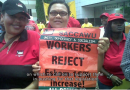
This essay explores the historical consciousness of young workers in South Africa, focusing on young black women workers. It draws on Lucaks ideas on history and class consciousness and Freirean participatory pedagogy to facilitate a critical reflection and dialogue between young Black working women on their memories and perspective of the conditions, realities and experiences of Black working women in colonial, apartheid and post-apartheid South Africa.

The crisis facing South Africa and the world today has its roots in: (1) the barbarism and injustices of market supremacism, racial supremacism and patriarchy; (2) the inadequacy of liberal democracy; (3) the excesses of commandist communism and vanguardist Marxism and (4) the failure of the dominant discourse to locate racism and patriarchy as much central to the problems we face as capitalism. The crisis can only be appropriately dealt with by appealing to the radical humanism of Socialism.
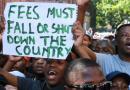
Campaigns demanding the fall of something or someone have been a feature of the South African movements scene in recent times. How far have these campaigns succeeded in articulating and achieving their agendas? The author argues that fallism represents both continuity and discontinuity of the traditions of the historic liberation movements and emergent social movements in South Africa.
We have no stereos
Droning love ballads
To lull us from our reality
The only music we
Know is the wordless symphony
Of the buzzing stars
The bright eye of the night
Candles our hope
We don’t know
Various shades
Of lamps and globes but
We know the colour
Of the moon
The only show
Our eyes can
Afford us is
The flaunt
Of the rising sun &
The display
Of the falling night...

I’m no supporter of Osama bin Laden but the assertion that his killing ‘marks the triumph against global terrorism’ is ‘laughable and absurd’, writes Mphutlane wa Bofelo. Why won’t the West recognise that it is its own disregard for the lives and worldviews of people in the Global South that fuels rage and resistance against it?
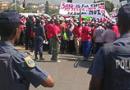
The arrest of six policemen for last week’s murder of protestor Andries Tatane is ‘a quick ploy to take attention away from the systemic factors that inform police brutality’, says Mphutlane wa Bofelo. Shouldn’t the country’s police force protect the interests of communities rather than criminalising service delivery protests?
Back to the front
No more heckling at the back
No more ranting in the dark
No more pontificating from a distance
No more writing behind the scenes…

Mphutlane wa Bofelo explores the role of the newly-established Democratic Left Front in dealing ‘creatively and proactively’ with the challenges of neo-apartheid and neoliberal capitalism in South Africa.
people of the motherland!
from now on
for the sake
of balancing
our patriotism
with our loyalty
to our art
we will ask
you to be patient…

South Africa’s President Zuma is defending the funding of political parties by business ‘on the basis that corporate citizens should invest in democracy’. But, observes Mphutlane wa Bofelo, these donations are not about supporting democracy, they are attempts to ‘cajole and capture the political establishment and the state to be beholden to and defensive’ of corporate interests.
While leader of the Democratic Alliance Helen Zille and leader of the Independent Democrats Patricia de Lille have announced that they will work together, Mphutlane wa Bofelo asks why the South African left can’t find areas of agreement instead of squabbling over differences.

Cheating in global sporting arenas such as the World Cup not only brings down the ‘beautiful game’, it also sends negative shock waves to the world’s spectators who lay witness to the prevail of deceit, writes Mphutlane wa Bofelo. The values of society will lose their gravity as notoriously deliberate offences on the field are attributed to the divine ‘hand of God’ with little or no retribution, warns Bofelo.
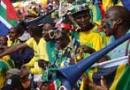
Inspired by the atmosphere both at the World Cup in South Africa and at the Cup of Cultures in Berlin, Mphutlane wa Bofelo sees ‘the possibilities for the development of national, continental and international identities, rooted in the acknowledgement and the celebration of diversity as well as the interconnectedness of humanity and the universality of human experiences.’ But, says wa Bofelo, ‘we cannot expect a one-off event like the World Cup to work like a magic wand and spontaneously heal the divisions and tensions of the past and the present.
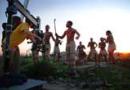
Not only did the Soweto uprising mark a radical shift in consciousness, it also sparked a renaissance in black South African cultural creativity, writes Mphutlane wa Bofelo. While in the 80s and 90s, ‘literature, theatre and the arts were an integral part of political work and writers and artists were visible and audible in political spaces and platforms’, argues Bofelo, today the arts ‘have been marginalised’ by the ‘pop culture which is utilised by the political establishment to de-politicise the masses’. But there are encouraging signs that radical underground artists are finding ways to keep the arts, theatre and music of revolution alive.

The recent murder of Eugene Terreblanche, founder of the white supremacist Afrikaner Resistance Movement, should have focused the attention of the world on the exploitative, oppressive and de-humanising conditions of the landless peasants and farm workers in South Africa, writes Mphutlane wa Bofelo. But it’s easier for the country’s elites to blame racism alone for the incident than to acknowledge the historic links between race and class dynamics and to tackle the disparities that these have created, he concludes.

Muslims who condemn women’s rights and gender equity often ignore the validity and legitimacy of the many issues feminism addresses, even though a number of the causes are compatible with the Islamic call towards justice for all, writes Mphutlane wa Bofelo. The usual message from the pulpit is that ‘Islam provides rights to women, but it is men who dispense these rights’, says wa Bofelo. It seems, however, that for many males ‘modesty and chastity has little to do with God and the integrity of the individual but a lot to do with controlling women’s body, voice and movement’.

Freedom songs ‘speak to the pertinent issues of the time, expose the excesses and injustices of the system and the comfortable beneficiaries and supporters of the system, and point to the type of society the people envisage and the means to attain it,’ writes Mphutlane wa Bofelo. That is why South Africa’s new political elite is ‘stunting’ the ‘creative imagination and revolutionary rhythm by harping on “yesterday's” songs’, says Bofelo, so that it can deflect the growing anger among the masses about the failings of their leadership back onto the ‘remnants of the old order’.
Mphutlane wa Bofelo mourns a South Africa in which critical thinking, thoughtful strategy and creative minds are marginalised. What is reified instead, he argues, is thoughtless action, the dismissal of theory and analysis and ‘the racist, sexist, violent-peddling hate-talk of Julius Malema’. Wa Bofelo holds that the lionisation of rash and unthinking youths in the past has led to a culture of crime and violence, disrespect for life and intolerance for dissent in South Africa. The media and academia, he states, have played a large role in this: They have always placed spectacle well above cautious and calculated action. Wa Bofelo believes that the youth of South Africa is not ‘the lost generation’, but ‘the generation in search of role models’. He concludes that ‘glorifying mediocrity, recklessness, violence and idiocy today is investing in the doom and damnation of the future… Malema’s is [as such] a serious act of injustice against the youth and posterity.’

Nelson Mandela’s 1990 statement on nationalisation sparked uproar from big business, but there’s little sign of private sector anxiety following ANC Youth League President Julius Malema’s recent call for the formation of state-owned mines. There’s only one explanation for the ‘relatively muted response’, says Mphutlane wa Bofelo – that ‘after 15 years of ANC government, the owners of capital now know that the radical leftist terminology that the ANC uses is just a rhetorical spin to sell rightwing programmes'.
president sexmachine
runs out of semen
calls in juju magic
to foster a son like
father like pornstar
overzealous the heir
strips in public
it is not the clothes
that are off but the mind
the naked head gives
another meaning to nudity
groupies throw not their undies in the air
but their brains out of their heads
the hearts are locked
in the wallets
the bluenotes woke up everybody
the blandnotes sends everyone
to endless slumber
the business chamber
is a torture chamber
on the road to damascus
marx the dessident
transfiguers to max the pet
on the johannesburg stock exchange
socialist tongues are strangled
the new booby traps
are the equity shares
sophisticated snares (to) turn
revolutionary firebrands
into business brands
former guerillas into gluttonous
consumerist gorillas
from the khaki
to the gucci
we whistle vivaldi
where we once
chanted amandla
we shout armani