


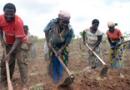
Everything is ‘up for dialogue’ but ‘few things can actually be negotiated’, says Eric Holt-Giménez, reporting back on last week’s Dublin Dialogue, a consultation with civil society organisations hosted by the UN High Level Task Force on the global food security crisis. Lacking budgetary or decision-making power, the task force cannot stray far from the mandates of purse-holder the World Bank in the design of its Comprehensive Framework for Action to end hunger, which presents the global market as ‘the solution rather than the cause of hunger’, and prioritises ‘the private sector rather than public institutions’. ‘Without organised pressure from civil society, there is little likelihood of advancing food sovereignty at the UN or anywhere else,’ says Holt-Giménez.
http://www.pambazuka.org/images/articles/383/48864market.jpgEric Holt-Gimenez looks at the FAO Food Security Summit in contrast to the parallel “Terra Preta” meeting organized by social movements, Indigenous Peoples’ organizations and civil society organizations to discuss issues of food sovereignty.
====
The FAO’s recent Food Security Summit held in Rome 1-4 June called for more free trade, more Green Revolutions, more direct food aid and more investment in agriculture to stem the growing global food crisis. The issue of agrofuels—the original reason for holding the conference in the first place—was effectively taken off the agenda by the United States. did world leaders address the root causes of the food crisis.
In a parallel meeting called “Terra Preta” organized by social movements, Indigenous Peoples’ organizations and civil society organizations, and supported by the International Planning Committee for Food Sovereignty, a “People’s State of Emergency” was called for. In a statement on the World Food Emergency called “No More Failures-as-Usual!” activists demanded governments accept responsibility in creating the food crisis:
“Historic, systemic failures of governments and international institutions are responsible. National governments that will meet at the FAO Food Crisis Summit in Rome must begin by accepting their responsibility for today’s food emergency… The emergency today has its roots in the food crisis of the 1970s when some opportunistic OECD governments, pursuing neoliberal policies, dismantled the international institutional architecture for food and agriculture. This food crisis is the result of the long standing refusal of governments and intergovernmental organizations to respect, protect and fulfill the right to food, and of the total impunity for the systematic violations of this right among others. They adopted short-term political strategies that engineered the neglect of food and agriculture and set the stage for the current food emergency.”
THE AGRA MEMORANDUM
The Terra Preta statement identifies the Green Revolution as one of the causes of the current crisis, and condemns the call for a “new” Green Revolution in Africa:
“We reject the Green Revolution models. Technocratic techno-fixes are no answer to sustainable food production and rural development. Industrialised agriculture and fisheries are not sustainable.”
Drawing from the here
These statements fly in the face of the “Memorandum of Understanding” signed by UN agencies and AGRA that claim the new Green Revolution will “significantly boost food production in Africa’s “breadbasket regions.” The strategy of the new AGRA-UN memorandum is to increase yields in Africa’s most productive regions to offset low yields in other areas. While this may appear on the surface as a new idea, it is actually quite old (like most of the ideas floated at the Food Summit). In fact, the original Green Revolution’s strategy was to seek impressive gains in production by concentrating their efforts on regions that were already high-producing, like India’s Punjab. This not only led to a displacement of poor farmers by rich farmers, it caused severe environmental problems.
Today, the Punjab has the world’s highest [email protected] or comment online at http://www.pambazuka.org