


Many patients have resorted to private clinics and pharmacies after struggling to get service at both government health facilities and those run by the Christian Health Association of Lesotho (CHAL), an organisation made up of six different churches that provides 40 per cent of health care in the country. Thabo* was forced to go to a private doctor after failing to get drugs or a medical examination at government or CHAL health centres in Maseru. 'I went to the government clinic because I was going to pay only 15 maloti (US$2.14) but now I have to cough up 120 ($17.14),' he said.
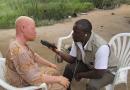
 There is enormous discrimination against people who live with Albinism in Ghana. Perception about the condition has assumed a superstitious twist, with suggestions sufferers don’t die, that they vanish. But why this level of discrimination against people who are only different from others because of pigment? In Tanzania, and many other African countries, they are killed for rituals and those in Ghana are scared these unwarranted attacks could soon occur here.
'On 25 May 2011, a Tripartite Commission comprised of the governments of Tanzania and Burundi and the UN High Commissioner for Refugees (UNHCR) met in Dar es Salaam to discuss the future of repatriation efforts for Burundian refugees. The situation of approximately 38,000 refugees in Mtabila camp in the country’s Kigoma region was a particular focus of the talks, which ended with a decision to close the camp on 31 December 2011. The government of Tanzania has announced that they expect a renewed repatriation drive.' This report from the International Refugee Rights Initiative examines the situation.
Africa Today speaks with Robin Fryday the producer of the film 'The Barber of Birmingham: Foot Soldiers of the Civil Rights Movement' and talks with Eddie Daniels on contemporary South Africa. Eddie Daniels was imprisoned on Robben Island for many years with Nelson Mandela, Walter Sisulu, and Dennis Brutus.
Voting got off to a slow start on Sunday in Cameroon’s presidential elections, which incumbent Paul Biya seems assured of winning to extend his 29-year rule. The 78-year-old veteran is seeking a sixth term against 22 other candidates, with opposition complaining that his control over the electoral system is so complete the outcome is a foregone conclusion. On paper, seven million people are eligible to vote.
There are an estimated two million disabled people in Ghana, who, according to the World Health Organisation, account for seven to 10 per cent of the population. Five years after its passage, the Persons with Disability Act has brought few changes to their lives. On paper its provisions promise plentiful employment opportunities, free education, accessible buildings and transportation, and societal acceptance. The reality is much different.
The Dalai Lama has accused China's rulers of creating a climate of fear, lies and censorship. 'In reality, for the communist totalitarian system and for many totalitarian systems, hypocrisy and telling lies has unfortunately become part of their lives,' he said in a conversation with Archbishop Emeritus Desmond Tutu via video link-up to Cape Town. The Dalai Lama was meant to travel to Cape Town from India for Tutu's 80th birthday celebrations at the weekend but cancelled his trip after South Africa failed to give him a visa in time.
In the year and a half since the earthquake in Haiti, the United Nations Stabilization Mission in Haiti (MINUSTAH by its French acronym) has expanded its role in the name of security, stability, and relief. However, since its establishment in 2004, multiple independent human rights organisations have documented myriad violations of the human rights of Haitians. These transgressions have continued unchecked since the earthquake, positioning MINUSTAH as a threat to Haitian stability and security instead of a safeguard.
14 October will see the launch of the book 'The Agrarian Question in the Neoliberal Era: Primitive
Accumulation and the Peasantry'. The launch forms part of a day-long event taking place at Nyerere theatre one at the University of Dar es Salaam, which will see top academics discussing the theme of the book. Click on the link provided to access the full programme.
 The counterfeit medicine business is a big business in Ghana. Experts say only 60 per cent of anti-malarial medicines in the country are genuine; the remaining 40 per cent are fake. As a result hundreds of people are dying yearly. But the institutions charged with the responsibility of dealing with the problem appear not to have the capacity to end it. This documentary investigates the counterfeit medicine business and reveals the business doesn’t look like ending now.
At least 24 people have been killed and scores more injured in clashes between mostly Coptic demonstrators and military police outside the state television building in central Cairo. Essam Sharaf, Egypt's interim prime minister, called for a calm early on Monday morning as a curfew was imposed in central areas of the capital, including Tahrir Square. Egypt's leadership also held an emergency meeting late on Sunday to discuss the situation, with clashes also reported in Alexandria, Egypt's second city.
This article from Project Syndicate looks at Egypt’s public finances. 'The interest that the country pays on its foreign loans is larger than its budget for education, healthcare, and housing combined. Indeed, these debt-service costs alone account for 22% of the Egyptian government’s total expenditures. The impact has become impossible to ignore. With growing political uncertainty and a slowing economy, Egypt is likely to witness decreasing government revenues, increasing demands for urgent spending, and rising interest rates on government borrowing. This could lead to a fiscal catastrophe for the government at the very moment when the country is attempting a complicated political transition.'
Visit this Facebook page to find out more about the ecological Internet campaign against the hubris that humans can or should geoengineer our shared biosphere.
Malawi has said there is no reason to apologise to newly-elected President of Zambia Michael Sata over his deportation and declaration as a prohibited immigrant in 2007. Seventy-four-year Sata, elected President two weeks ago after beating a Mutharika-ally Rupiah Banda, on Saturday snubbed the Malawian leader’s invitation to attend the Comesa summit in protest against the Mutharika government and demanded for an apology concerning the 2007 quarrel.
Food prices are likely to become more volatile in coming years, increasing the risk that more poor people in import-dependent countries will go hungry, the United Nations said in an annual report on food insecurity published on Monday. Global food price indices hit record highs in February and were a factor in the Arab Spring of unrest in north Africa and the Middle East. Prices have since eased but the UN report said economic uncertainty, low cereal reserves, closer links between energy and agriculture markets and rising risks of weather shocks were likely to cause more dramatic price swings in the future.
After years of living in fear of showing her ID or driving licence to anyone, a transgender Durban woman can now proudly display her documents without being embarrassed or harassed. Her physical journey to womanhood started two years ago when she began hormone treatment and since then she has developed breasts, her facial hair has diminished and her weight has gone down by almost 30kg because the increase in oestrogen has led to a decrease in muscle mass. The task of changing her gender officially was much more difficult. Home Affairs said that since she had not undergone any gender reassignment surgery, her journey to womanhood was incomplete and her details could not be changed.
Evicted from their homes in 2009 when the government initiated efforts to restore Kenya's largest water tower, the Mau Forest Complex, thousands of the affected families are still without permanent shelter. The fact that the country's policy on internally displaced persons (IDPs) has remained in draft form since 2009 does not give the evictees hope that their plight will be resolved soon.
In August, SA's minister of water affairs and Lesotho's minister of natural resources signed an official agreement to implement Phase 2 of the Lesotho Highlands Water Project (LHWP). The LHWP has been fraught with problems since the treaty was signed in 1986, says this article from Business Day, which
notes that there are good reasons why the public should be paying more attention to the huge development and that there are better alternatives to building more huge dams in Lesotho.
Government has secured 300 acres of land to set up a multi-functional prison for terror suspects.
The disclosure was made by the Commissioner General of Prisons, Dr. Johnson Byabashaija. He said the new detention centre would also accommodate cyber crime suspects and drug traffickers.
As Occupy Wall Street protests in the US enter their fourth week, the size of the crowd has begun to grow. 'But as the nascent movement gathers steam, struggles and problems are apparent. Is their message clear enough? Who is their leader? How long can they last, camped out in a concrete park as the weather chills? Who will control it?'