


A Reading of Fanon’s The Wretched of the Earth as an apologetic discourse for legitimate defence
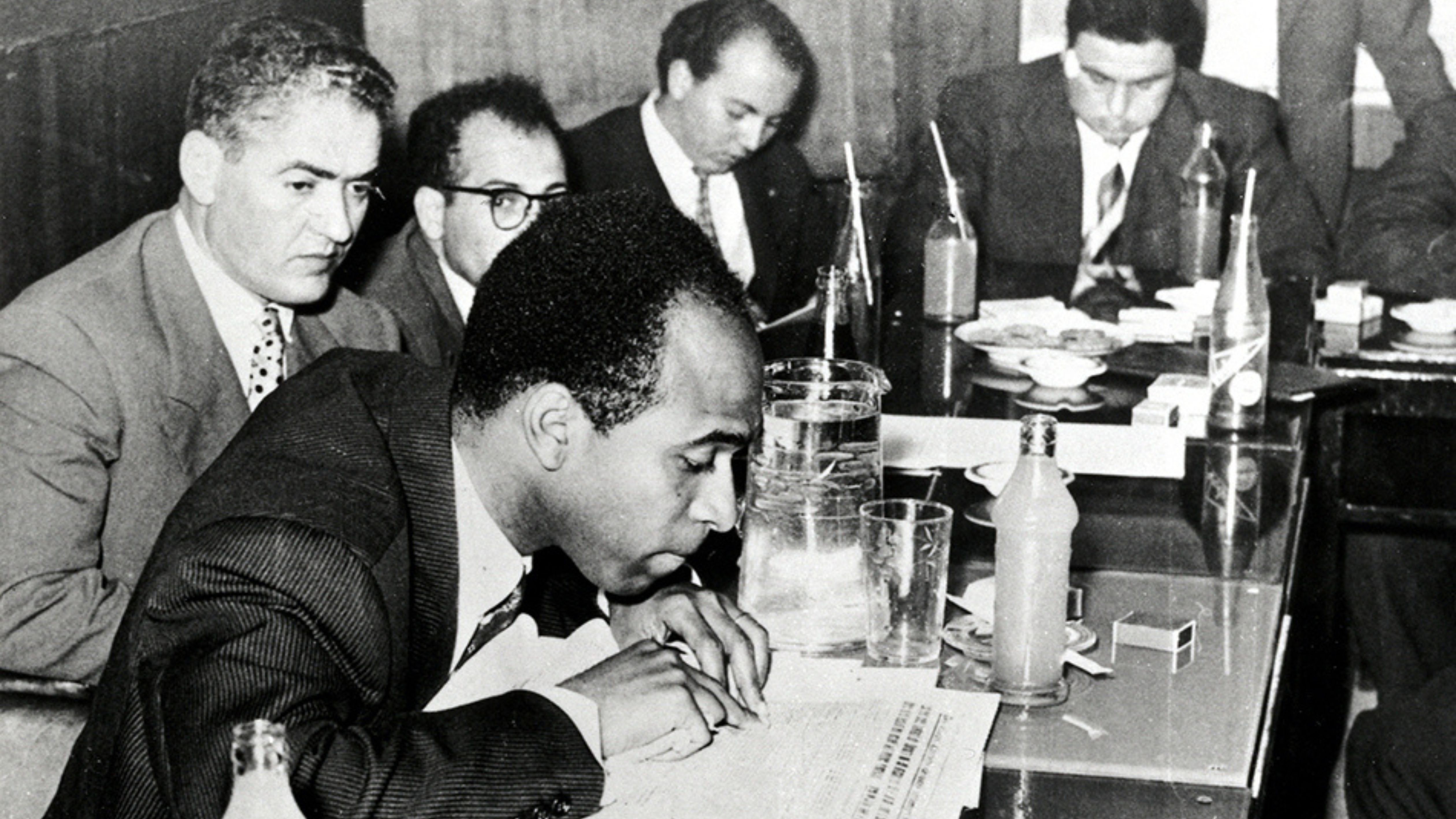

A reread of Frantz Fanon’s The Wretched of the Earth, and violence, legitimate defence, and self-determination within the frame of international law and post-2020 scholarship.
Few books have disturbed the conscience of modern political thought as profoundly as Frantz Fanon’s The Wretched of the Earth (1961). Written in the final years of French rule in Algeria and published on the eve of Fanon’s death, the text erupted into an intellectual landscape shaped by the Cold War, African liberation movements, and a moral fatigue with European humanism. Its searing indictment of colonial domination and its audacious claim that “decolonisation is always a violent phenomenon” positioned Fanon at the turbulent crossroads of ethics and revolution. To many contemporaries – especially liberal humanists – Fanon appeared to sanctify violence; to others, especially the colonised, he articulated the only language through which the subjugated could reclaim their humanity. More than six decades later, his words continue to ignite scholarly, political, and moral debates about the limits of resistance and the right to self-defence.
This essay situates The Wretched of the Earth within the conceptual terrain of legitimate defence – a term that bridges moral philosophy, jurisprudence, and revolutionary ethics. It argues that Fanon’s provocative discourse is not a celebration of bloodshed but an apologia for self-preservation within a world rendered pathological by systemic violence. The colonized subject, stripped of agency and condemned to non-being, finds in revolt not cruelty but the reassertion of moral equilibrium. Fanon’s rhetoric, when read closely, advances a coherent philosophical defence: that violence becomes legitimate only insofar as it responds to prior aggression, restores human dignity, and prepares the ethical rebirth of the community. His argument thus transforms the battlefield into a moral theatre where the oppressed reclaim their right to exist.
This essay re-reads Frantz Fanon’s The Wretched of the Earth (1961) as an apologetic discourse for “legitimate defence” in anti-colonial struggle. Rather than a blanket celebration of violence, Fanon’s argument is reconstructed across four textual sites – “Concerning Violence,” “The Pitfalls of National Consciousness,” “On National Culture,” and “Colonial War and Mental Disorders.” Close readings show that (i) Fanon’s notorious claims emerge from an analysis of colonialism as structurally violent and “compartmentalized,” (ii) his psychiatric practice frames counter-violence as a response to psychosocial mutilation, and (iii) his teleology is a postcolonial humanism that disciplines insurgent violence toward civic reconstruction, not perpetual vengeance. I place this reading beside post-2020 scholarship (Robcis 2020; Mbembe 2020; Gibson 2021; Ndayisenga 2022; Castelli 2022; Shatz 2024) and relevant international-law developments (UNGA Res. 2625 (1970), Res. 3103 (1973), and Additional Protocol I (1977)) to argue that Fanon’s discourse can be read as a historically situated defence of self-determination against colonial force, normatively aligned with a constrained right of defence rather than a metaphysics of violence.
The relevance of this apologetic reading extends far beyond the Algerian war that inspired Fanon’s reflections. Contemporary struggles against racialised policing, neocolonial extraction, and epistemic domination echo Fanon’s central thesis that injustice institutionalised as peace is itself violence. Recent scholarship – from Camille Robcis’s (2020) reconstruction of Fanon’s psychiatric ethics to Adam Shatz’s (2024) biographical analysis of his revolutionary humanism – invites renewed attention to Fanon not as a prophet of destruction but as a theorist of restorative defiance. By engaging both Fanon’s text and the evolving international-law doctrines that legitimate resistance to colonial and racist regimes, this essay rereads The Wretched of the Earth as a morally bounded defence of counter-force – an argument that violence, when disciplined by justice and humanism, constitutes legitimate defence rather than nihilistic revenge.
Reframing the problem: What Does “Legitimate Defence” mean here?
“Legitimate defence” is a legal-moral idea: the right to repel wrongful force. In decolonisation, the claim is that anticolonial force answers a prior, systemic aggression – the colonial order itself. Fanon’s opening chapter makes the premise stark: decolonisation “is always a violent event,” not as a romantic slogan but as a diagnosis of a world whose everyday grammar is force, segregation, and armed policing. The colonial world, he writes, “is a compartmentalised world,” governed by soldiers and barracks; counter-violence emerges as the colonised take “history into their own hands.” In short, Fanon’s rhetoric arises from a sociology of domination.
This framing parallels post-war shifts in international law that recognised struggles against colonial domination as lawful exercises of self-determination. UN General Assembly Resolution 2625 (1970) codified self-determination as a basic principle; Resolution 3103 (1973) affirmed the legitimacy of peoples’ struggles “by all necessary means” against colonial and racist regimes; and Additional Protocol I (1977) treated “wars of national liberation” as international armed conflicts, bringing them within humanitarian-law protections. Read together, Fanon’s moral vocabulary and these legal recognitions situate anticolonial force as defence against structural aggression, not an ethic of violence for its own sake. (United Nations Treaty Collection)
Textual grounding I: “Concerning Violence”
Two famous lines frame Fanon’s argument. First, the thesis that “decolonisation is always a violent event” appears within an analytic description of colonialism as a regime whose “cohabitation…continued at the point of the bayonet.” Second, the colonial world is “divided in two,” policed spatially and racially; that Manichaean split manufactures a political ontology in which the colonised are cast as negation. Counter-violence, then, is portrayed as the colonised reclaiming agency within a world stratified by organised force. It is not a free-floating cult of violence but the reversal of an already violent order.
The most controversial sentence – “At the individual level, violence is a cleansing force” – appears in this chapter and has often been abstracted from context. In place, Fanon connects it to the psychic unbinding of inferiority complexes produced by colonial domination; it is a clinical metaphor for de-subjectivation and re-subjectivation under conditions of war, not a transhistorical glorification of cruelty. Even here, Fanon indexes the danger and cost of war, and his later chapters warn against the degeneration of revolutionary energy into authoritarianism. The dystopia he fears is rule by an unproductive national bourgeoisie – not a promised land of permanent insurrection (Abahlali baseMjondolo).
Textual grounding II: Psychiatry and “Colonial war and mental disorders”
Fanon was a psychiatrist at Blida-Joinville; his caseload documented trauma generated by colonial policing and counter-insurgency. Recent scholarship clarifies how his clinical work grounds his political theory. Camille Robcis (2020) shows Fanon’s links to “institutional psychotherapy,” a practice politicising the clinic by treating alienation as simultaneously psychic and social. Fanon’s case histories in Wretched illustrate colonial violence’s psychosomatic toll as well as the ambivalence of revolutionary participation – its risks and its therapeutic possibilities in restoring agency to a violated subject. In this light, “cleansing force” denotes an uncaging of the colonised person’s agency under, and against, the pathologies induced by the colonial order (Moodle Hampshire College).
The 2024 POMEPS Studies collection on “Fanon in the Middle East” situates this reading within a wider comparative lens, noting how debates about Fanon’s “violence” routinely eclipse his psychiatric labour and his warnings about post-liberation failures. That conversation also highlights how renewed interest in Fanon follows contemporary crises where the boundaries between resistance, terror, and humanitarian law are disputed – precisely the space where “legitimate defence” becomes a contested grammar.
Textual grounding III: “The pitfalls of national consciousness”
In “Pitfalls,” Fanon’s target is the ascendant “national bourgeoisie” after independence: a class that inherits the colonial state’s extractive shell and swaps foreign domination for indigenous clientelism. This is crucial to an apologetic reading: Fanon’s defence of counter-violence is teleological. It is justified only insofar as it clears the way for a democratic social order and avoids reproducing domination under a new flag. Here, Fanon anticipates the moral failure of “independence without transformation,” warning against tribalism, chauvinism, and the reduction of liberation to elite patronage. Such warnings hem in the scope of legitimate defence by tethering force to an emancipatory horizon – justice, bread, dignity, and participation – rather than revenge. (See also Adam Shatz’s 2024 biography for a synoptic rendering of how Fanon’s political and clinical lives interpenetrate this cautionary humanism) (Macmillan Publishers).
Textual Grounding IV: “On National Culture” and the Humanist Horizon
Fanon’s revolution is not merely military; it is cultural and anthropogenic – the making of a “new human.” Contemporary scholarship emphasises this humanist arc. Achille Mbembe reads Fanon as gesturing toward a planetary, de-provincialised humanism beyond racial sovereignty; the point of decolonisation is to repair the world, not invert hierarchies. Recent work in literary and legal studies likewise foregrounds Fanon’s “new humanism” as a normative demand that the movement beyond colonialism must be a movement beyond domination as such. This humanist meta-frame is the decisive constraint on an apologetic defence: the end is non-domination; the means are justified only insofar as they are ordered to that end and disciplined by it (Columbia University Press).
Recent Scholarship (2020-2025): Violence, Ethics, and Law
Post-2020 scholarship has complicated both celebrations and condemnations of Fanon’s “violence.”
-
Ethics of care & trauma: Drawing on Fanon’s clinic, recent work argues that some counter-violences may be intelligible within an ethics of care, because repair sometimes presupposes confronting the structures that injure. These arguments explicitly resist any romanticisation of cruelty while acknowledging colonialism’s “slow violence” (MDPI).
-
Inevitability vs. normativity: Z. Ndayisenga (2022) distinguishes an empirical claim (violence’s inevitability in colonial and anticolonial projects) from a normative justification, urging careful, context-bound defences rather than maximalist theses. Alberto Castelli (2022) reads Wretched as granting physical force a role in overthrow and in civic re-founding, while taking seriously historical and contemporary criticisms. These are precisely the nuances an apologetic account of self-defence must hold (SAGE Journals).
-
Revolt and reconstruction: Nigel Gibson’s Fanon Today: Reason and Revolt of the Wretched of the Earth (2021) curates global engagements that refuse to freeze Fanon at “violence,” re-entering reason and civic creation. Adam Shatz’s The Rebel’s Clinic (2024) further anchors Fanon’s politics in his therapeutic vocation and his insistence on postcolonial accountability (DarajaPress).
Together, these works support a reading of Fanon as offering a bounded defence of counter-violence: legitimate where it responds to colonial force, oriented to world-repair, and constrained by prospective responsibilities to non-domination.
Interfacing with International Law: From Self-Determination to IHL
Fanon wrote amid a legal revolution. The UN’s Friendly Relations Declaration (1970) affirmed that peoples have a right to self-determination; subsequent resolutions characterised anti-colonial struggles as legitimate. Additional Protocol I (1977) then recognized wars of national liberation as international armed conflicts, bringing liberation fighters under humanitarian-law protections (including prisoner-of-war status under certain conditions). An apologetic reading of Wretched aligns with this arc: anticolonial force becomes defensible insofar as it answers an unlawful domination and is governed by norms of distinction and proportionality that protect non-combatants – a limit Fanon thematises negatively through his disgust at post-liberation authoritarianism and tribal chauvinism (United Nations Treaty Collection).
Addressing the hard question: does Fanon glorify violence?
Contrary to the perception that transcends Fanon’s text regarding violence, there is no justification to conclude that Fanon glorifies violence. On the contrary, he abhors violence as a dehumanising act. It is within that scope that he prescribes counter-violence as a legitimate act to restore the dignity of the colonised. Counter-violence is therefore a regenerative act of self-determination re-creation justifiably deployed by the oppressed against the oppressors in view to free themselves of oppression. In this respect, two objections recur. These two recurrent objectives can be captured as “Cleansing force” is glorification, and “Fanon is indifferent to ends”.
-
“Cleansing force” is glorification: In isolation, the sentence is combustible. In context, it sits inside a psychiatric account of disalienation under a permanently violent order; it describes affective unfreezing among the colonised who had been interpellated as subhuman. The line functions diagnostically (what this does to a subject) rather than as a universal ethic (what one ought to do everywhere). Fanon elsewhere chronicles trauma, cruelty, and the risk of moral collapse; he is not naïve about what war does to bodies and souls (Abahlali baseMjondolo).
-
Fanon is indifferent to ends: On the contrary, the strongest pages of Wretched are fanatically concerned with ends: how to prevent liberation movements from curdling into oligarchy; how to organise political education, worker cooperatives, and culture as participation; how to cultivate a “new humanism.” Violence that reproduces domination is self-refuting. Fanon’s defence is apologetic only where counter-force terminates in civic equality (Cambridge University Press & Assessment).
A focused close reading: three micro-passages
(i) Colonial compartmentalisation (On Violence): Fanon’s spatial language – barracks, police posts, forbidden cities – translates domination into movement and sightlines. The “world divided in two” is policed difference: a cartography where law appears as naked force. Counter-violence here is phenomenological as much as tactical: reclaiming bodily presence where one’s movement had been penned. This is not a metaphysical preference for arms; it’s a reply to a world organised by arms.
(ii) “Cleansing force” (On Violence): The notorious sentence is followed in Wretched by a political warning: once people have struggled, they become “jealous” of their achievement and suspicious of heroic cults – an insistence on horizontalism against charismatic capture. Even the “therapeutic” register, then, doubles as an anti-authoritarian guardrail (Archive.org).
(iii) National Bourgeoisie (Pitfalls): Fanon’s invective against postcolonial elites is not digression; it’s the book’s normative heart. Liberation that produces a comprador class invalidates the defence that justified force in the first place. Thus the apologetic reading carries its own internal audit: “legitimate defence” ceases when the defended order becomes another architecture of domination. (For contemporary syntheses of this point, see Shatz 2024 and Gibson 2021, Macmillan Publishers).
Conclusion: Fanon’s measured defence
The Wretched of the Earth is an apologetics – but not of violence per se. It is an apologetic of the colonised people’s defence against an order that is violent to its core; and it is normatively stringent about the direction of that defence: toward participation, work, culture, and a new humanism; against chauvinism, tribalism, and oligarchy. Post-2020 scholarship – psychiatric (Robcis), political-theoretical (Gibson), historical-biographical (Shatz), and legal-normative (Ndayisenga; Castelli) – supports that Fanon’s text is best read as a bounded, end-oriented argument for constrained counter-violence in the name of world-repair. The legal evolution of self-determination and humanitarian law further clarifies how a discourse that begins as insurgent moral rhetoric now also resonates with a codified right of peoples to resist domination, under law’s own constraints.
Mawuloe Koffi Kodah is based at the University of Cape Coast, Ghana
Email: [email protected]
References
Castelli, A. (2022). Liberation through violence in Fanon’s The Wretched of the Earth: Historical and contemporary criticisms. Peace & Change, 47(4), 325–340. https://doi.org/10.1111/pech.12554 (Wiley Online Library)
Fanon, F. (2004). The Wretched of the Earth (R. Philcox, Trans.; with J.-P. Sartre preface & H. K. Bhabha foreword). Grove Press. (For key passages, see the widely used course excerpt.)
Fanon, F. (1963). The Wretched of the Earth (C. Farrington, Trans.). Grove Press. (For the “cleansing force” line often cited from the 1963 edition.) (Abahlali baseMjondolo)
Gibson, N. C. (Ed.). (2021). Fanon Today: Reason and Revolt of the Wretched of the Earth. Daraja Press. (DarajaPress)
Mbembe, A. (2020). Out of the Dark Night: Essays on Decolonization. Columbia University Press. (Columbia University Press)
Ndayisenga, Z. (2022). Fanon on the arbitrariness of using violence: An inevitable for both colonialism and decolonization. Journal of Black Studies, 53(8), 875-892. https://doi.org/10.1177/00219347221077273 (SAGE Journals)
Oxford Research Encyclopedia entry on Fanon (overview of major themes and reception). (Oxford Research Encyclopedias)
Robcis, C. (2020). Frantz Fanon, institutional psychotherapy, and the decolonization of psychiatry. Journal of the History of Ideas, 81(2), 303–325. https://doi.org/10.1353/jhi.2020.0009 (Moodle Hampshire College)
Shatz, A. (2024). The Rebel’s Clinic: The Revolutionary Lives of Frantz Fanon. Farrar, Straus and Giroux. (Publisher page.) (Macmillan Publishers)
UN General Assembly. (1970). Declaration on Principles of International Law concerning Friendly Relations (A/RES/2625). (United Nations Treaty Collection)
UN General Assembly. (1973). Basic Principles of the Legal Status of the Combatants Struggling against Colonial and Alien Domination and Racist Regimes (A/RES/3103). (Refworld)
– ICRC. (1977/1987). Additional Protocol I, Art. 1(4) and commentary. (ICRC IHL Databases)