


Fluctuating Formulas of Neo-imperialism: reflections on the elimination of USAID
_workers_on_5_February_2025_-_1.jpg)
USAID has been a vital component of America’s global domination. Murrey and Daley alert us to watch out for its new manifestation, as it is restructured to serve the next phase of US imperialism.
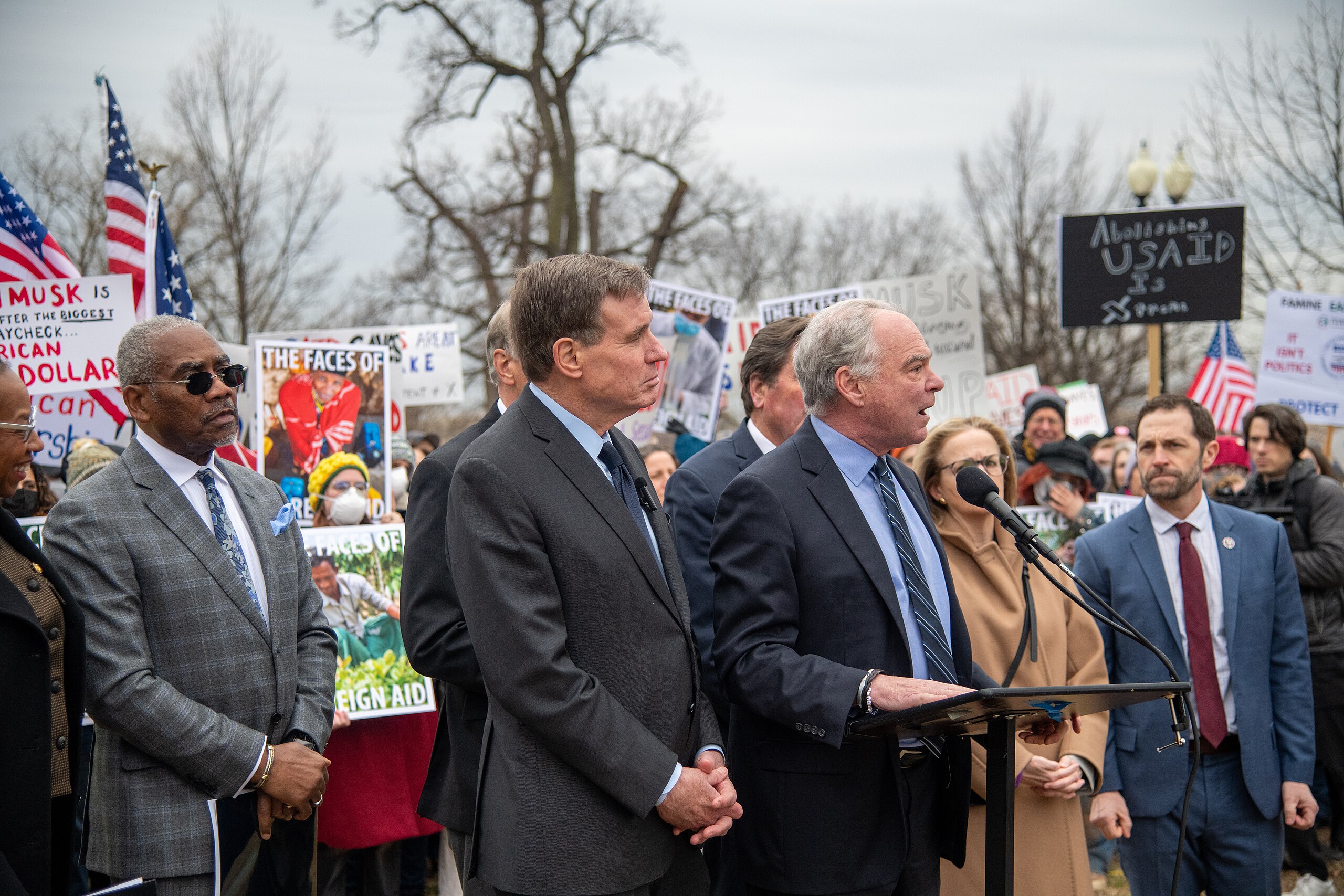
The shuttering of USAID, the US government’s aid agency, by Elon Musk’s Department of Government Efficiency (DOGE) within weeks of Trump beginning his second term as US president included sudden mass layoffs, a stop on funding and project cancellations, putting an end to the six-decade lifespan of the Organization for Economic Cooperation and Development’s (OECD) largest bilateral donor. The closure of USAID was accompanied by the closure of other organs of the federal government, including the Environmental Protection Agency’s environmental justice unit. Readers of Pambazuka will know that USAID was never a disinterested donor body merely gifting American dollars to beneficiaries in the majority world.[1] USAID infrastructures and funding have been understood as a component of imperialist counterinsurgency,[2] and agricultural development programs have been viewed as efforts to immunise agrarian societies from revolutionary demands for redistribution.[3]People and movements motivated by worker empowerment and gender, racial, and sexual justice are not mourning the elimination of USAID on the basis that it was sufficient to the project of redress or liberation.
USAID, for over 60 years, cultivated a developmental space within the DC Beltway, and the affluent urban spaces in Northern Virginia through which substantial amounts of development capital circulated.[4] Unlock Aid (2024) described these practices, ‘The open secret in Washington, DC is that too little of American foreign aid ever leaves America’s capital city.’[5] So, we now have a nativist presidency who has shuttered an organisation whose impact propped up US hegemony overseas and fostered an aid industrial complex at home. As one former contractor of USAID recently told one of us, ‘aid has always been a big American business and DOGE has not changed that, the question is now who will emerge as the next big players.’ Development geographers and other critical scholars are working to make sense of the new alignments between billionaires and aid funding that depart from a previous period of ‘philanthrocapitalist’ state-market hybrids.[6] Philanthrocapitalism is a term used to describe the practice of investment in social programmes by businesses that is tied to profit generation. Private equity investment in microfinance as Development Aid is one such example. Philanthro-capitalist investment in Africa includes investments in mining and other extractive activities, which they claim will benefit local people. In recent years, the International Financial Institutions and Global North governments have encouraged and supported philanthro-capitalist activities in Africa, often through direct grant subsidies, or advocating for the political environment that makes it possible.
Another 21st century transformation in the aid architecture is the emergence of military development or humanitarianism. While aid as military equipment has been around since the Second World War, the possibility of militaries themselves becoming aid actors emerged as a feature of the restructuring of Global North aid in the post-war Cold War, and during the period of civil war in 1990s’ Africa and the 2000s’ War on Terror. Even where militaries are not active, private security firms have mushroomed to support aid personnel, making the boundary between aid donors and their recipients a militarised one.
Supporters of aid have argued for its retention from a perspective of benevolence, for the ‘soft power’ influence that it gives to its donors, and finally because it saves lives, especially of those undergoing humanitarian crises often caused by the donors themselves. The ‘hard power’ element – the most important, which includes the support for corrupt military and other authoritarian regimes and violent extractivism - is often downplayed as an unfortunate by-product. USAID’s Office of Transition Initiatives, which was set up in 1994 and by 2009 operated in 36 countries, provided rapid response funding for local activities, such as ‘political transition’, ‘stabilization’, ‘peace’, and ‘democracy’ in Global South countries. This entity operated independently, without any administrative controls, transparency, and accountability - basically any oversight by the US Congress.
For decades, we have been teaching, writing, and advocating for the abolishment of international development. Two years ago, we co-authored a book, Learning Disobedience: Decolonising Development, on the need to abolish international development as a discipline of study and practice precisely because of its imperial roots and racist practices, but, more importantly, because it strips beneficiaries of their capacity to image and institute social change. We cannot condone the crude rupture that we are currently witnessing in the reduction in the role of USAID. The closure of lifesaving emergency humanitarian projects and the sweeping elimination of jobs and employment opportunities illustrate the bankruptcy at the heart of the capitalist aid project itself – the failure to recognize beneficiaries and workers as ‘real’ people who can be harmed by the system.
An anti-imperial transition from aid must occur alongside redistribution, restitution, and reparative mechanisms. There needed to be an acknowledgment of international development as a colonial manifestation, as a way in which countries like the United States were able to exercise their dominance, were able to even create employment in their own heartlands, that it entrenched forms of dependence and that it did it in the wake of the Cold War: there were illusions of sovereignty for African countries and forced forms of austerity where the state was no longer being responsible for citizens well-being and the only way to stabilize those countries. We have witnessed far-right, white supremacist, neo-imperial figures mobilise key aspects of our post-developmental insights and arguments in disempowering ways (for example, regarding case studies of the unequal distribution and concentration of aid finances to the Global North, or the siphoning-off of aid finances for elite and bourgeoisie circles).
The way that the elimination of USAID was conducted, coded, and imposed, was in the service to the further entrenchment of white masculine supremacy. The destruction of USAID was not motivated by the need to eliminate imperial structures of dependency; it was the opposite, about untethering linkages of international solidarity and transnational activism. The elimination of certain bare-minimum programming, which assisted what Thomas Sankara critiqued as ‘mere survival’ of people and communities so systemically impoverished by capitalism, has been occurring in a political context in which grotesque capital accumulation not only continues but is accelerating.
How Pan-African thinkers and collectives respond is important in ensuring that the shuttering of USAID does not merely accelerate the dominance of private finance and corporate power in ‘development’ sectors. The question for our collectives is if and how we can instrumentalise the collapse of USAID to create space for truly reparative alternatives to instrumental aid, [7] including and alongside efforts to plug illicit financial flows that leave many regions of Africa, Asia, and Latin America as net creditors to the countries of the imperial core.[8]
Patricia Daley is Professor of the Human Geography of Africa in the School of Geography and the Environment at the University of Oxford.
Amber Murrey is an Associate Professor in the School of Geography and the Environment at the University of Oxford. She is a decolonial political geographer, ethnographer and educator.
Endnotes
[1]Stirrat, R. L., and Henkel, H. (1997). The Development Gift: The Problem of Reciprocity in the NGO World. The ANNALS of the American Academy of Political and Social Science, 554(1), 66-80. https://doi.org/10.1177/0002716297554001005 (Original work published 1997)
Noxolo, P. (2017). ‘Decolonial theory in a time of the re-colonisation of UK research’,
Transactions of the Institute of British Geographers, 42, 3, 342-344.
[2] Attewell, Wesley (2023). The Quiet Violence of Empire: How USAID Waged Counterinsurgency
in Afghanistan. Minneapolis: The University of Minnesota Press.
[3] Ajl, M., & Sharma, D. (2022). The Green Revolution and transversal countermovements: recovering alternative agronomic imaginaries in Tunisia and India. Canadian Journal of Development Studies / Revue Canadienne d’études Du Développement, 43(3), 418–438. https://doi.org/10.1080/02255189.2022.2052028
[4] Roberts, S. M. (2014). Development Capital: USAID and the Rise of Development Contractors. Annals of the Association of American Geographers, 104(5), 1030–1051. https://doi.org/10.1080/00045608.2014.924749
[5] Unlock Aid, 20024, https://www.unlockaid.org/our-impact
[6] McGoey Linsey, (2015). No Such Thing as a Free Gift: The Gates Foundation and the Price of Philanthropy. London: Verso
[7] Noxolo, 2017; Sylla, N.S., Fischer, A.M., Kaltenbrunner, A. and Sathi, S. (2024), Global Reparations within Capitalism: Aspirations and Tensions in Contemporary Movements for Reparatory Justice. Dev Change, 55: 560-600. https://doi.org/10.1111/dech.12855
[8] Ndikumana, Léonce; Sarr, Mare (2019): Capital flight, foreign direct investment
and natural resources in Africa, Working Paper, No. 2019-12, University of Massachusetts,
Department of Economics, Amherst, Mass., USA.