


Reparative Justice, Abolitionism, and Decolonization: Africana Critical Perspectives on Criminology
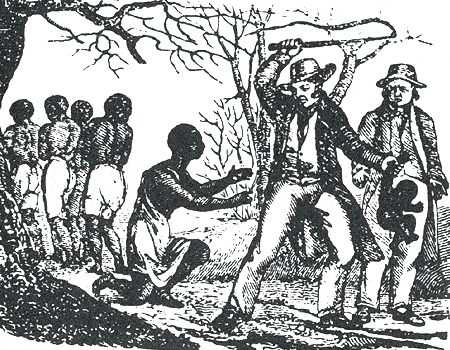

A criminology on reparations and emerging contestations at a time of global moral and accountability reckoning of the gravest crime against humanity.
This article posits that criminology, just like human life, originated in Africa with an original paradigm of the forgiveness of the unforgivable [as Derrida put it];[1] while Desmond Tutu retorted that there is no such thing as the unforgivable under Ubuntu[2]. In contrast, the European colonizers of the world privileged the obsession with ‘the punishment of offenders’, as Garland defined the focus of criminology[3]. With evidence from classical African cultures that were documented in writing by those who invented writing as a pharmaceutical device for healing thousands of years before there was anyone called a European, the papyrus calls on criminologists to excarnate this original humane African societal reaction to wrongful behavior with emphasis on love, reparations, and peace-making as opposed to the more recent alternative of hatred, revenge, and war-making. There is no evidence in history of genocide and a slave mode of production in African culture before the imposition of Eurocentric notions of modernity, according to Walter Rodney. Since this original model worked better for centuries without building a single prison or arming a militarized police force, this papyrus concludes in support of the Abolition Geography of Ruth Gilmore[4] and the Abolition Democracy theorized by Angela Davis[5], following the thesis of Du Bois in Black Reconstruction. This approach will help to decolonize the criminal justice system across Africa and the rest of the world for the benefit of all rather than continue the retention of the cruel and inhumane imperialist reason that was designed for the control of others.
In March 2026, Ghana moved a motion at the General Assembly of the United Nations for the recognition of the Trans Atlantic Slavery as the Greatest Crime Against Humanity. While the media presented the motion as solely the initiative of Ghana,[6] a UN document indicates that the resolution was co-sponsored by many African countries. There were co-sponsors from the Caribbean, including Barbados and St Kitts and Nevis, and from other regions, Venezuela and Belarus.
Other efforts have been underway in different parts of global Africa in the call for moral reckoning on slavery and reparations. The African Union Commission was co-sponsoring a conference on reparations with Howard University and the University of the Witwatersrand at the time of the UN resolution. The English Caribbean countries have also been demanding reparative justice collectively and are forging collaborations with Africa in the reparation struggle. The CARICOM-Africa Day recognizes the shared need for ‘reparatory justice for Africa and its Diasporas’ through educational and cultural exchanges[7]. The exclusive campaign for reparations from the US government by those who identify as American Descendants of Slavery[8] is not extended to all people of African descent, but they should have been consulted and on-boarded by Ghana. While the leadership of Ghana must be commended for successfully spearheading this recognition for people of African descent, the selective approach of the country may be part of the reasons why all the European Union countries collectively abstained and the US, Israel, and Argentina jointly opposed the resolution.
Building on Kwame Nkrumah’s thesis in Neo-Colonialism: The Last Stage of Imperialism[9]—itself extending Lenin’s argument that imperialism is the highest stage of capitalism[10]—I have proposed a new theoretical endpoint: reparative justice as the final stage of decolonization[11]. This move grounds decolonization not merely in the dismantling of imperial structures but in actively addressing the historical and ongoing harms that imperialism produce(d).
Imperialism as the General Framework of Deviance
My argument in Counter-Colonial Criminology that imperialism is the general form of all deviance provides the conceptual bridge[12]. Deviance, from this perspective, is not fundamentally about norm-breaking by powerless individuals but about the invasion, occupation, and colonization of the private or public space of another. In this sense: Micro-level deviant acts by the relatively powerless mirror, in structure if not scale, macro-level imperial and corporate predation by the powerful[13]. Both are variations of harmful power enacted as invasion.
This directly challenges mainstream criminology’s longstanding assumption that poverty and powerlessness are the primary causes of deviance. As I note, the evidence shows the opposite: Most poor people remain overwhelmingly law-abiding. The relatively powerless generally victimize those even more powerless. The powerful commit widespread, socially devastating harms while enjoying structural impunity, according to Zemiology – the study of social harms[14].
This aligns strongly with Steve Box’s work on the thesis that power is more causally associated with crime than poverty[15]. Similarly, Jeffrey Reiman’s Pyrrhic defeat thesis demonstrates that the reason why the poor get prison and the rich get richer is not because the poor are necessarily more crime-prone: the criminal justice system is designed to focus on the poor even when they are innocent while ignoring the far greater harms of the powerful[16]. Thus, the true criminogenic factor is not powerlessness—but the abuse of power. Power creates the capacity and opportunity for deviance; inequality shapes the direction that deviance takes. This is more so in international relations where might is right and violence against weaker nations with impunity is the order of the day as Fanon theorized in part two of the chapter, concerning violence which he concluded with a call for reparations as follows:
Europe is literally the creation of the Third World. The wealth which smothers her is that of the underdeveloped peoples. The ports of Holland, the docks of Bordeaux and Liverpool were specialized in the Negro slave trade, and owe their renown to millions of deported slaves. So when we hear the head of a European state declare with his hand on his chest that he must come to the aid of the poor underdeveloped peoples, we do not tremble with gratitude. Quite the contrary; we say to ourselves: “It’s a just reparation which will be paid to us.” Nor will we acquiesce in the help for underdeveloped countries being a program of “sisters of charity.” This help should be the ratification of a double realization: the realization by the colonized peoples that it is their due, and the realization by the capitalist powers that in fact they must pay. –Frantz Fanon, The Wretched of the Earth, pages 102-103[17].
Reparative Justice as the Final Stage of Decolonization
If deviance is rooted in imperial forms of slavery, conquest, domination and colonization, then the only true antidote is a justice system that undoes invasion, restores relationships, repairs harm, and decolonizes social structures. This leads logically to my thesis: Reparative justice is the final stage of decolonization, without reparative justice, injustice will remain to be addressed.
Reparative justice acknowledges historical and structural harms, centers victims and communities that suffered historical harms, requires active repair by offenders (individual or institutional), and prevents future domination by disempowering punitive state and corporate apparatuses of harm. Where conventional justice systems focus on punishment, repression, and the maintenance of state power, reparative justice seeks restoration of dignity, collective healing, acknowledgment of harm, and material redress.
The European Tradition’s Misrecognition of Reparative Justice
I observe that reparative justice has been marginalized in European criminology, often dismissed as a “primitive” practice associated with acephalous or Gemeinschaft societies (Tönnies). Even when reparative elements persist, they are rebranded as: restorative justice (though past conditions may never be restored); restitution (what was lost may never be fully restored), or reintegrative shaming (though reparative justice does not seek to reintegrate nor to shame any party).
There are important conceptual differences. The distinction of reparative justice is crucial: Reintegrative shaming involves a moral performance aimed at reintegration, but shame is central, and Africans are not seeking to be reintegrated with colonizers, we are seeking to restore our independence. Restorative justice often emphasizes dialogue and reconciliation the way the Truth and Reconciliation Commission attempted in South Africa but without addressing reparative justice through land redistribution, free education, payment to families of the victimized, and the return of stolen apartheid gold and diamonds to the rightful owners. Reparative justice focuses on material and symbolic redress, and does not require shame, especially in cases of historical or structural wrongs where shame is inappropriate or politically problematic. Scholars like David Garland and Peter Young cited Neil MacCormick to show that reparations are not inherently punitive; they may arise out of a moral obligation to voluntarily repair some of the harm done even without criminal conviction[18].
Toward a More Humane, Decolonized World
Following my logic, a society grounded in reparative justice would reject the coercive and imperial remnants embedded in modern criminology and criminal justice, including: criminal immigration control given that Africans populated the rest of the world without requiring visas and passports or the militarized separation of families; militarized repressive policing, given that Indigenous peoples ran orderly societies without institutionalizing the police force until ‘Babylondon’ imposed the repressive fetish in 1829 to keep restive populations of the poor and the enslaved under control; the prison-industrial complex is obsolete, as Angela Davis argued, again, given that Indigenous peoples never built a single prison until Westerners conquered them and modernized them through torture; racism, sexism, imperialism must end in order for humanity to thrive; down with militarism, homophobia, wither away the war on drugs that Asian countries use as the excuse to execute Africans and the poor while routinely releasing Westerners convicted of drugs offences[19]. End capital punishment, homelessness, illiteracy and class domination by the state.
In their place, I envision a world organized around the principle of “from all according to their abilities, to all according to their needs,” as stipulated by Karl Marx[20], echoing the Acts of the Apostles (Acts 2:4) where the parties were masculinized as ‘his’. Reparations can be seen as the ethical foundation of social healing and decolonization. In this framework, reparative justice becomes more than an alternative sanction; it becomes the ethical core of a non-imperial social order.
Intellectual Activism:
I trace the development of the reparative justice framework through African and Caribbean activism. A key moment was the 2002 video documentary Reparative Justice, which helped popularize the term[21]. When the video was screened in Trinidad and Tobago as part of the UNESCO conference on the anniversary of the abolition of the slave trade in 2008 (I had just arrived in the country when I noticed that the conference program had no paper on reparations and I offered to present), a radio DJ read about it in the Trinidad Express newspaper and decided that my video was what made him vex that day. He closed his show by listing all the people who deserve reparative justice if Africans deserve that. When Brown University issued a preliminary report on the involvement of the Brown Brothers in the slave trade, they called for comments. I wrote to them to inform them that what they called questions about reparations is what I call reparative justice. I asked them if they would set aside a scholarship fund for students of African descent towards reparative justice? They replied that studying and documenting the history was enough reparations. But they also adopted my term, reparative justice, in their final report without citing me. Over time, the paradigm gained traction and became the official language of Caribbean reparations movements, including the University of Glasgow’s multimillion-dollar reparative partnership with the University of the West Indies and the 100 million dollars raised by Harvard University for reparative measures. These universities should share some of the reparative funds with universities in Africa, I urged, and CARICOM is pursuing academic exchanges with Africa while the University of Glasgow has endowed scholarship funds for students from Africa.
Why Criminologists Should Support Reparative Justice
Criminologists have largely ignored the global reparations movement, but the papyrus argues they should embrace it. Drawing on Chinweizu, it notes that the slow response to the reparations demands of African-descended people—despite numerous precedents for other groups—reveals the persistence of global anti-Black racism:
- In 1921, the US paid $25m to Colombia for excising Panama from Colombia.
- The Mapuche of Southern Chile are seeking the return of 30 million acres stolen by Europeans since 1540.
- The Inuit (Eskimo) of Canada were offered 850,000 sq. miles of their ancestral land in 1992.
- In the US, claims by the Sioux to the Black Lands of South Dakota are in court and the US government is planning to give 400,000 acres of grazing land to the Navaho and some more to the Hopi in the South-West of the USA.
- In 1988, the US government admitted wrongdoing in the internment of 120,000 Japanese-Americans under executive order 9066 of 1942, during World War II (WW II) and awarded each internee $20,000.00.
- Japan paid reparations to the Asian countries that it occupied in WW II and North Korea is seeking $5b in damages for 35 years of Japanese colonialism.
- European allies after World War I (WW I) demanded reparations from Germany, fixed at 132 billion gold marks in 1921. Further reparations were demanded at the end of WW II from Germany to the tune of $320b.
- Germany also paid reparations to the Jews for the Nazi Holocaust including an initial sum of $2b, plus $952m in personal indemnities; $35.70 per month for each concentration camp inmate; $820m for the resettlement of displaced Jews in Israel; and other unspecified amounts.
- With such precedents, it would be sheer racism to deny reparations to people of African descent for the 500 year-long holocaust.[22]
This article reminds us of the above long list of successful reparations cases worldwide (e.g., payments to Japanese Americans, Holocaust survivors, Indigenous nations, and states such as Colombia), demonstrating both feasibility and historical precedent to show that reparative justice is in the interest of humanity and not exclusively for people of African descent. It also highlights ongoing African and African diasporic struggles, including land battles in Zimbabwe, Namibia, South Africa, and Australia; the Herero genocide claims; and calls for reparations after the Rwandan genocide.
Additionally, the papyrus revisits the long history of African American reparations activism—from Bishop Henry Turner and Marcus Garvey to Du Bois, the Black Panthers, and Randall Robinson—emphasizing that the movement is neither new nor marginal[23].
Strategies for Reparations
This article evaluates different strategies for securing reparations: Litigation, although sometimes successful (e.g., Black farmers’ cases), often leads to limited or symbolic victories. Direct action, legislative action, diplomacy, and lobbying tend to produce more substantial outcomes. Mediation and arbitration, rather than litigation, are recommended because international legal victories cannot always be enforced (as seen in Nicaragua’s failed attempt to enforce an ICJ ruling against the United States). Lord Anthony Gifford’s legal framework is summarized, emphasizing that slavery was a crime against humanity under international law and that descendants have standing to claim reparations.
Rebutting Arguments Against Reparations
This article systematically challenges common objections to reparations: Claims that white Americans “freed” enslaved Africans are historically inaccurate, given Black soldiers’ decisive roles in the Civil War. Arguments that “current generations are not responsible” ignore precedents such as reparations for Holocaust survivors and Japanese Americans. Concerns about corruption are dismissed as paternalistic: debtors cannot refuse repayment because they distrust how the victim might use compensation.
The text also responds to claims about African complicity in the slave trade, arguing that collaboration under coercion does not absolve principal perpetrators. Similar dynamics occurred during the Holocaust. Most Africans are survivors of attempted genocide; complicity was limited to elites under colonial duress.
The paper extends the critique to Arab slavery, arguing that Arab nations also owe reparations or, at minimum, apologies, and that Islamic legal principles provide frameworks for redress. I critique Henry Louis Gates’s documentary Wonders of the African World for misdirecting blame toward African collaborators while downplaying European responsibility.
Lessons for Criminology
In conclusion, reparative justice offers essential lessons for criminology: Punishment is not always the best response to wrongdoing. African models (e.g., Ubuntu, Truth and Reconciliation processes) offer humane, community-centered alternatives. The criminal justice system continues to reproduce colonial inequalities, as seen in the over-incarceration of Black people in the UK and US. Reparations are not only for past harms—they also address ongoing structural inequalities maintained by global capitalism and neo-colonialism. Du Bois’s Black Reconstruction is identified as the foundational theoretical basis for reparative justice, illustrating how formerly enslaved people rebuilt democratic institutions that benefitted all Americans.[24]
The DREAM Framework
This article concludes with the author’s proposed DREAM model for reparative justice:
-
D—Democratization: full political inclusion; ending disenfranchisement and debt bondage.
-
R—Reparations: sustained financial commitments over centuries.
-
E—Education: scholarships, affirmative action, and global educational investment.
-
A—Apology: genuine, formal apologies from responsible nations.
-
M—Mobility: visa-free movement for people of African descent.
Finally, this article warns that reparations can be co-opted by imperialist interests if African unity and democratic oversight are not safeguarded. True reparative justice must benefit all African-descended peoples, not elites. To prevent the hijacking of the reparations fund, it should be paid into a trust fund that will be administered by elected trustees (with gender parity and term limits) from the six regions of people of African descent, charged with awarding grants for community-controlled development projects, infrastructures, and research grants and scholarships to eligible individuals and groups in perpetuity.
Onwubiko Agozinois a Professor of Sociology and Africana Studies at Virginia Tech, Blacksburg, Virginia. He is the author of Black Women and the Criminal Justice System and of Counter-Colonial Criminology, among other publications.
Endnotes
[1] Derrida, Jacques. On Cosmopolitanism and Forgiveness. London: Routledge, 2001
[2] Tutu, Desmond, and Tutu, Mpho. The Book of Forgiveness. New York: HarperCollins, 2014.
[3] Garland, David. Punishment and Modern Society. Oxford: Oxford University Press, 1990
[4] Gilmore, Ruth. Abolition Geography Essays Towards Liberation. New York: Verso, 2022.
[5] Davis, Angela. Abolition Democracy. New York: Seven Stories, 2009.
[6] An example of the isolation of Ghana in the media reporting is the BBC report. See https://www.bbc.com/news/articles/cvg06q36052o
[7] Commission, CARICOM Reparations. Message from the CARICOM Reparations Commission in observance of Africa-CARICOM Day – 7 September 2024. [https://caricom.org/message-from-the-caricom-reparations-commission-in-…] 2024.
[8] Muhammad, Aisha. ADOS Reparations Framework: A Guide to Developing a Functional Reparations Program. New York: Kindle, 2025.
[9] Nkrumah, Kwame. Neo-Colonialism: The Last Stage of Imperialism. London: Thomas Nelson & Sons, 1965.
[10] Lenin, Vladmir. Imperialism: The Highest Stage of Capitalism. Moscow: Progress Publishers, 1916
[11] Agozino, Biko. Reparative justice: The final stage of decolonization. 5, s.l.: Punishment & Society, 2021, Vol. 23. 613-630.
[12] Agozino, Biko. Counter-Colonial Criminology: A Critique of Imperialist Reason. London: Pluto Press, 2003.
[13] Rodney, Walter. How Europe Underdeveloped Africa. London: Bogle l'Ouverture, 1972
[14] Agozino, Biko. Counter-Colonial Criminology: A Critique of Imperialist Reason. London: Pluto Press, 2003.
[15]Box, Steven. Power, Crime, and Mystification. London: Tavistoick, 1983.
[16] Reiman, Jeffrey, and Leighton, Paul. The Rich Get Richer and the Poor Get Prison Thinking Critically About Class and Criminal Justice. London: Routledge, 2023.
[17] Fanon, Frantz. The Wretched of the Earth. New York: Grove Press, 1963.
[18] Garland, David and Young, Peter. Power to Punish: Contemporary Penalty and Social Analysis. Oxford: Heineman, 1983.
[19] Agozino, Onwubiko. The Abolition of the Death Penalty and the Execution of Africans for Drug Offenses in Asia. [book auth.] P.Z.M.U., Imbong, R.A.D., Chew, M.Mt., Schöpf, C.M. (eds) Sanchez. The Palgrave Handbook on Decoloniality in Asia. Singapore: Palgrave Macmillan, 2025.
[20] Marx, Karl. Critique of the Gotha Programme. London: Marxists Internet Orgasnization, 1875.
[21] Agozino, Biko. Reparative Justice. [https://www.youtube.com/watch?v=kEcdGS7eu_g] Indiana: Iva Valley Media, 2002; Chinweizu. Reparations and A New Global Order: A Comparative Overview. [https://nointervention.com/archive/Africa/other/NewGlobalOrder.html] Abuja: African Reparations Mandate, 1993.
[22] Agozino, Biko. Reparative Justice. [https://www.youtube.com/watch?v=kEcdGS7eu_g] Indiana: Iva Valley Media, 2002.
[23] Chinweizu. Reparations and A New Global Order: A Comparative Overview. [https://nointervention.com/archive/Africa/other/NewGlobalOrder.html] Abuja: African Reparations Mandate, 1993.
Robinson, Randall. The Debt: What America Owes to Blacks. New York: Dutton, 2000.
[24] Du Bois, W.E.B. Black Reconstruction: An Essay Toward a History of the Part Which Black Folk Played in the Attempt to Reconstruct Democracy in America, 1860-1880. New York: Harcourt, Brace and Company, 1935.