


DECLARATION BY THE REGIONAL EXECUTIVE COMMITTEE OF THE ASSEMBLY OF THE PEOPLES OF THE CARIBBEAN ON THE RANSOM IMPOSED BY FRANCE ON THE HAITIAN PEOPLE
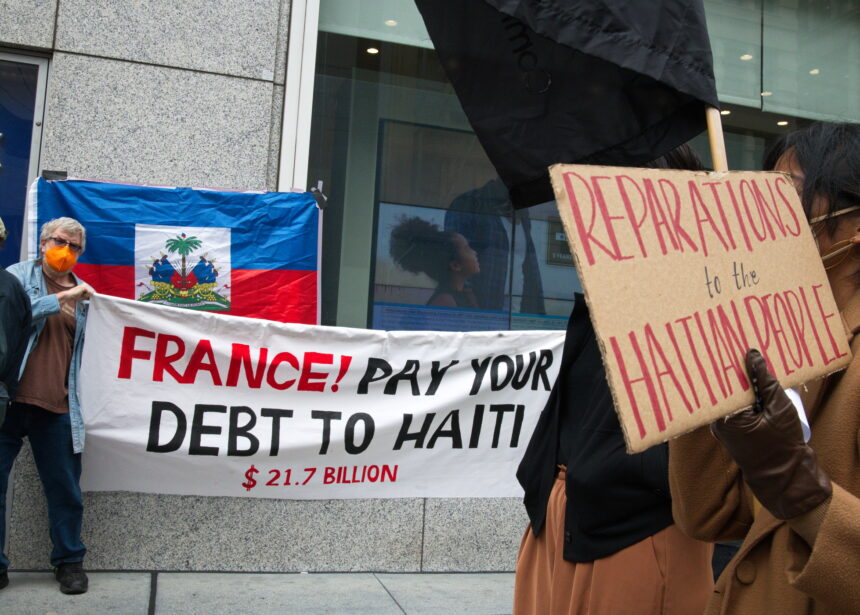
On the second centenary anniversary of the odious order of 17 April 1825 by which France extorted 150 million gold francs over Haiti’s battle won independence, the Regional Executive Committee of the Assembly of Caribbean peoples demand justice, restitution, and reparation for Haitians
The Regional Executive Committee of the Assembly of Caribbean People wishes to express its indignation on the occasion of the 200th anniversary of the ransom imposed on Haiti by an order of King Charles X of France on 17 April 1825 demanding payment of the exorbitant sum of 150 million gold francs as a condition for recognition of the independence won on the battlefield 21 years earlier.
On this painful anniversary, the Assembly of Caribbean People is launching a vibrant appeal for general mobilisation to demand that France repay the sums extorted from the young republic in full and pay appropriate reparations for the immense and lasting damage caused to Haiti from more than 300 years of slavery and by the odious order of 17 April 1825.
Since the resounding victory of the enslaved people of Haiti and the proclamation of a new independent Republic on 1 January 1804, the French Empire has done everything in its power to suffocate the young nation, place it back under the colonial yoke and re-establish slavery. The ordinance of 1825 was not simply a scam but part of the struggle led by powerful capitalists against freedom and the rights of peoples. The France of the Bourbons wanted to re-establish the monarchy and reconstitute a shaken colonial order and re-establish the institution of slavery, as demonstrated by the documents seized by Henry Christophe a few years earlier in the suitcase of one of the emissaries who had come to negotiate an “indemnity” in favour of the slave-owning colonists.
As well as punishing those who dared to challenge the colonial order, the Ordinance sought to erase the victory of 1803 and reintegrate the Haitian economy into the world system by ensuring the continuity of the plundering. It is vital for the global capitalist system to demonstrate that oppressed peoples cannot and must not revolt, and that any process inspired by that Haitian gesture could only lead to painful failure.
It is important to point out that the customs of the time, which continued to be applied for many centuries, meant that at the end of a war it was the defeated side that had to pay compensation to the victor. We won the war and had to pay the vanquished. The circumstances in which this ransom was imposed leave no doubt as to the odious nature of the operation. The commission led by Baron Mackau that came to impose the ransom, were accompanied by several warships equipped with more than 500 cannons. With, of course, the threat to destroy the city of Port-au-Prince if President Boyer refused to sign. This is an emblematic case of odious debt as defined at the end of the 19th century and formalised by Alexander Sack in 1927.
In the text of this infamous ordinance, the name of Haiti is never mentioned; it refers to the inhabitants of the western part of the island of St Domingue.
There are two main points to note:
a) the central importance of the colony of St Domingue, which generated 40% of world production and represented a fabulous source of accumulation for French capitalists;
b) the radical nature of the Haitian revolution, which combined independence, self-determination of peoples, social revolution, anti-slavery, internationalism and revolutionary pan-Africanism, and which postulated a true globalisation of human rights based on the principle of the equality of all human beings (‘tout moun se moun’).
In 1838, following long and difficult negotiations, the amount of the debt was reduced to 90 million gold francs. However, this new agreement reinforced the conditions already mentioned in the ordinance, which structured a new relationship of dependence between Haiti and France. Under the agreement, Haiti was obligated to sell its coffee at 50 per cent less than the world market price, and to grant preferences to French ships arriving in Haitian ports, which would only have to pay 50 per cent of the customs duties charged by the country's customs authorities. A monstrous attempt to revive Colbert's principle of exclusivity.
How did they arrive at the initial figure of 150 million gold francs? They calculated the value of the plantations lost by the slave-owning colonists as a result of the Haitian revolution and the value of food exports. This calculation included the market value of the slaves. Slavery was abolished in St Domingue in 1793 and in France in 1794. Charles X's decree reaffirmed that human beings were only objects intended to provide profits for the owners of capital. One of the most powerful messages of the Haitian revolution was the proclamation that no human being could be treated as a commodity and the radical equality of all human beings (‘Tout moun se moun’). The Haitian revolution is a decisive step towards the demarchandisation that is essential to the establishment of societies free of all forms of oppression.
Also, the Taubira law of May 2001 passed by the French Parliament recognises that slavery is a crime against humanity. We hope that the fight for full restitution of the colossal sums stolen from the Haitian people will be linked to CARICOM's just demands for reparations for the crime of slavery committed over several centuries by the European powers. In the lively debates that followed the Haitian Government's and Senate's acceptance of the proposal, one Haitian writer suggested that France will sooner or later have to pay the unpaid wages of Africans enslaved on our soil for more than 300 years, who generated an impressive volume of profits for the European ruling classes.
The payment of the ransom had devastating consequences for Haitian society. To cite one example, according to the archives of French banking institutions, the debt service paid by the Haitian State in May 1841 was transported in boxes weighing 1968 kilograms and containing 85961 gold coins. Several studies calculate that the amount paid by Haiti reached 520 million euros. The service of this ignominy generated an extraordinary haemorrhage of financial resources that conditioned Haiti's finances for 127 years. The 150 million gold francs demanded in 1825 represented 10 times the State's annual tax revenue and 300% of Haiti's annual GDP. To pay the annual instalments from 1828 onwards, the Haitian State had to borrow from French banks, which applied usurious rates and unfair practices.
Devoting the bulk of tax revenues (sometimes more than 70 per cent) to the payment of this ransom obstructed the process of construction and paralysed public investment in basic infrastructure and essential education and public health services. Faced with a lack of funds to pay the annual ransom, the Haitian government had to sell a large volume of precious wood on the international market, accelerating the process of deforestation that had already begun during the period of French colonisation. Thousands of tonnes of mahogany, guaiac and campêche were cut down, destabilising the agricultural ecosystems, and reducing productivity of the peasant economy.
The amount that France must repay immediately needs to be studied in depth. President Jean Bertrand Aristide spoke of 21.7 billion US dollars, the economist Thomas Picketty speaks of an unavoidable repayment of 28 billion US dollars and other studies estimate this repayment at 115 billion US dollars minimum by counting what many historians call the double debt. These sums represent only a small portion of the immense damage caused to the young republic. The amount of the restitution of the sums stolen by France must be determined by the Haitian people, in particular the peasantry, who suffered so painfully from the ravages caused by this neo-colonial domination. The Haitian people must be the main players in the reconstruction process. They must set the amount of restitution and define a process for appropriate reparations. They cannot accept repayment mechanisms that, like Charles X's order, call into question or violate their sovereignty and dignity.
The fight we are waging today with the Haitian people to demand justice, restitution and reparation has an important symbolic dimension and is at the heart of the fight against neo-colonialism, imperialism and all the mechanisms of capitalist domination that reduce our peoples to hunger, misery, over-exploitation and despair.
We call on the Peoples of the world to demand that France pay the entire sum owed to Haiti. This payment cannot be less than the 115 billion US dollars which only compensate for part of the damage and harm caused by this criminal ransom. We also call on the peoples of the world to rise up against capitalist domination by associating themselves with the cardinal values of justice, solidarity and dignity enshrined in the great Haitian revolution of 1804.
No to slavery debt! No to the commodification of human beings!
Long live revolutionary solidarity among peoples!
France must immediately repay the sums extorted from the Haitian people!
Haiti must finally emerge from more than 200 years of solitude imposed by imperialist powers!
Justice, restitution, reparation!