


Cuba and Caribbean Sovereignty: An Unpayable Debt
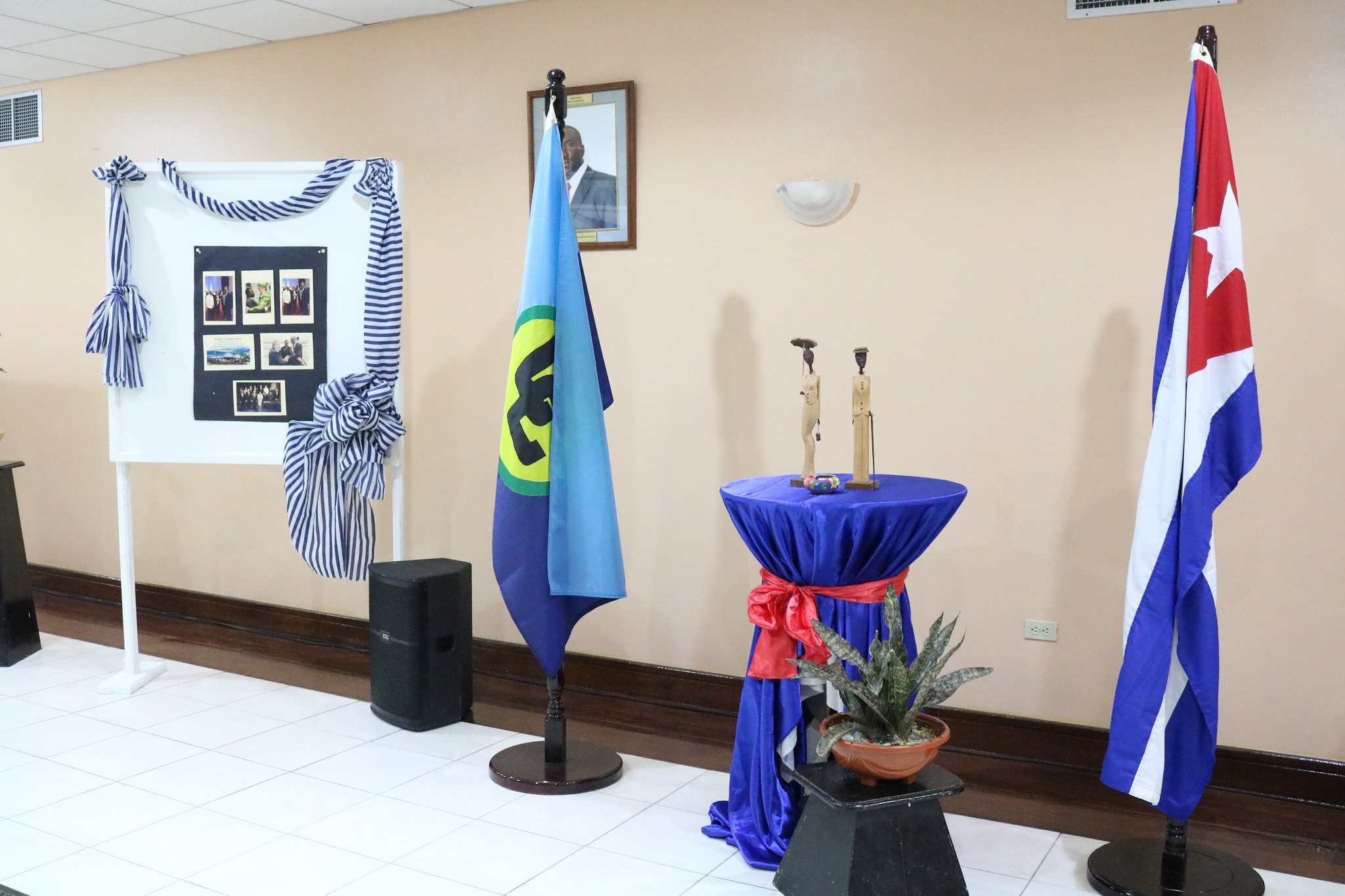
An analysis of the debt the Caribbean states owe Cuba given the country’s numerous contributions to the Caribbean and their reciprocal responsibility towards Cuba.
The USA and Existential Threats to Cuba
Closely coinciding with the US government’s kidnapping and incarceration of the President of Venezuela Nicolas Maduro and his wife Celia Flores, has been a clear and openly acknowledged intention on the part of the US, to isolate, squeeze, starve and ultimately destroy the Cuban government and its people and to crush the Cuban revolution. Drunk on the euphoria of the rapid beheading of the Bolivarian Revolution and the asserting of US control over the oil resources and oil revenue of Venezuela, the US secretary of state, of Cuban émigré origins, made openly declarations about US intentions to control the Western hemisphere and he issued a specific warning to Cuba, declaring that “Cuba is in a lot of trouble” and that he would “be very concerned if he were a government official in Cuba” (in NBC News Online 2026).
Since this declaration, the US has undertaken several decisions in conformity with this new stance of uncompromising aggression towards the Caribbean and Latin America. Significantly, these new actions do not conform to the usual acts of sanction normally associated with an imperialist power seeking to crush a rival state. Instead, the actions undertaken by the Trump administration towards the Caribbean pointed to a new phase in which every day, banal, ordinary internal policy decisions of Latin American states were being “directed” by the US, in ways that seemed deliberately provocatively demeaning and belittling, and were meant to mock and scoff at those countries sovereign claims and aspirations.
As evidence of these intrusive and sovereignty-subverting actions by the US have been a recent revelation by a Caribbean Prime Minister that the US had insisted that citizens of his country should be disallowed from pursuing medical degrees in Cuba (see Wilkinson 2026a). While the US would later issue a denial to this claim, US officials continued to “call for an end to exploitation and forced labor in the illegitimate Cuban regime’s overseas medical missions program” (Wilkinson 2026b). What these events reveal however, is that heightened direct interference in the day-to-day policy decisions of Caribbean and Latin American states, had now become a feature of the new “Donroe Doctrine” of the Trump Presidency.
Linked to these deliberate acts of humiliation have been related US policies intended to undermine the economic livelihoods and social living of Caribbean people and to induce instability and chaos in the region. One such policy was the denial of visas to countries of Latin America and the Caribbean which put in jeopardy the livelihoods and social aspirations of thousands of Caribbean and Latin families (see White House Presidential Actions 2025).
More ominously, have been the bombing of fishing boats in Caribbean waters by the US military, followed by boasts about “new” weaponry. Significantly, these bombings have continued long after the US operation to kidnap the President of Venezuela, and as recently as fishermen from the small Eastern Caribbean states of St. Lucia and St. Vincent and the Grenadines were killed in the territorial waters of St. Vincent and the Grenadines (see Trumpet News 2026).
These acts of economic and political aggression by the Trump administration towards the countries of Latin America and the Caribbean cannot be dismissed as episodic or as Trump-specific diplomatic failures or as crude actions of an uninformed President who has underestimated the benefits of mutual inter-dependence and soft-power to US hegemony itself. Instead, these developments represent a deliberate and dangerous structural shift in US foreign policy associated with the ending of US global power, but manifesting as heightened militarism and political aggression in the Western Hemisphere, as a last-ditch effort to project strength, despite its internal economic decline and despite global political competition from regions like China and the BRICS alliance.
Whatever the rationale for this renewed US aggression, one of its most direct and pernicious manifestations is the current policy of isolation and destruction of Cuba. This objective of destroying Cuba has been most directly reflected in the US government’s placing direct pressure on Cuba’s neighbors to cut off oil supplies to Cuba. This was achieved through an Executive Order of January 29, imposing penalties on countries supplying Cuba with oil, a development which the UN has warned will create a humanitarian disaster (MSN News 2026). According to its specific intentions, the Executive Order, proposes to:
- impose a new tariff system that allows the United States to impose additional tariffs on imports from any country that directly or indirectly provides oil to Cuba.
- Authorize the Secretary of State and Secretary of Commerce to take all necessary actions, including issuing rules and guidance, to implement the tariff system and related measures, and it
- Empowers the President to modify the Order if Cuba or affected countries take significant steps to address the threat or align with U.S. national security and foreign policy objectives (White House Fact Sheet 2026).
The immediate impact of this executive order has been seen in the starvation of oil resources, resulting in severe shortages in Cuba, blackouts presenting a potential humanitarian crisis in that country. Ominously, MSN Online News in a headline entitled “Trump Openly Cheers Starvation as a Deal Making Tactic”, quotes Trump gloating that “Cuba right now is a failed nation, they don't even have jet fuel for airplanes to take off, they're clogging up their runway… I have Marco Rubio talking to Cuba right now, and they should absolutely make a deal. It’s really a humanitarian threat” (MSN Online News 2026).
No Caribbean Sovereignty Without Cuba
It is in such a context that the states of Latin America and the Caribbean are being called upon to remember their debt to Cuba, and to push back against the US desire to starve and crush Cuba and are being called to identify concrete measures through which Cuba can be defended and supported in this current moment.
As a first step towards pursuing such resistance, it is important to remind global Africa of Cuba’s contribution to the Caribbean, and by extension to Third World and Black liberation. Specifically, since Caribbean governments are being coercively enrolled in this current US push to destroy Cuba, it is important that Caribbean leaders and people reaffirm their understanding of why the Cuban revolution has been central to the independence, sovereignty and freedom of the Caribbean region.
It is impossible to accurately quantify the Caribbean’s historical debt to Cuba. Without the Cuban revolution, the Caribbean post-colonial experience would have been far more imbued with features of neo-colonialism than is currently the case. The independence of the English-speaking Caribbean states would have been diminished, neutered and rendered ineffectual and meaningless had there not been a Cuban revolution which created new spaces and widened the possibilities for self-actualization and for self-determined Caribbean action. The Caribbean states today would have existed largely as underdeveloped peripheral satellites to US imperial power had it not been for the psychological, geopolitical, economic and political impact of the Cuban revolution, reshaping the framework within which the small, black-majority states of the Eastern Caribbean were able to exist and develop as sovereign entities in a hostile world.
Cuba’s contribution to the sovereignty of Caribbean states can be highlighted in three broad ways: (a) as a concrete example of anti-colonial, anti-neo-colonial and socialist development, (b) as an example of uncompromised sovereign practice and sovereign existence, and (c) as a provider of material support to Caribbean development.
(a) Cuba as an Example of Socialist, Anti-Colonial, Anti-Neo-colonial Development
First, Cuba’s example as a socialist state, 90 miles from Florida, and under a crushing US economic embargo since the early 1950s, provided a tangible demonstration that a concrete alternative to the dictates of global capitalism was possible by small states, even when under direct threat from the world’s most dominant power. Not only is Cuba a small socialist state, but it has pursued a framework of internal consolidation and development which has allowed it to exist as a key actor on the global stage. It has a highly developed military. It has an extensive and sophisticated diplomatic service. It has a sophisticated intelligence network. Cuba also developed a strong civil society network of popular civic organizations and offered a model of internal democratic development which deviated from the formal Westminster-type limited democracy which was inherited in the English-Caribbean. These popular civic organizations have not only been critical for the defence of the revolution, but have also contributed to Cuba’s ability to withstand several decades of sabotage from the world’s most powerful country.
In a context where most Caribbean states were coming to independence as weak, neo-colonial states in the 1960s and 1970s, with little experience of navigating global politics as sovereign states, the presence of Cuba as a fully consolidated socialist state with a highly developed social system and which had resolved many of the economic and social problems which had continued to plague the Caribbean, was a profound example of what was possible. Cuba’s socialism, anti-imperialism and principled non-alignment had a profound impact on how the states of the English-speaking Caribbean defined their own sovereignty. Indeed, many of the small left-wing, and left-of-centre parties in the Caribbean began to fashion their manifestos against the background of what had been achieved in Cuba.
(b) Cuba as an Example of Uncompromised Sovereign Practice and Existence
The second intangible and immeasurable contribution which Cuba has made to Caribbean independence was through the example of how Cuba has used its sovereignty.
The independence movement in the Caribbean took place under a cloud of debate about “size”, “viability” and the minimal requirements of sovereignty (Lewis 1975). Many of these countries, like Grenada, St. Lucia, Antigua, St. Vincent and others were coming to impendence as “Associated States” of Britain, and with no previous jurisdiction over or experience with “foreign policy”. They had no practical experience of how the newly won instrumentality of independent statehood could be used to develop relations with countries outside the orbit of North America and Western Europe. As the first Prime Minister of Jamaica Alexander Bustamante put it “we are with the West”, or according to the first Prime Minister of St. Lucia, his country could fly “neither in the face of history or of geography”. As a result of such a limited world-view the leaders of these countries, without the example of Cuba, would have been unable to fashion a robust and confident post-colonial world-view for themselves, beyond the “politics of inadequacy” (Thorndyke 1979) which had been pre-determined for them by their colonial histories beginning in 1500.
(c) Cuba as a Provider of Material Support to Caribbean development
The final and most obvious way in which revolutionary Cuba has contributed to shaping and sustaining the sovereignty of Caribbean people has been through its tangible material support to Caribbean governments since formal diplomatic relations were established between Cuba and the four independent states of Guyana, Jamaica, Trinidad and Tobago and Barbados in 1972. Cuba’s support in the areas of health, education, sports, agriculture, engineering, culture and the arts to the Caribbean is one of the most storied examples of principled international solidarity.
There are thousands of professionals in all fields, hundreds of professional athletes including Olympic gold medalists, thousands of Spanish-speaking bi-lingual Caribbean citizens, and millions of persons who have been healed from various ailments, whose lives have been transformed for the better because of the Cuban revolution. Indeed, it was reported in 2006 that over a quarter million Caribbean and Latin American citizens had their sights restored by Operation Milagro, the eye-care program organized between Hugo Chavez and the Cuban government (Cuba Solidarity Campaign 2026).
Given the failure of Western capitalist countries to offer sustained levels of assistance and to make genuinely reparatory payments at the moment of independence (Beckles 2021), the role of Cuba in offering such a wide range of economic and social development assistance has been absolutely indispensable to the kinds of post-colonial development that the Caribbean states were able to achieve.
Conclusion: The Caribbean and Black Africa Cannot Abandon Cuba
It is clear therefore that the sum of what we have called “the independence and sovereignty of the Caribbean” would have been significantly diminished and inconsequential had it not been supported by the presence of the Cuban revolution. The Caribbean owes an unpayable debt to Cuba. It would therefore be a profound moral failure on the part of Caribbean governments and people were Cuba to be abandoned at this critical juncture in the history of its revolution and in the history of global imperialism.
While many Caribbean governments appear to be hamstrung in the face of an aggressive US power, it is even more necessary now that the voices of Caribbean leaders be heard in defence of the survival of Cuba and in condemnation of the calculated humanitarian crisis, which the US is orchestrating against Cuba. Relatedly, given the apparent weaknesses of Caribbean leaders in the face of US power, it is necessary for the Caribbean people, academia, civil society organizations to put pressure on their governments to resist the isolation of Cuba, or to themselves directly amplify their voices and their actions in direct support of Cuba and its people. The Caribbean simply cannot allow Cuba to fall. If Cuba fails, Caribbean sovereignty will come to an end. As one writer has noted, “Trump’s corollary to the Monroe Doctrine aims at taking over the entire region, which he is effectively achieving with the complicit silence of the region’s governments, social organizations, and academic institutions” (Caro 2026).
Tennyson S.D. Joseph is a Caribbean national and a member of the Global Pan-African Movement (GPAM – North America). He is a former Senator in the Parliament of St. Lucia and is currently an Associate Professor of Political Science at North Carolina Central University.
References
Beckles, Hilary. 2021. How Britain Underdeveloped the Caribbean: A Reparation Response to Europe's Legacy of Plunder and Poverty, Kingston: The University of the West Indies Press.
Caro, Ariela Ruiz. 2026. “Cuba: Once Again the Target of the US Government”, in Counterpunch (Online) Feb. 19, 2026 (Downloaded February 19).
https://www.counterpunch.org/2026/02/19/cuba-once-again-the-target-of-the-us-government/
Cuba Solidarity Campaign. 2026. “Cuba Restores Sight to Nearly a Quarter Million Latin Americans”, in Cuba Solidarity Campaign (Online) June 7, 2006. (Downloaded February 17, 2026).
Lewis, Vaughan. 1975. Size, Self-Determination and International Relations: The Caribbean, Jamaica: Institute of Social and Economic Research, UWI.
MSN Online News. 2026. “Trump Openly Cheers Starvation as a Deal Making Tactic”, in MSN Online News, February 17. (Downloaded February 17, 2026).
NBC News Online. 2026. “Marco Rubio Says he Believes Cuba is in a lot of Trouble”, NBC Online. January 4, 2026. (Downloaded February, 19, 2026).
Thorndyke, Anthony. 1979. “The Politics of Inadequacy: A Study of the Associated Statehood negotiations and constitutional arrangements for the Eastern Caribbean, 1965-67”, in Social and Economic Studies, Volume 28 No. 3, September. Pgs. 567-617.
Trumpet News. 2026. “US Military Strike in Caribbean kills 3, Saint Lucian Fishermen Feared Among Victims”, in Trumpet News (Online) February 17, 2026. (Downloaded February 19, 2026).
White House Presidential Proclamations. 2025. “Restricting and Limiting the Entry of Foreign Nationals to Protect the Security of the United States” in White House Presidential Proclamations (Online), December 16, 2025. (Downloaded February 17, 2026).
White House Fact Sheet 2026. “President Donald J. Trump Addresses Threats to the United States by the Government of Cuba”, White House Fact Sheet (Online). The White House, January 29. (Downloaded February 17, 2026).
Wilkinson, Bert. 2026a. “US Pressures St. Lucia to Ban Students Studying in Cuba”, in Amsterdam News (Online) February 5, 2026. (Downloaded February 19, 2026).
https://amsterdamnews.com/news/2026/02/05/us-pressures-st-lucia-to-ban-students-studying-in-cuba/
Wilkinson, Bert. 2026b. “Diplomatic Denial: “U.S. says it never told St. Lucia to drop Cuban Medical Program”, in Caribbean Life (Online) February 5, 2026. (Downloaded February 19, 2026).
https://www.caribbeanlife.com/diplomatic-denial-u-s-says-it-never-told-…