


AFCON 2025: A Title Re-Decided Off the Pitch and What It Reveals About Power Relations in Africa
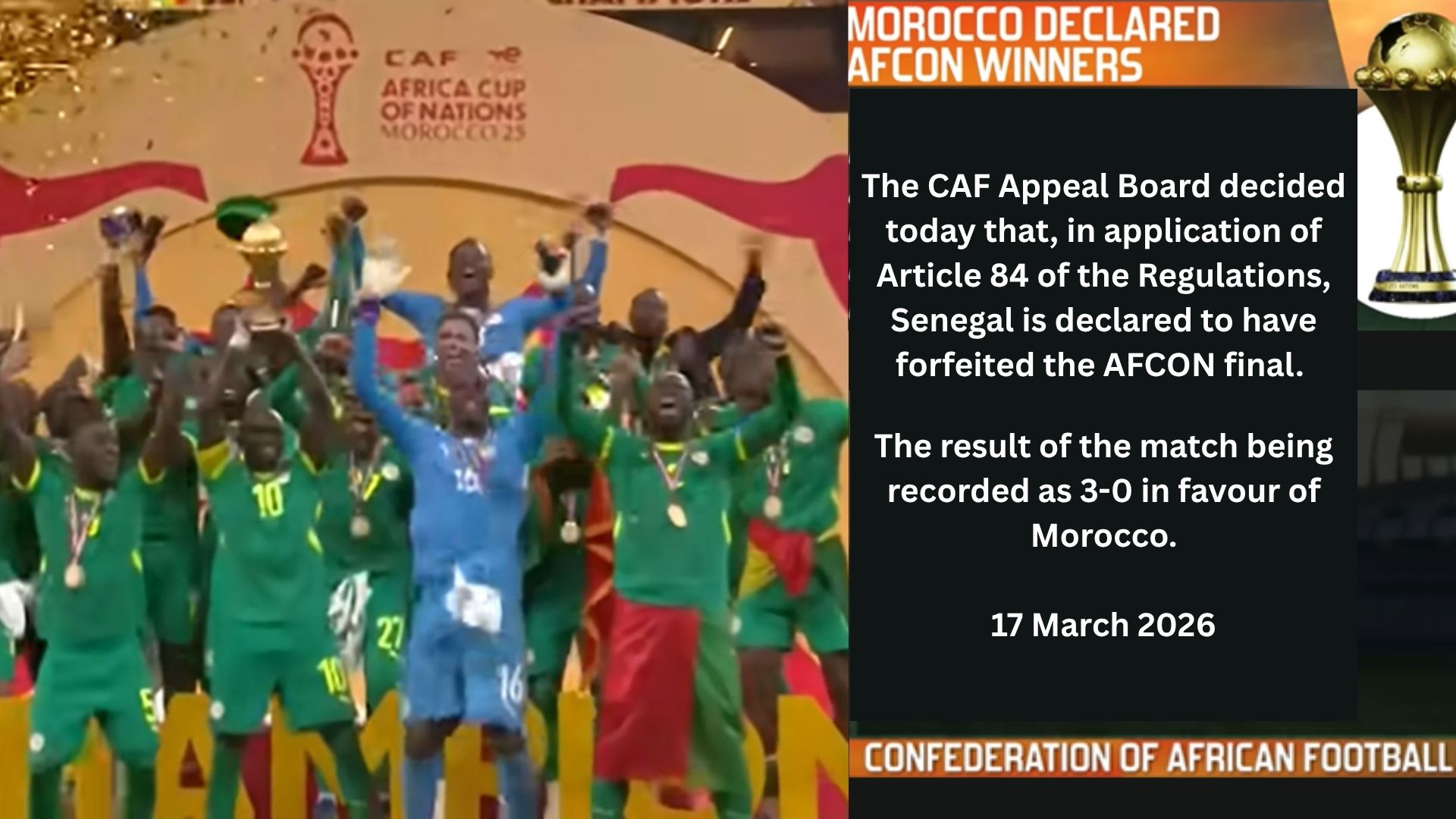
Senegal was declared the winner of AFCON 2025 on the pitch; power structures have determined that the post-tournament winner is Morocco.
Fifty-seven days after the final whistle was blown, the Confederation of African Football (CAF) changed the result of Africa's biggest football tournament. Morocco is now declared the winner of AFCON 2025, not because of a goal scored during the match, but because of a decision made weeks later. Senegal, who had celebrated victory on the field, has been stripped of the title after officials ruled that their protest during the match counted as forfeiting the game.
This is not just a football story. It raises deeper questions about fairness, power, and how decisions are made across Africa.
In January 2026, thousands of Senegalese fans filled the streets of Dakar and cities around the world. Their national team, known as the "Lions of Teranga," had defeated Morocco 1–0 in a tense and competitive final. People celebrated with music, flags, and fireworks. For many, it was a moment of pride not only for Senegal, but for African football as a whole.
Now, weeks later, that moment has been taken away. This raises an important question: who really decides what counts as victory? Football rules stipulate conditions under which abandonment and forfeiture can be uncontestably applied. Within the rules, the penalised team should refuse to play after referee instruction, and the referee unable to resume the match and continue the game to its conclusion. Legal experts in football law will explain abandonment as a permanent stop of the match. When the match referee and the match commissioner have supervised the resumption and continuation of a game, a central question arises: should this be more appropriately viewed as suspension instead of abandonment, which leads to forfeiture?
In drawing on Articles 82 and 84 of CAF regulations, one is unable to affirm the actual time limit a suspension of a game should take to become default abandonment that leads to forfeiture. We are also not informed by FIFA’s Law 5 (referee authority in abandonment) and 7 (duration or non-completion of the match), and disciplinary codes that strictly state the maximum suspension time after which a resumed game played to its conclusion can still be deemed abandoned and attract the forfeiture punishment. As Senegal’s legal challenges to the CAF decision evolve, these and other questions that will emerge will shape the political and legal landscape of African football in the coming decades.
These questions connect to broader ones about the dispossession of Africans from many achievements in their intellectual and revolutionary struggles. Why do international systems and structures want to take away all victories from African peoples, whether the victory of the Haitian Revolution, the victory at Cuito Cuanavale or the victory of the Senegalese soccer players?
Many fans across Africa watched the match and believed they saw the better team win. They saw skill, discipline, and determination on the field. For them, this was not just Senegal's victory. It was a victory for the spirit of the game itself.
At the same time, this decision reminds us of past problems in global football. In 2015, FIFA was shaken by a major corruption scandal. Top officials were accused of taking large bribes and using their positions for personal gain. Some were arrested; others were banned from football entirely. This moment forced many people to question whether football was being run fairly.
That history matters today. It leads many to ask: has football really changed, or do the same problems still shape major decisions?
Beyond the Game: Fairness and Trust
As we noted in our earlier editorial, African football is more than entertainment. It is a space where people see their hopes, talents, and identities reflected on a global stage. AFCON represents unity, pride, and excellence among Africans.
In January 2026, thousands of Senegalese fans filled the streets of Dakar and cities around the world. Their national team, known as the “Lions of Teranga,” had defeated Morocco 1–0 in a tense and controversial final. People celebrated with music, flags, and fireworks. The victory also coincided with a public homage to Patrice Lumumba, whose legacy of African unity and resistance resonates deeply with fans across the continent. For many, this moment was a celebration not only of football, but of African pride, solidarity, and history.
But when a result is changed nearly two months later, confusion replaces celebration. For younger fans especially, it can be hard to understand how a game can end one way and then be decided differently later. If results are not final on the field, then where are they truly decided?
For decisions to be respected, they must be clear, timely, and easy to understand. When they are delayed or unclear, people begin to lose trust.
Rules, Power, and Fairness
CAF justified its ruling by citing regulations on teams abandoning matches. Rules are important because they help keep the game fair and ensure everyone knows what is expected. But rules only work if they are applied consistently and without bias. That the match was resumed by the referee and the Senegalese team continued to play provides a context for a continuing legal struggle over the championship title for the 2025 AFCON.
The problem is that it is not always clear whether the rules are applied equally to all teams. CAF's own record provides a striking illustration. In the 2019 CAF Champions League final between Wydad Casablanca of Morocco and Espérance Sportive of Tunis, Tunisia, Wydad walked off the field and refused to resume play for nearly ninety minutes after a disallowed goal and a malfunctioning VAR system. Yet CAF did not uphold the referee's abandonment-based outcome. Its Executive Committee controversially ordered a replay — an unprecedented intervention that was later struck down by the Court of Arbitration for Sport, which restored Espérance as champions. By contrast, in the 2025 AFCON final, CAF applied a strict, automatic forfeiture against Senegal for a far shorter walkout — despite the team returning to complete the match and winning on the field — retroactively awarding the title to Morocco under Article 84. In 2019, a full abandonment did not produce an enforced forfeiture. In 2025, a temporary protest that did not prevent the match from reaching its conclusion was deemed a forfeiture-worthy violation. This stark contrast reveals not simply a legal ambiguity, but a pattern of selective interpretation that corrodes confidence in the institution's impartiality.
In Africa, countries and federations have very different levels of resources, influence, and international connections. When decisions seem to favor some over others, even indirectly, fans naturally question whether the system is fair.
Adding to this concern is the way CAF's disciplinary and ethics committees operate. These bodies are responsible for reviewing incidents, interpreting rules, and making final decisions on issues like protests, suspension or match abandonments. Members include lawyers, former judges, and football administrators from across Africa. While they are meant to be independent, the selection process is largely internal, and the deliberations behind their rulings are not made public. Fans, media, and even teams rarely see how evidence is considered or why a decision is reached. This lack of transparency makes it hard to know whether outcomes are consistent or influenced by politics, money, or regional power differences.
It raises the important question: if the process is hidden, how can people trust that the result is truly fair?
This issue is not unique to football. When decisions that affect entire nations are made behind closed doors, it can feel familiar to many Africans because it resembles a broader experience with global systems of rules. Why are the rules of the International Monetary Fund (IMF) not applied evenly across the globe? As described in Time magazine, the so-called "rules based international order" is seen by many African thinkers — including economists like Hippolyte Fofack — as a system that appears neutral but is structurally skewed to benefit powerful nations.
In that system, rules can disguise power relations in trade, politics, and economics that have historically exploited the continent and her peoples. For fans watching CAF's decisions unfold without clarity or explanation, the result can feel similar: a process that appears to serve certain interests while leaving ordinary people on the outside.
So, the issue is not just about following rules. It is about whether those rules are applied in a way that inspires confidence among African fans and football lovers around the world.
Hosting, Influence, and Unequal Power
It is also important to note that Morocco, the country that benefits from this decision, hosted the tournament. This does not mean the Moroccan team did anything wrong. This is not to challenge the people of Morocco who are themselves fighting an oppressive monarchical clique. However, it highlights a broader issue.
Not all countries have the same level of influence in African football. Some federations, particularly in North Africa, have historically had more resources and stronger international connections. This can give them greater visibility and influence in continental decisions.
Morocco's own history illuminates this tension. The Moroccan monarchy has long functioned as a comprador ruling class, orienting the country's political economy toward European capital and metropolitan interests rather than continental African solidarity. This alignment was expressed most starkly when Morocco applied to join the European Union — a bid that was refused — while simultaneously participating in African competitions. Only after that avenue closed did the monarchy move to re-engage African continental institutions, a strategic repositioning that reflected elite calculation rather than any transformation in class interest. The Moroccan people, who have their own rich traditions of resistance against this monarchical order, are not implicated in these arrangements. The question is whose interests are served when CAF's decisions consistently align with the preferences of a ruling class that has historically looked northward across the Mediterranean rather than southward across the Sahara.
These dynamics shape how people interpret decisions. When outcomes appear to align with existing power differences, they raise concerns about whose interests are being prioritized.
A truly united African system must work actively to reduce these imbalances, not reinforce them.
The Silenced Voice: African Fans
Perhaps the most overlooked group in this situation is the fans. Millions of Africans followed the tournament closely. They celebrated, debated, and emotionally invested in every match. Senegalese fans believed they had witnessed a historic victory. They saw a match that was paused, match officials did not declare abandonment, walk-off in protest had been called off, and the match continued under normal control of the referee into extra time with a 1-0 win over the Moroccan team. Now they are told that what they saw no longer counts. This creates a disconnect between official decisions and lived experience.
Football is powerful because it belongs to the people. It connects communities across borders, languages, and cultures. But when major decisions are made without clear and timely explanation, fans can feel excluded and ignored.
A Crisis and an Opportunity
This situation is not just about one match. It reflects broader challenges in how decisions are made and communicated across African institutions. Delays, lack of clarity, and uneven influence all contribute to growing frustration. At the same time, this moment offers an opportunity for change.
CAF and other continental bodies can take steps to rebuild trust by making decisions faster and within clear timelines, explaining rulings in ways that ordinary people can understand, ensuring that no country or federation has unfair influence, and creating independent systems to review major decisions.
Senegal Names It: The Call for an Independent Investigation
On March 18, 2026, the Senegalese government moved beyond protest into formal accusation. In an official communiqué, government spokeswoman Marie Rose Khady Fatou Faye declared that Senegal "unequivocally rejects this unjustified attempt at dispossession" and called for an independent international investigation into suspected corruption within CAF's governing bodies. The government described the ruling as "grossly illegal and profoundly unjust," arguing that it "stems from a manifestly erroneous interpretation of the regulations." The Senegalese Football Federation simultaneously announced its intention to appeal before the Court of Arbitration for Sport in Lausanne. What makes this moment significant is not merely the legal challenge — it is that a sovereign African government has formally named corruption as the operating logic behind a continental institution. That is a political act with consequences far beyond football.
The dimensions of this scandal extend further still. Eighteen Senegalese fans were jailed in Morocco following the chaos of the January 18th final, receiving sentences ranging from three months to a year. Prime Minister Ousmane Sonko told the Senegalese parliament that the matter had gone "beyond the realm of sport." Meanwhile, the referee who allowed the match to continue after Senegal's 14-minute walkoff — rather than awarding Morocco the win immediately — now finds that same walkoff cited retroactively as grounds for forfeiture. The contradiction is glaring. A match played to its conclusion, won in extra time, with a goal scored and a trophy lifted, has been converted by administrative decree into a 3-0 defeat. If that is the application of rules, then the rules themselves require urgent examination.
Reclaiming the Promise of African Unity
Pan Africanism is built on the idea that African institutions should serve African people with fairness, dignity, and respect. Sport is one of the clearest ways this idea comes to life. At its best, football rewards effort, teamwork, and talent. It gives people hope and a sense of belonging. But when results are decided far from the pitch, that promise is weakened.
AFCON 2025 will be remembered not only for what happened during the match, but for what happened after. The real challenge now is whether African institutions can learn from this moment and do better.
Because in the end, victory is not just about who holds the trophy. It is about whether people believe the result is fair—and whether they can trust the system that made that decision.
The Past as Moral Fuel in Pan-African Thought
In Pan-African political thought, historical memory is not merely archival — it is a living force that animates present struggles. The past functions as moral fuel because it demonstrates, against the logic of colonial and neo colonial dehumanization, that African and African-descended peoples have always been agents of their own liberation.
When enslaved Africans resisted captivity, when African societies mounted resistance to colonial conquest, when thinkers from Sembene Ousmane, Yaa Asantewaa to Kwame Nkrumah to Walter Rodney built frameworks of freedom, they deposited courage into a collective account that future generations draw upon. The past provides a moral center that refuses the colonizer's narrative of African passivity, sets firm boundaries on what is politically acceptable, and holds the present accountable to a standard forged in struggle.
Haiti and the Lessons for African Sport
The Haitian Revolution of 1791 to 1804 remains central to Pan-African thought and action because it accomplished what Atlantic slavery insisted was impossible: enslaved African people organized, fought, and won.
For two centuries, European Historians have rendered the Haitian Revolution unthinkable. We urge the African youth to read this essay by Michel-Rolph Trouillot, "An Unthinkable History: The Haitian Revolution as a Non-event" (1995). In this essay, Michel-Rolph Trouillot argued that the Haitian revolution was "unthinkable" because it defied the Enlightenment-era framework of racism and colonialism, making a successful slave revolt impossible to conceive in Western discourse. Haiti gives focus to political struggle by proving that the most entrenched systems of racial domination can be overthrown — and it provides examples of courage that discipline the present, reminding us that the current order is never permanent.
It is the same today. An African team like that of a team from Senegal that kicked the French military out of Senegal in 2025 cannot win the African Cup of Nations, at least, not in the same year they kicked out France.
This historical consciousness matters urgently when we observe how AFCON's decision to deliver the 2025 tournament victory off the field to Morocco over Senegal reproduces precisely the logic that Pan-African movements have always resisted: the substitution of administrative power and political arrangement for the agency of African peoples themselves.
The ancestors who built movements for freedom did not do so for African institutions to become instruments of the same manipulation they fought against. What Haiti teaches is that legitimacy cannot be awarded — it must be won, on the field, by the people.
The Streets Know What the Committee Forgot
When Senegalese fans poured into the streets of Dakar, New York, Paris and Madrid in January 2026, they were not only celebrating a football result — they were enacting a living tradition of popular validation that no administrative body can manufacture or revoke. This is the moral fuel that Pan-African history provides: the knowledge that ordinary people, through collective joy, collective grief, and collective resistance, have always been the true arbiters of what is real and what is just.
The children who danced in those streets with Senegal's colors carry that memory in their bodies. No ruling issued weeks later in a closed committee room can reach inside that experience and unmake it. This is why the past matters — not as nostalgia, but as a standard.
African peoples have seen their victories stolen before, by colonial administrators, by imposed treaties, by rigged systems dressed in the language of law. They recognize the pattern. And they have always, in time, found ways to resist it.
Drawing the Line: What African Institutions Owe the People
The moral fuel of Pan-African history does not counsel despair — it demands accountability. Walter Rodney taught that underdevelopment is not an accident but a process, engineered through institutions that extract value while returning nothing to the people who generate it. When CAF operates without transparency, when its committees deliberate in secret, when its rulings arrive weeks after the fact to reverse what millions witnessed with their own eyes, it risks becoming one more institution that processes African energy for purposes other than African flourishing. The generation of fans, players, and organizers who love this game have every right — grounded in the long history of African struggle — to demand better. The Haitian revolutionaries did not accept the rules of a system designed to keep them in chains. The anti-colonial movements did not accept the legitimacy of borders drawn in Berlin.
The task now is the same: to insist that African institutions honor the people they exist to serve, beginning with the simple, radical act of letting the result on the field stand.
Horace G. Campbell is a peace and social Justice activist. He is also Professor of African American Studies and Political Science at Syracuse University and Chairperson of the Global Pan African Movement, North American Chapter. He is the author of Global NATO and the Catastrophic Failure in Libya, Monthly Review Press, 2013.