


The Togo Protests: A Challenge to a Revised Political Dynasty?
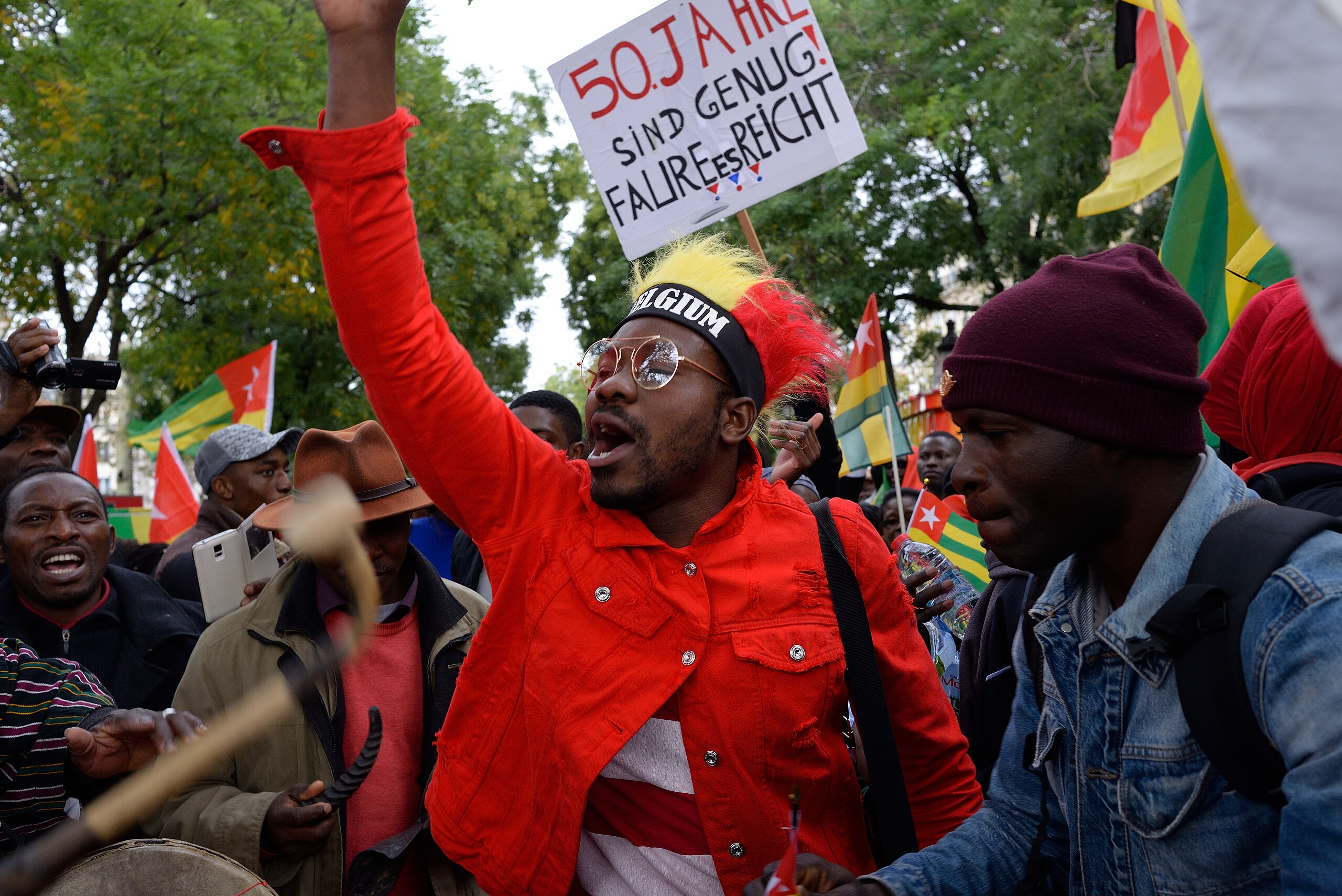

An exploration of the current protests in Togo, the background, and the demands that continue the recurrence of the agitations.
Togo, a West African country with a population of nearly 10 million and bordered to the East by Benin, West by Ghana, and North by Burkina Faso, South by the Gulf of Guinea, is no stranger to mass protests since its independence in 1960. It is one of the countries that has witnessed the force of colonial power, the coercive stretch of the post-colonial state, imperial roles in the assassination of leaders, and the unyielding spirit of youths and population demanding democratic and transformative changes in society. The forces that had assassinated Patrice Lumumba in the Democratic Republic of Congo in January 1961 also killed Sylvanus Olympio in Togo in January 1963 in the prologue of murdering African leaders who dared to secure independence and move beyond anti-colonial struggles to resist imperialist operations.
In the history of the African continent, leadership in some of the 54 countries has witnessed the violent overthrow of pro-African and pro-people transformation agendas under the machinations of France, America, or collaborations among the French and the US with British support. The leadership and factions that have been propped up to replace the African leadership they overthrew have, in most cases, tended to be dictatorial, undemocratic, and established dynastic orders that have sometimes resorted to brutal and repressive measures to perpetuate rule.
The story is not restricted to now African countries that were colonized by a single European nation but also some who were traded or taken as war trophies following victories or defeats in the globalized European wars of the 1900s. The African peoples in these nations sometimes engage in demonstrations to demand deserved participation in and decision-making about who should lead them and how long that leadership should last. The people have also sometimes rallied around the military, where uniformed personnel provided a sense of hope for the provision of avenues where their country's resources could be accessed by the citizens, and the democratic basis of society could be rebuilt.
In the eyes of European nations that may benefit from the modus operandi of oppressive regimes on the continent, repressive rule does not matter unless a democratic, military, or dictatorial regime in suit or green camouflage goes against the interests and dictates of France and America.
The Republic of Togo has been one of the countries in the crosshairs of this colonial and postcolonial history. From 1884, when Africa and its peoples were shared, divided, and regrouped among European countries who had initially been traders and war partners of some kingdoms of Africa, to the end of globalised European War I (WWI) in 1914, Togo, the Eastern part of Togoland[1], was claimed by Germany. The Germans ceded their claim to the French, and East Togoland became a French-administered League of Nations and later UN trusteeship until April 27, 1960. It was a move from the harsh treatment and African forced labour of Germany’s Musterkolonie (model colony)[2] to a system that would teach Africans to evolve to become assimilated and advanced into French citizenship, ‘an arrived status.’ The exploitation of resources, as seen in other colonised countries, did not cease. It took another dimension.
The liberation wind that had blown in Ghana under Kwame Nkrumah in 1957 was, however, witnessed in the French-controlled Togoland under Sylvanus Ephiphanio Olympio. But, the Togolese founding president, and leader of the Comité de l’Unité Togolaise (CUT), the major anti-colonial movement in French Togoland, spent barely three years in power after his election in 1961. He was assassinated by Étienne Gnassingbé Eyadéma, a sergeant in the French military.[3]
Olympio was replaced by Nicolas Grunitzky, a rival and the brother of his wife, Dina Grunitzky. There was, nevertheless, to be a second coming of Étienne Eyadéma in 1967, which would establish a post-independence dynasty in Togo. In the 38-year rule, there was intolerance of opposition and the administration, as observable in other African countries, was embroiled in charges of corruption and patronage.
With the passing of Eyadéma in 2005, there had been hope of democratization of the leadership selection process, where the people might have more say about who leads them. The dynasty however, materialised when Faure Essozimna Gnassingbé was appointed to replace his father in violation of the country’s constitution.[4]
The Protests
There have been several protests against Gnassingbé's rule in the 58 years of its existence. The coup that occurred under the pretext of avoiding a power vacuum led to protests in 2005, which were met with a brutal crackdown by the new regime. The French army stationed in Lome was under alert to act despite allegations of personal relations between the Togolese President and the French President Jacques Chirac, or perhaps for the sake of friendship and French interests.[5] About seven people died, and several protesters were injured.[6] The streets of the capital city of Lome were militarized.
Soldiers, police and members of an elite unit known as the Red Berets manned the city’s main intersections. Witnesses said earlier about 2000 people had gathered in Be with banners reading “Togo is not a monarchy” and “The coup d’etat will not succeed”.[7]
International condemnations from the Economic Community of West African States (ECOWAS), the African Union, the United Nations, and calls for a return to democratic rule by these blocs and the US did not put any pressure that would lead to democratic reforms in the country. The protest registered its disappointment, but the crackdown and dispersion of the protesters ensured the mass uprising could not be sustained to bring down a leadership that had the full backing of all the coercive forces in the Togolese state. Some analysts suggest that over 70 per cent of the military, and 90 per cent of the officer corps,[8] have been from Faure’s ethnic group, which forms about a quarter of the Togolese population, and remain loyal to the ruling family.
Ethnic stacking, the use of ascriptive identity and ethnic markings in constructing security institutions is not restricted to Togo nor is it new to the African continent.[9] Obviously, homogenous groups and spaces with large populations of a particular ethnic group might have disproportionate numbers of uniformed men from the larger group. In West Africa, colonial security forces mostly used one or few ethnic group(s) that were labelled as having ‘warlike spirits’.[10] Post-colonial militaries which derive mostly from the European-type bequeathed by the respective colonialists, have however not been spared by ethnicity, and the identifier has been instrumentalized in addition to other factors to conduct coups, or used by some regimes to maintain loyalty of the security apparatus and political hegemony.[11]
The various protests in Togo are thus also directed against the imbalance in representation in national institutions that should protect all Togolese. Mass uprisings against the Faure regime were also recorded in 2017 when several thousand Togolese took to the streets demanding that the president step down. They wanted an end to the Gnassingbé dynasty. The government had conceded by introducing a two-term presidential limit, but the proposed constitutional change could not dissuade the protesters from calling for an end to the cumulative 50-year rule of the Gnassingbé family.[12] The mass protests on the question of term limits continued until the 2019 Constitution included the provision that the President will serve for five years, renewable for two terms only.[13]
As the call to end the Gnassingbé dynasty increased, an innovative plan for the perpetuation of rule was unveiled in 2025. Togo switched to a parliamentary system with a ceremonial office of the president and a powerful President of the new Council of Ministers (PCM), who will have no term limits as the country’s prime minister. Unlike the 2019 constitutional provision, the PCM position grants a 6-year term, renewable indefinitely. The PCM is the main decision-making and civil and military authority in the country. The PCM will be from the party with the majority of seats in the National Assembly and has the power to appoint a third of the seats in the senatorial positions within the new constitution. The rest will be elected by representatives of local authorities. The constitution was approved by the Union pour la République (UNIR) party representatives in the country’s National Assembly in March, and approved with a second vote on April 18th at the request of President Gnassingbé following opposition protests against the reform.[14] The development dashed democratic hopes in Togo’s political debate and opposition parties’ efforts to establish a finite term for the Gnassingbé dynasty.[15]
Expectedly, the change in the constitution to extend Faure’s rule met the anger of youth activists and opposition forces in early June. Another 3-day marathon protest began on Thursday, June 26, 2025, demanding an end to the 58-year rule. Like previous protests, many protesters were arrested, and soldiers dispersed the crowds with tear gas and batons. The move by the Togo administration and the coercive forces on the first day of the protest forestalled the continuity of the protest into the planned days.[16]
These protests, however, go beyond a call for change in the face of the ruling elite. It underscores the frustrations of Togolese youths who, like many of their African counterparts, face unemployment, inflation, a high poverty rate (45 per cent in Togo’s case)[17], and a lack of political reforms that give them a voice in the administration of the country.
As the entrenched leadership secures constitutionality to maintain rule in Togo, these protests will continue and so might the means to repress the same. Opposition parties boycotted the senatorial elections, and the country might remain in a quagmire of recurring protests until reforms ensure developmental outcomes for the burgeoning youths, and there is transparency, accountability, and democracy built on the will of the Togolese people.
Endnotes
[1] The western part, which was British controlled (Trans Volta Togoland), is mostly the current Volta region which forms the easternmost section of Ghana. The western Togoland decided through a plebiscite on 9 May 1956 to be in union with the Gold Coast (Ghana) when the latter gained its independence in 1957. https://media.un.org/photo/en/asset/oun7/oun7463706
[3] Sue Donnelly, October 30, 2019. A student of good character – Sylvanus Olympio: first President of Togo https://blogs.lse.ac.uk/lsehistory/2019/10/30/a-student-of-good-charact….
[4] Togo warned after 'coup' https://www.theguardian.com/world/2005/feb/07/andrewmeldrum
[5] See https://www.aljazeera.com/news/2005/2/12/clashes-follow-togo-coup; See also https://www.theguardian.com/world/2005/feb/07/andrewmeldrum
[8] https://2009-2017.state.gov/j/drl/rls/hrrpt/2003/27757.htm; https://africacenter.org/spotlight/togo-revises-constitution-to-elimina…
[9] Harkness, K. A. (2021). The Ethnic Stacking in Africa Dataset: When leaders use ascriptive identity to build military loyalty. Conflict Management and Peace Science, 39(5), 609-632. https://doi.org/10.1177/07388942211044999
[10] Ntewusu, S.A (2013). FROM EX-SOLDIERS TO TRADERS AND TRANSPORTERS: THE CASE OF THE GOLD COAST HAUSA CONSTABULARY: 1874-1942, ECAS Proceeings https://repositorio.iscte-iul.pt/bitstream/10071/7608/1/Aniegye_Ntewusu_Samuel_ECAS_2013.pdf; See also Ukpabi, S. C. (1966). The origins of the West African Frontier Force. Journal of the Historical Society of Nigeria, 3(3), 485–501; and Aboagye, F. (1999a). The Ghana Army: A Concise Contemporary Guide to its Centennial Regimental History (1897–1999). Accra: Sedco Publishing Ltd.
[11] Anugwom, E.E. (2001). The military, ethnicity and democracy in Nigeria. Journal of social development in Africa, 16(2), 93-114. https://scispace.com/pdf/the-military-ethnicity-and-democracy-in-nigeria-i4xcbrnjvk.pdf; Jenkins, J.C., & Kposowa, A.J. (1992). The Political Origins of African Military Coups: Ethnic Competition, Military Centrality, and the Struggle over the Postcolonial State. International Studies Quarterly, 36(3), 271–291, https://doi.org/10.2307/2600773
[12] Togo protests against Faure Gnassingbé https://www.bbc.co.uk/news/world-africa-41174005