


Paper Kites & Genocide
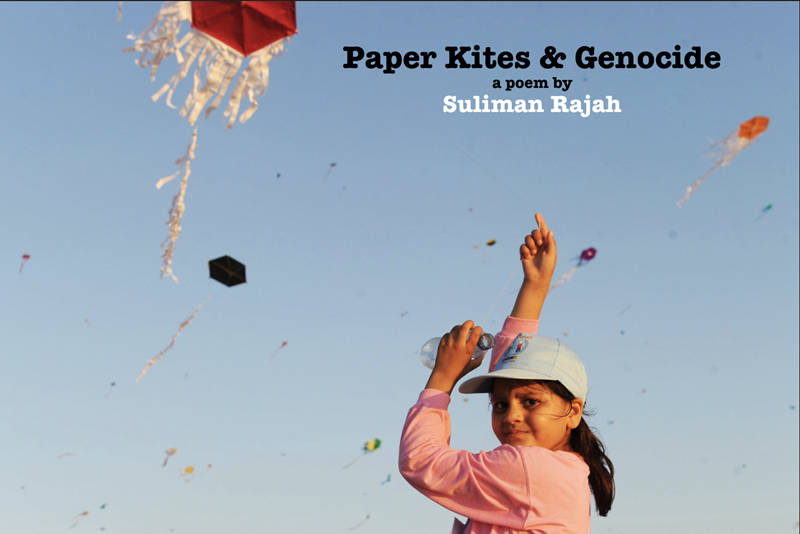
A poem bearing witness to Gaza, where a child's kite becomes a symbol of resistance, memory, and the unbearable threat of innocence.
For the children who still look upward
A child found a piece of paper
where a house had been.
Not paper from a book—
there were no books there anymore—
but the pale skin of something
that had once carried words.
He found two splinters of wood,
a thread,
a little colour left on a torn shirt,
and built a kite.
He did not know
that the sky had become political.
He only knew
that the wind was still free.
So he lifted the kite
above the tents,
above the broken walls,
above the dust of bedrooms
where children's names
were still sleeping in the rubble.
And for a moment
the child was not displaced.
He was not hungry.
He was not counting explosions.
He was not learning
the difference between
the sound of a drone
and the sound of a missile.
He was simply
a child
holding a string
to the sky.
And the sky
held him back.
The kite was never merely a kite.
It was a declaration
made without a parliament.
A small rebellion
against gravity.
A child's refusal
to accept that everything
must remain on the ground.
It carried no army.
No rifle.
No uniform.
No flag large enough
to frighten a soldier.
Only colour.
Only wind.
Only the astonishing human insistence
that after everything has been taken—
there must still be
something
to give the sky.
And suddenly
the kite became dangerous.
Not because it carried fire,
but because it carried
a childhood.
Not because it could destroy a city,
but because it reminded the world
that children still existed
inside the ruins.
And what is more threatening
to a machinery of destruction
than the sight
of something innocent
refusing to disappear?
Then came the warning.
Stop the kites.
Stop the balloons.
Stop the children
from sending their little pieces of sky
across the invisible line.
Or the bombs will come.
And somewhere,
in an office far from the tents,
someone turned a child's toy
into a military category.
A kite became a target.
A string became a threat.
Paper became a weapon.
Childhood became
an act of war.
And the world
was asked to nod.
But high above Gaza,
the kites began to speak.
One kite said:
What do you see?
The other answered:
I see the ground.
And what is there?
Less than yesterday.
And tomorrow?
I cannot see tomorrow.
Why?
Because there is too much smoke.
The first kite trembled
against the wind.
Do you remember the houses?
I remember their shadows.
Do you remember the schools?
I remember the sound of children
before the schools disappeared.
Do you remember the gardens?
Only the dust where gardens used to be.
Do you remember the sea?
Yes.
Does it still remember them?
The second kite was silent.
Then:
The sea remembers everything.
But it cannot speak loudly enough.
Higher they climbed.
Below them,
Gaza was no longer a city
so much as a wound
trying to remember its name.
They saw roads
leading nowhere.
Walls
without rooms.
Rooms
without families.
Beds
without sleepers.
Shoes
without feet.
Photographs
without houses.
Names
without voices.
And the kites understood
something terrible:
The bombs had not merely destroyed
what people possessed.
They had begun destroying
the evidence
that people had ever possessed it.
One kite looked down.
There was a tree here.
Where?
There.
Beside the house.
I see no tree.
There was a tree.
I know.
How do you know?
Because I saw a child
draw it once.
They drifted farther.
Then the first kite cried:
Look!
What?
A butterfly.
Far below,
among the rubble,
something moved.
A tiny trembling creature
crossing a fragment of green
that had somehow survived.
The kites circled above it.
For one impossible moment
the butterfly carried the entire weight
of the living world.
Then came the smoke.
The ground vanished.
The butterfly vanished.
The green vanished.
And the second kite whispered:
Was that the last witness?
The first answered:
I think so.
They remained silent
for a long time.
Then one asked:
Who will tell them
the butterfly was here?
The other said:
We will.
But who will believe a kite?
Perhaps nobody.
Then why remember?
Because forgetting
is how the dead
are killed twice.
Below them,
another child
picked up another piece of paper.
His hands were small.
The paper was torn.
The string was too short.
His mother looked at the sky
before she looked at him.
She did not say:
Don't dream.
She did not say:
Don't play.
She said:
Come inside.
Because mothers in Gaza
have learned the grammar
of impossible choices.
They have learned
that even innocence
must sometimes hide.
They have learned
that a child can be killed
for flying too high.
And the kite,
still caught in the wind,
understood the final cruelty.
The bombs had already taken
the houses.
The soldiers had already taken
the roads.
The bulldozers had already taken
the gardens.
The hunger had taken
the strength.
The graves had taken
the names.
The smoke had taken
the horizon.
And now—
the sky itself
was being claimed.
So the kite spoke
to the earth:
I am sorry.
The earth answered:
For what?
For being able to leave.
The earth was silent.
Then:
Do not apologise.
Why?
Because you are the last thing
that can still tell the world
what happened here.
So rise, little kite.
Rise above the rubble.
Rise above the tents.
Rise above the graves
that have no stones.
Rise above the silence
of governments
that learned to count the dead
without learning their names.
Rise above the speeches
that turn children
into statistics.
Rise above the words
that make murder sound
like policy.
Rise above the people
who will ask:
But what did the kite do?
Tell them:
Nothing.
That is precisely
what makes it unbearable.
It did nothing.
It carried no bomb.
It carried no rifle.
It carried no hatred.
It carried a child's hand
into the wind.
And that was enough
to make the powerful
afraid.
One day,
when the dust has settled—
if it ever settles—
someone will walk
through what remains of Gaza.
They will find a piece of string
caught in the branches
of a dead tree.
They will find paper
half buried in the earth.
They will find
a little red triangle
of colour.
And perhaps they will ask:
What was this?
And the earth will answer:
A child once believed
the sky belonged to everyone.
And perhaps,
somewhere beyond the reach
of missiles and borders,
the butterflies will return.
One will settle
upon the broken stone.
Another will rise
from the dust.
And the wind
will remember the kites.
But let nobody say
that the butterfly survived
because the world was kind.
It survived
because something in life
refused to surrender.
And let nobody say
that the kites were weapons.
They were witnesses.
They saw the houses
before they became rubble.
They saw the children
before they became names.
They saw the gardens
before they became dust.
They saw the butterfly
before the earth
forgot its colour.
And when the last witness
was erased,
the kites looked down
upon the empty ground
and carried the memory
higher.
Higher.
Higher.
Until the whole sky
became an accusation.
Suliman Rajah is a songwriter and poet whose work focuses on human rights, social justice, and the resilience of the human spirit. His writing often gives voice to the voiceless, exploring themes of memory, loss, and the indomitable nature of childhood hope in the face of overwhelming adversity. He believes in the power of words to act as witnesses to history.