


ASUU Strikes and The Battle For Nigeria’s Universities
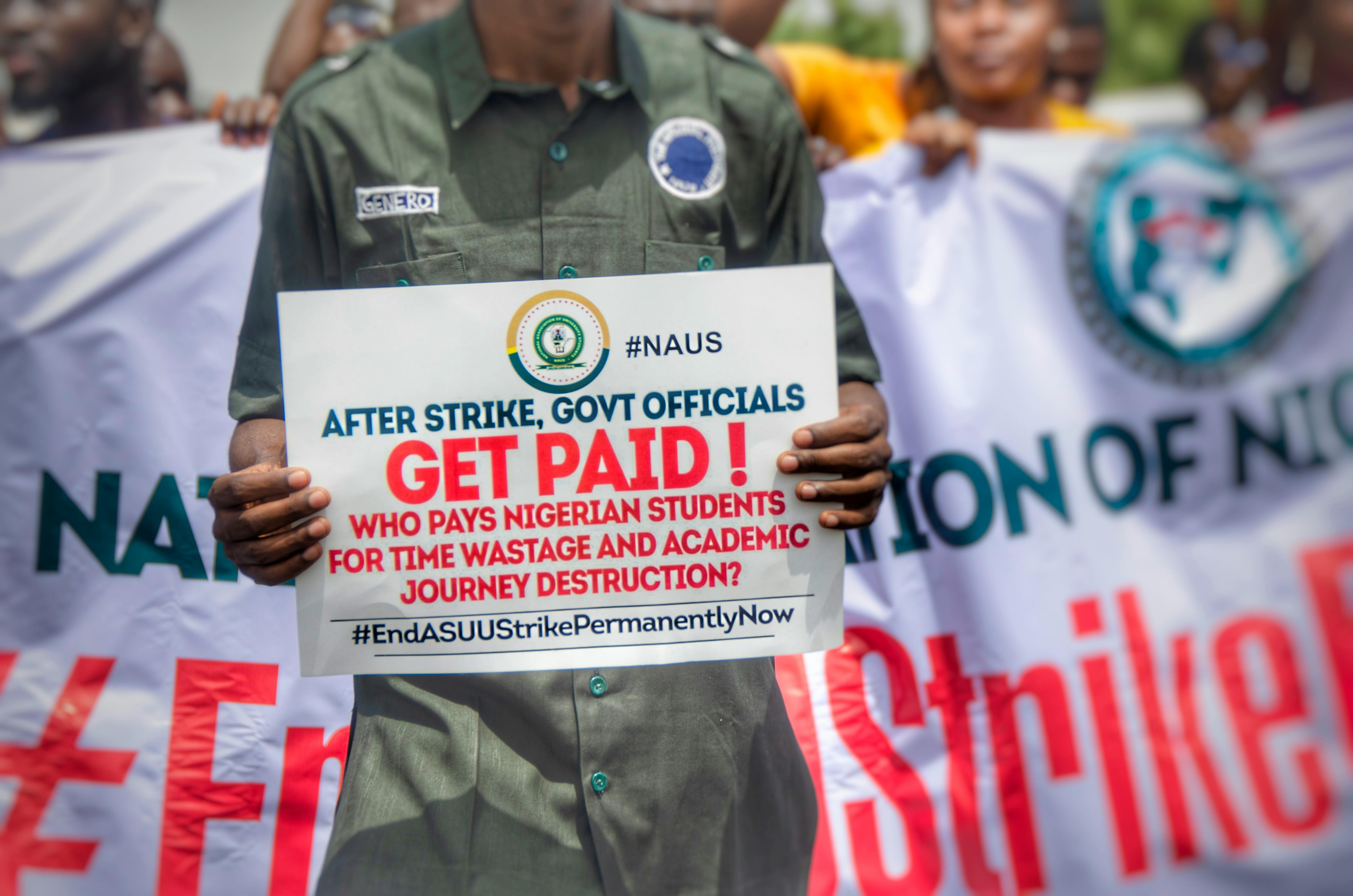
Exploring the relations between the Academic Staff Union of Universities and the Nigerian government: From strikes and the erosion of public education—symptomatic of national decay—to pathways for renewal.
The prolonged conflict between the Academic Staff Union of Universities (ASUU) and the Nigerian government reflects not just labour unrest but a deeper crisis of inequality, neglect, and state priorities. This article examines the strikes through Marxist and conflict theory lenses,[1] drawing from lecturers’ voices and highlighting how the erosion of public education mirrors the decay of national values.
Every semester, Nigerian students pack their bags with familiar uncertainty. Will this term be completed? Will lecturers go on strike again? Will four years stretch into six or seven? These are not idle anxieties. They are the lived reality of millions navigating a university system in perpetual crisis, where the Academic Staff Union of Universities (ASUU) and the Federal Government remain locked in a struggle that has come to define Nigerian higher education. My conversations with lecturers from Obafemi Awolowo University, the University of Ibadan, and the Federal University of Oye Ekiti reveal a clear truth: the strikes are not the disease but the symptom. The real ailment is structural, embedded in systemic neglect, neoliberal reforms, and elite indifference.
At the heart of this crisis lies a document gathering dust in government offices, the 2009 agreement between ASUU and the Federal Government. After eighteen months of negotiation, both sides signed a landmark deal promising revitalization funding, earned allowances for lecturers, improved welfare, and institutional autonomy. It was the kind of agreement that could have changed Nigerian higher education. Sixteen years later, it remains largely ignored, with successive governments treating it as political theatre rather than a binding commitment. “Since government changes every few years, the agreement keeps shifting,” one lecturer explained. “There is no accountability,” he added.[2]
When asked why strikes persist despite limited gains, lecturers shared the same frustration: “What else can we do?” Negotiation without sincerity becomes performance. Strikes, disruptive as they are, remain the only language the government understands.
UNESCO recommends that countries allocate at least 26 percent of their national budgets to education. Nigeria spends only between 5 and 8 percent, according to the UNESCO Global Education Monitoring Report (UNESCO, 2024).[3] While much of the world treats education as the foundation of national development, Nigeria funds it as an afterthought. This is not a technical failure. It is a political choice. “The root cause of the ASUU strike is the government’s failure to prioritize education,” an Obafemi Awolowo University (OAU) lecturer said. “It is systemic neglect,” he added.[4] That neglect is visible in every corner of the university system, from overcrowded classrooms with damaged furniture to outdated libraries, unpaid salaries, and laboratories without basic equipment. This is not poverty, it is policy. Successive governments have chosen to starve public universities while sending their children to private or foreign institutions.
From a sociological perspective, the conflict mirrors Dahrendorf’s notion of imperatively coordinated associations.[5] The state, as custodian of authority and resources, is the superordinate actor, while ASUU is the subordinate group contesting power. When legitimate channels for negotiation are blocked, conflict is inevitable. Marxist theory sharpens this understanding. ASUU’s demands for fair pay and better conditions represent a clash between labor and the state, which controls capital and privilege.[6] The defunding of public education since the Structural Adjustment Programme of the 1980s was not accidental; it shifted resources from the collective to the elite, turning education from a social right into a private commodity. Strikes are therefore acts of resistance against a system that commodifies knowledge and undermines equality.
Nothing captures this decay better than the Japa phenomenon, the mass migration of Nigerian academics. According to the Tertiary Education Trust Fund (TETFund),[7] hundreds of lecturers leave annually for institutions in South Africa, the United Kingdom, and the United States. Each departure drains Nigeria of decades of expertise and mentorship. One OAU lecturer observed that more than half of the University of Lagos staff left within a decade. Ethiopia, South Africa, the United Kingdom, and the United States continue to recruit Nigerian lecturers in large numbers. Each departure represents not just the loss of a worker but the erasure of decades of intellectual investment. Nigeria is not merely losing academics. It is losing its intellectual soul.
The consequences go beyond the disruption of calendars. “Strikes badly affect teaching and research,” a University of Ibadan lecturer told me. “Supervision of final year projects stopped for months, and students lost interest,” he added. Those words, lost interest, capture the quiet collapse of curiosity. When students stop caring and lecturers lose motivation, universities cease to be places of inquiry and become factories for certificates. Families drain savings for degrees that take twice as long, and graduates emerge into job markets indifferent to their qualifications.
This is not unique to Nigeria. Across Africa, neoliberal austerity has hollowed out public education. Governments slash school budgets while expanding political offices and defense spending. Western universities benefit, recruiting African academics at minimal cost. This is an extraction not of minerals but of minds. An OAU lecturer summarized the crisis: “Universities risk global irrelevance. Strikes lower rankings, weakens degrees, and extends programs that should last four years into six or more.”[8]
ASUU faces a moral and strategic dilemma. Ending strikes feels like surrender, yet continuing them risks damaging the very institutions the union seeks to protect. However, silence would be worse. Strikes remain one of the last tools of collective resistance in a political order deaf to dialogue. Real change demands structural reform. The government must finally honor the 2009 agreement, provide sustained funding, and establish accountability mechanisms that outlive election cycles. Beyond policy, there must be a cultural shift to recognize education as a public good rather than a privilege. Without this, Nigeria will continue exporting its best minds while importing development solutions from abroad.
ASUU strikes, for all their pain, hold up a mirror to the Nigerian state, revealing not just administrative failure but moral bankruptcy. What we see reflected is a government that privileges power over knowledge, neglect over care, and short-term politics over long-term nation-building. The crisis of Nigeria’s universities is ultimately a crisis of vision. The struggle for revitalized education is a struggle for national survival. Defending public universities is defending the very possibility of a democratic and self-determining Africa. Whether Nigeria chooses decay or renewal will depend on the collective insistence of its people that education remains a right, not a privilege.
Chinenye Cynthia Izuchukwu is a prospective graduate student in Sociology with interests in social inequality, justice, and organizational leadership. She has experience in talent management and social research, and her work explores how African communities confront inequality, power, and social transformation.
Endnotes
[1] Coser, L. (1956). The Functions of Social Conflict. Free Press; and Turner, J. H. (1975). Classical Sociological Theory. Wadsworth Publishing.
[2] Interview excerpts drawn from field conversations with university lecturers (2025).
[3] United Nations Educational, Scientific and Cultural Organization (UNESCO) (2024). Global Education Monitoring Report: Investment in Education.
[4] Interview excerpts drawn from field conversations with university lecturers (2025).
[5] Dahrendorf, R. (1959). Class and Class Conflict in Industrial Society. Stanford University Press.
[6] Marx, K. (1977). A Contribution to the Critique of Political Economy. Progress Publishers.
[7] Tertiary Education Trust Fund (TETFund) (2023). Annual Report on Academic Staff Development and Brain Drain in Nigeria. Abuja: TETFund.
[8] Interview excerpts drawn from field conversations with university lecturers (2025).