


The Gen Z Madagascar Movement: How Youth Used Digital Tools to Redistribute Political Power
How digital platforms redistributed political power during Madagascar’s Gen Z uprising, enabling horizontal coordination, contesting narratives, reshaping political geography, and supporting diaspora participation and counter-surveillance.
On September 18, 2025, two opposition municipal officials in Madagascar requested permission to hold a peaceful rally protesting chronic electricity and water shortages. The government denied the request and placed both officials under judicial supervision. One week later, thousands of young Malagasy citizens, organizing under the Gen Z Madagascar movement, mobilized through Facebook, Instagram, Discord, and Signal, and took to the streets. Within three weeks, President Andry Rajoelina had fled the country, and a transitional government was in place.[1]
The speed of the political collapse followed sixteen years of growing frustration under a regime characterized by corruption, failing infrastructure, and entrenched patronage networks. What set this uprising apart, however, was not only the outcome but the way it was organized. Digital tools allowed citizens to synchronize discontent across geography, class, and generation in ways the state could not control. Local anger over basic services quickly evolved into a national, and even transnational, movement, reshaping how political power could be exercised and contested in Madagascar.
This article examines how digital platforms shifted political capacity from state institutions to citizens during the Gen Z uprising. It focuses on three key dimensions: how digital infrastructures enabled coordination and horizontal organization; how citizens contested narratives and asserted authority over truth; and how digital tools reshaped political geography, facilitated transnational diaspora participation, and supported surveillance and counter-surveillance practices. The discussion then turns to the challenges of translating digital mobilization into meaningful participation in governance and concludes with reflections on the ongoing activism of Madagascar’s youth as they navigate the limits and possibilities of digital political engagement.
Digital Infrastructures as Coordination Mechanism
From the start, the Gen Z Madagascar movement operated as a networked mobilization.[2] Digital platforms allowed horizontal coordination without centralized leadership. Facebook and Instagram provided broad outreach, while encrypted apps like Signal and Discord enabled real-time communication, planning, and logistics. Using multiple platforms created redundancy: when authorities targeted one channel, others remained operational.
This distributed approach marked a significant change from Madagascar’s traditional political organizing, which has long depended on hierarchical party structures and elite networks. Those institutions move slowly and are vulnerable to repression through arrests, infiltration, or co-optation. In contrast, Gen Z Madagascar was decentralized, with diffuse leadership and situational authority. Individuals could act independently, allowing the movement to maintain momentum even under pressure.
The network also adapted quickly to disruptions. Arrests or the deletion of social media accounts did not halt activity. Coordination through digital networks, rather than formal institutions, let participants respond flexibly to changing circumstances.
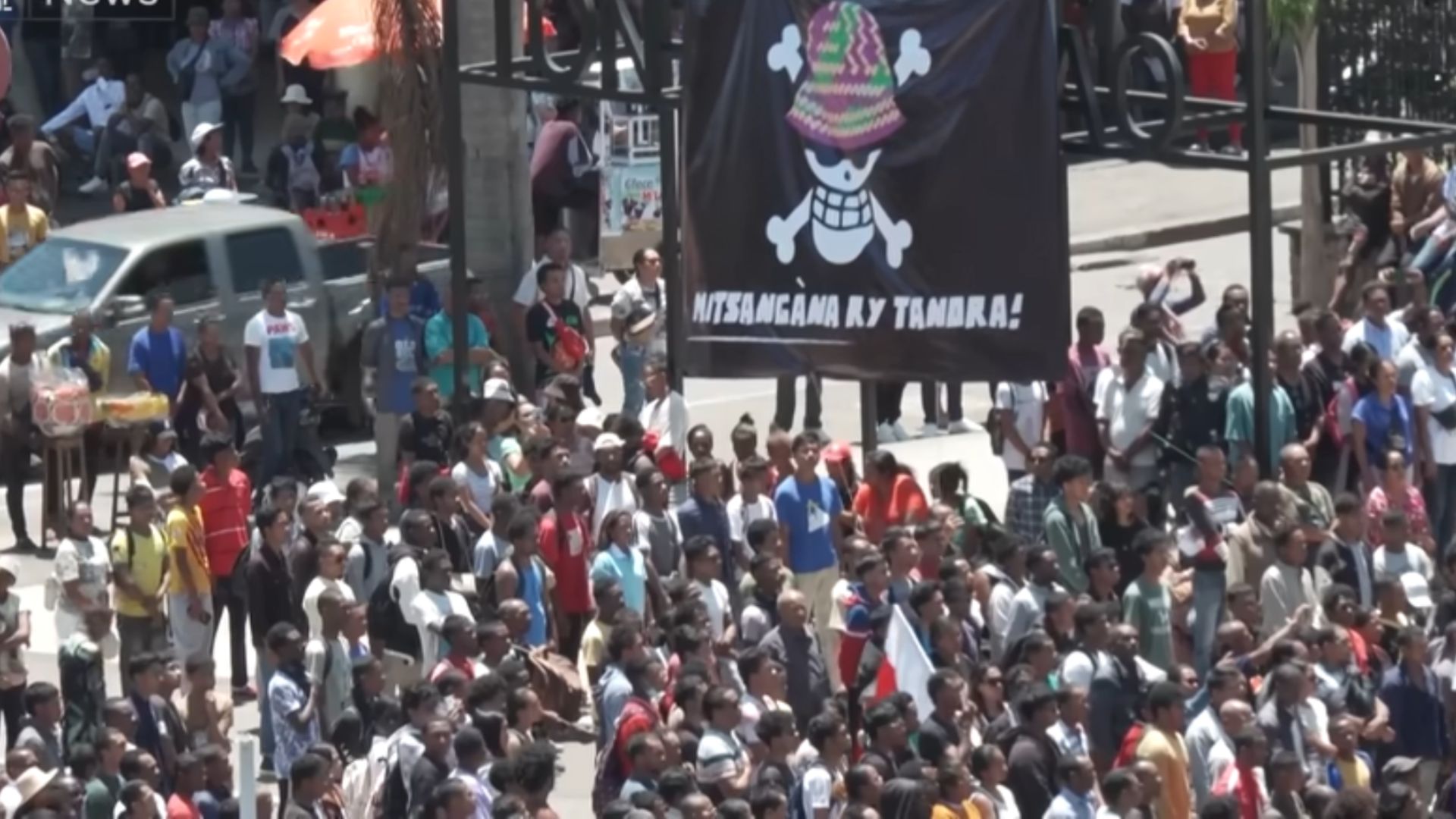
This model also lowered the barrier to participation. Citizens could contribute through brief or intermittent involvement—attending demonstrations, sharing content, or providing information. The approach broadened engagement across age, class, and region, bringing in people who had never joined political parties or associations. Shared symbols and imagery, including the widespread use of the One Piece logo, reinforced cohesion without formal organization. Digital connectivity thus replaced institutional membership, creating an inclusive, flexible, and resilient movement.
Contested Narratives and Collective Verification
The Gen Z uprising was not just a fight for political power; it was also a struggle over meaning and legitimacy. Digital platforms became the central battleground. As protests spread, the Rajoelina administration sought to reframe the movement as the product of foreign interference rather than domestic discontent. In public statements, Rajoelina claimed that “foreign manipulation” was driving the unrest, portraying protesters as naive participants in a larger conspiracy and denying them independent political agency.[3]
The strategy served several purposes. It diverted attention from infrastructure failures and governance shortcomings that had sparked the protests. It also cast young Malagasy citizens as incapable of autonomous political thought. And it attempted to isolate the movement by suggesting that legitimate grievances were being exploited by outsiders.
Citizens pushed back systematically. They documented infrastructure failures: universities in disrepair,[4] hospitals without reliable equipment, neighborhoods experiencing repeated water and power outages. When Rajoelina promised solutions, activists shared archived footage of previous unfulfilled commitments. Videos of peaceful demonstrations countered government claims of “looting,” while families of those killed publicly testified to the circumstances of their deaths. Each official claim was met within hours by evidence from multiple sources.
Through these acts, authority over truth shifted from the state to networks of citizens. Digital platforms became spaces for real-time verification, amplification, and defense of the movement’s claims. This created a new form of horizontal accountability: the credibility of political statements was judged collectively rather than through official channels. Memes, short videos, and digital satire also emerged as powerful tools, bypassing formal rhetoric and reaching broader audiences. By making political participation accessible to those previously excluded from formal debate, these practices challenged the cultural authority of political elites and reshaped how legitimacy was produced in Madagascar’s public sphere.
Reconfiguring Political Geography
Madagascar’s political landscape has long been shaped by a center–periphery divide. The capital, Antananarivo, has historically concentrated administrative power, economic resources, and political attention, while provincial regions remained politically marginal. Previous movements rarely gained national traction without controlling the streets of the capital.
Digital tools disrupted this hierarchy by creating a networked geography of protest. Shared messages, hashtags, symbols, and livestreamed footage allowed demonstrations in other cities to gain attention equal to events in Antananarivo. Local actions no longer had to pass through capital-based media to reach a national audience. Visibility now depended on connection within digital networks rather than physical proximity to the center of power.
This shift reshaped political recognition across the country. Citizens in distant regions could act in solidarity and adopt tactics and messaging from elsewhere in real time. A protest in one city could spark coordinated responses in others within hours, creating a sense of nationwide participation. The uprising’s digital infrastructure not only connected participants but also reconfigured Madagascar’s political space. Long-excluded peripheries became visible and active, showing that power and attention could circulate horizontally rather than flowing only from the capital.
Transnational Networks and Diaspora Participation
The Malagasy diaspora joined the Gen Z uprising through digital networks that collapsed geographic and political distance. Social media, messaging apps, and livestreaming tools allowed citizens abroad to follow events in real time, coordinate support, and engage directly with the movement at home. Communities, particularly in France, provided financial and technical assistance that helped sustain the movement despite government attempts to suppress it.
Diaspora activists also worked to amplify the uprising internationally. They contacted global media outlets, engaged with embassies and consulates, and organized solidarity demonstrations in their host countries. By connecting local mobilization to international audiences, they increased diplomatic pressure on the Rajoelina government and strengthened the credibility of domestic activists.
For decades, remittances were the primary way diaspora communities engaged with Madagascar. During the Gen Z uprising, however, their full potential was leveraged for political action. Digital platforms allowed them to contribute strategically, using their skills, networks, and social legitimacy to support the movement in real time. They shaped narratives, coordinated resources, and extended the uprising’s reach, demonstrating how digital tools can integrate global citizens into domestic political processes and transform diaspora engagement from passive support to active political participation.[5]
Inverting Surveillance
The Rajoelina government tried to disrupt the Gen Z movement’s online momentum through digital repression. Authorities mass-reported protest accounts, spread disinformation, monitored activists’ communications, and created fake profiles to infiltrate chat groups or post pro-government content. Yet these tactics exposed the limits of authoritarian control in a digitally connected society, where coordination, visibility, and legitimacy can no longer be contained by the state.
Activists quickly adapted. Using what is called counter-surveillance, or sousveillance,[6] they documented police movements, recorded acts of violence, and shared visual evidence online. These tactics reversed the usual balance of observation: instead of the state watching citizens, citizens were now watching the state. By collecting and circulating footage of repression, they made official abuse harder to hide and constrained the government’s ability to act with impunity.
Sousveillance became both a shield and a tool of accountability. By turning visibility itself into a form of resistance, activists challenged the state’s monopoly over information and forced public scrutiny onto those in power.[7]
The Challenge of Translation
In just three weeks, the Gen Z Madagascar movement, backed by the CAPSAT contingent, forced the collapse of President Andry Rajoelina’s regime despite his attempts to retain control. The speed of that fall was unprecedented in Madagascar’s modern history, where earlier uprisings often played out over months and depended on political parties or extended negotiations. But the movement now faced an urgent challenge: how to translate a youth-led digital uprising into meaningful participation in formal governance.
Horizontal and decentralized networks are highly effective at organizing protests, yet they struggle when it comes to policymaking and institutional engagement. The same features that gave Gen Z Madagascar strength—flexibility, informality, and distributed leadership—are proving to not easily align with bureaucratic systems built on rules, representation, and hierarchy. The movement succeeded in removing a corrupt regime but found itself with little leverage over what followed.
Digital participation is also uneven. Reliable internet access, smartphones, and digital literacy remain concentrated in urban and higher-income communities. Many rural and lower-income citizens remain disconnected, creating the risk of a new “digital elite” rather than a broadening of democratic participation.
Similar patterns have appeared in other digital uprisings, including the Arab Spring, where rapid mobilization did not necessarily translate into long-term political power.[8]For Madagascar, the question is whether the Gen Z movement’s energy, coordination, autonomy, and participatory ethos can be translated into formal institutions while preserving its decentralized and innovative political practices. While the foundations for influence have been established, translating them into durable governance and lasting democratic transformation remains uncertain.
Conclusion
The Gen Z Madagascar movement demonstrated how digital platforms can redistribute political power from the state to citizens, enabling young Malagasy to coordinate actions, verify information, and challenge official narratives. Its networks connected domestic and diaspora communities, amplifying influence beyond national borders and creating a new arena for political engagement. The movement also shifted perceptions of who can exercise political agency, showing that young citizens could catalyze national action and disrupt longstanding patterns of political control. For many, this was the first time their collective voice shaped public debate and forced attention to grievances that had long been ignored.
A month into the transitional government, however, uncertainty remains. The prime minister was appointed without consulting Gen Z representatives, and several cabinet positions went to familiar political figures. These choices have raised doubts about whether the promised reforms will lead to real change. Citizens are also waiting for evidence that the transitional authorities will hold Rajoelina and officials from his regime accountable. Pressures from external actors, including lingering French influence and neocolonial dynamics, remain a concern. And progress on the daily issues, such as power and water outages, that sparked the uprising has yet to materialize.
The Gen Z Madagascar movement[9] itself is also evolving. Its goals and identity are being contested: who legitimately belongs to the movement, who can speak for it, what strategies it should pursue, and whether it should enter formal politics or remain independent. These internal discussions reflect the growing pains of a generation learning to navigate political influence in an environment still dominated by older elites. At the same time, supporters of the previous regime continue to challenge the transitional government’s legitimacy, arguing that Rajoelina’s removal was unconstitutional.
Still, Madagascar’s process of rebuilding is only beginning, and the durability of this new digital political power is still being tested. Although many questions remain, one thing is certain: the uprising has fundamentally changed how (young) Malagasy people relate to power. It demonstrated that authority can be challenged, legitimacy must be earned, and citizens possess the networks and capacity to reclaim political influence. For current and future leaders, the message is clear: the public can mobilize rapidly, strategically, and transnationally, and political legitimacy rests on accountability and tangible results.
The youth whose leadership forced Rajoelina to flee and lifted the country’s collective paralysis now face the task of converting momentum into sustained political capacity. The revolution is unfinished. The path ahead is still uncertain, but the courage and continued engagement of Madagascar’s youth provide grounds for cautious optimism about the country’s future. Ho an’ny taninjanaka.[10]
Jenny Rakoto is a PhD sociology student at Loyola University Chicago.
Endnotes
[3]https://www.ctvnews.ca/world/article/madagascars-president-denounces-coup-attempt-as-protests-flare/
[5]https://newlinesinstitute.org/strategic-technology/digital-diasporas-how-social-media-and-the-internet-are-transforming-diaspora-mobilization-in-homeland-conflict/
[8] https://kalam.chathamhouse.org/articles/beyond-the-uprisings-pragmatic-lessons-from-the-arab-spring/
[10] Ho an’ny taninjanaka (Malagasy): “For the generations to come.”