


African Liberation Day 2026: Haiti and the Struggle for Global African Liberation.
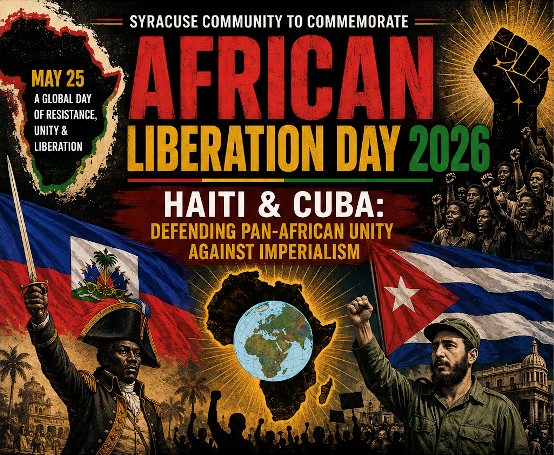
Speech delivered on May 23, 2026, by Dr. Jemima Pierre, for the Global Pan African Movement’s Africa Liberation Day celebration in Syracuse, New York, themed, “Haiti & Cuba: Defending Pan-African Unity Against Imperialism.”
Hello, comrades. My name is Jemima Pierre. I'd like to wish you all a happy African Liberation Day. Thanks so much to the organizers of the Global Pan-African Movement for inviting me. I'm sorry I couldn't join you all in person, but I have prepared some comments that I hope will help us understand what's currently happening in Haiti in order for us to contextualize Haiti and the struggle for global African liberation.
On February 3rd, 2026, the U.S. embassy in Haiti announced that a U.S. warship, the USS Stockdale, had arrived off the coast of Port-au-Prince. The warship joined two U.S. Coast Guard cutters, the USCGS Stone and the USCGS Diligence[1], already patrolling the waters surrounding the island nation, joining what the embassy claimed was an effort to “maintain Haiti's security.” Yet few people in Haiti believe that the U.S. has an interest in maintaining Haiti's security, and most recognize that the arrival of the USS Stockdale was something else, an open threat to the republic by the Trump regime.
Why the blatant military threat against Haiti? The U.S. regime no longer needed the services of the nine-member presidential council (CPT, the French acronym) – the puppet government that the U.S. had itself installed in Haiti in April 2024. The presidential council (CPT) was created after the fall of Ariel Henry, the same individual that the U.S. and the core group had pushed into the prime minister role after the assassination of Haiti's President Jovenel Moise in 2021. The Presidential Council's term was set to expire February 7, 2026, a date fixed by the U.S. The intention was to have a system of “democratic transition” in place by the time that the Council's term expired in the form of what the U.S. called free and fair elections, which ultimately meant a U.S.-vetted Haitian government. This did not happen.
So in the days before the end of the Presidential Council's mandate, its members rushed to put into place their own democratic transition plan. They attempted to remove the installed Prime Minister, Alix Didier Fils-Aimé, the U.S. chosen lap dog of the moment, who was also the representative of the Haitian business elite. The Presidential Council members, as well as many others, feared the consolidation of power under one man, one that they themselves were forced to choose as prime minister. But the thugs of the Trump regime were not having it. They threatened and then sanctioned those who dared to attempt to remove Fils-Aimé and then sent their military vessels to surround the island. In the end, the U.S. got its way again in Haiti. The U.S. is now running Haiti through another prime minister that it installed, in an unelected position, with no popular mandate.
Things are different this time, though. This time, the puppet prime minister, Fils-Aimé, has a private army at his disposal. Last year, the puppet government was forced by the Trump regime to sign a 10-year contract with Erik Prince,[2] the genocidal soldier of fortune and Blackwater founder. I hope people remember Blackwater in Iraq. Under this contract, Erik Prince can bring military equipment into Haiti and is also planning to bring 150 mercenaries to work in Haiti. The plan is for him to run a drone war against supposed gang members. The Blackwater mercenary forces are then to be joined by a so-called “gang suppression force” of 5,500 foreign mercenaries authorized by the UN under Chapter 7 deployment.
Let's also remember, as an aside, that the UN is no friend of Haiti. It has maintained a consistent occupation of Haiti since the 2004 coup, and it continues to support only violent options in Haiti. In fact, the UN Security Council has renewed the mandate of this ongoing occupation every year since 2004. The latest renewal was on January 29, 2026. Now, while Kenyan President William Ruto was the first of African leaders to provide his police and soldiers to participate in the violent occupation of Haiti, soldiers from another African country, Chad, recently arrived in Haiti to serve as the new blackfaces of U.S. imperialism.
Because Haiti only gets coverage in the white racist media when consent needs to be manufactured for its violent treatment by the U.S. and its Western minions—France, Canada, the Organization of American States—many people think that this is only about gang violence or security in Haiti. As I always say, it is not.
Over the past few months, the number of violent deaths of innocent people from Erik Prince's drone attacks in collaboration with Haitian police and foreign occupation forces has skyrocketed[3]. As our people die, there is not one word of condemnation from the same voices that pushed for military control and occupation of Haiti in the first place, such as the United Nations, the Organization of American States, the Congressional Black Caucus, or any of these groups or NGOs that were pushing for foreign invasion and occupation of Haiti.
So in Haiti, we're not only witnessing the emergence of another U.S.-backed dictator installed by the U.S. and supported by a foreign military with a license to kill at will. Under this rule, Haiti has changed its mining laws to open up massive extraction of minerals to foreign companies. Meanwhile, many are saying that the U.S. has turned Haiti's main airport, the Toussaint Louverture International Airport, into a U.S. military base. The airport is not in service as we speak, and we think that it will probably be a launching pad for the presumed attack on Cuba.
I must point out, as I often do, that none of what is happening, and what has happened in Haiti since 2004, is legal. None of it is allowed in Haiti's constitution, and none of it is done through the will of the Haitian people. What is going on in Haiti is a continuation of the destruction of the Haitian state that began with the 1991 coup d'état that removed Haiti's first popularly elected president, Jean-Bertrand Aristide, and culminated in the 2004 removal of the same president during his second term. What is going on in Haiti is the entrenchment of the full denial of the country's sovereignty. What is going on in Haiti is full-on colonial control, but one that is being lived as a state in perpetual but controlled chaos.
The current predicament of Haiti is a state with no accountability to its people, while armed and controlled by an external force. Haiti is run by an externally imposed executive without a mandate but with lethal technologies. This executive is allowed to supposedly bring “security” without acknowledging theright of the people; the executive acts without control and without political limits. U.S. imperialism in Haiti doesn't have to pretend that it is looking for a “transition to democracy” through “free and fair elections.” Instead, we have a silent authoritarian mutation made possible by the forced collapse of our state by U.S. imperialism, and the violent economic and military repression of mass protests. Most importantly, we have, among the Haitian leaders, the resigned acceptance of this exception, which is the control of Haiti by foreigners. This is an exception many – inside and outside Haiti – have accepted as a norm.
In other words, Haiti is not on the verge of chaos. Rather, Haiti is on the verge of normalizing a foreign armed political vacuum. Haiti, once again, finds itself at the heart of a system that treats it as an object, a testing ground.
Our job as anti-imperialists and Pan-Africanists is to be clear-eyed about the ways that the current U.S. empire is asserting its full control over the longest experiment at self-determination in the modern Black world. For two centuries, imperial counterinsurgency against Haiti has aimed to terminate the most ambitious revolutionary experiment in the modern world. The tactics deployed to attack Haitian sovereignty have been persistent.
The current moment is difficult for the Haitian people, but as we celebrate African Liberation Day, we are confident that Haiti will rise again, and we must be ready to always stand in solidarity with Haiti.
Thank you all.
Jemima Pierre is a Distinguished Faculty of Arts Professor of African and African Diaspora Studies in the Social Justice Institute (GRSJ). She is also a Research Associate at the Johannesburg Institute for Advanced Study (JIAS).
Endnotes
[1] Charles, J. “Amid political turmoil in Haiti, U.S. warships arrive at the coast of port-au-prince.” Miami Herald. February 3, 2026. https://www.miamiherald.com/news/nation-world/world/americas/haiti/article314559715.html
[2] Blaise, J. “Blackwater founder Erik Prince reveals details on 10-year contract with Haitian authorities.” The Haitian Times, August 15, 2025. https://haitiantimes.com/2025/08/15/erik-prince-10-year-contract-with-haiti/
[3] Blaise, J. “Drone strikes in Haiti that killed 1250, including 17 children, condemned by rights group.” The Haitian Times. March 11, 2026. https://haitiantimes.com/2026/03/11/hrw-condemns-haiti-drone-strikes-killing-children/