


African Liberation Day 2026: “Haiti and Cuba: Defending African Peoples and African Unity Against Imperialism”
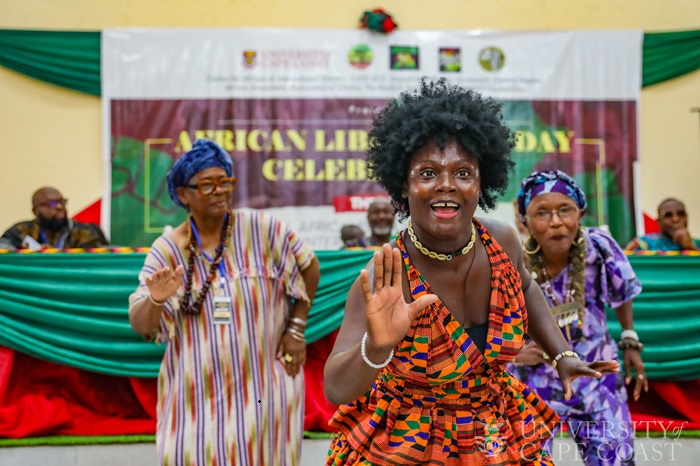
As African Liberation Day 2026 convenes under the banner of Haiti and Cuba, Global Africa must confront the living realities of imperial militarism, ongoing colonialism, and racial capitalism, from the streets of Syracuse to the battlefields of Sudan and Palestine. Drawing on the revolutionary traditions of Nkrumah, Padmore, and Carlos Cooks, Campbell issues an uncompromising charge to educate, organize, and build institutional structures capable of bending the arc of history toward reparative justice and African dignity.
We gather today to honor everyone who has kept the flame of liberation and emancipation alive—the members of our committees, our coordinators, and the broader community of organizations: African Initiative, Global Pan-African Movement (GPAM), PACCNY, and our comrades in Ghana and Barbados. We want to thank the Director of the Community Folk Art Center (CFAC) for working with us to host this event.
We draw inspiration from generations of freedom fighters who have gone before us. For decades, those supporting African liberation, peoples' rights, and reparative justice functioned out of the dynamism of the Garveyites in New York City. I am pleased to be on the panel with my esteemed comrades: Comrade Jemima Pierre, Comrade Rosemari Mealy, and Comrade Zophia Edwards. Their clear presentations uplift our spirits and inspire us to live up to the theme of this year's celebration.
Today, those who conceptualized this African Liberation Day (ALD) did so to make our focus more targeted and strategic. We honor the traditions of Carlos Cooks and Elombe Brath, who first formulated the celebration of ALD.[1] Carlos A. Cooks was born in the Dominican Republic to parents from St. Martin. His life reflected wider patterns of Global African migration and political movement across the Caribbean region in the early twentieth century, echoing radical intellectuals and activists such as Arturo Schomburg, who migrated from Puerto Rico to the United States. The Schomburg Center for Research in Black Culture stands as a testament to that tradition. [2]
Cooks was a Garveyite who carried forward the radical Black tradition that placed New York at the center of Pan-Africanism. Basing his organizing primarily in Harlem—especially around 125th Street and Lenox Avenue—he built the African Nationalist Pioneer Movement into a major hub of Black nationalist politics. He linked African Americans, Caribbean migrants, continental Africans, and anti-colonial struggles, heavily influencing later generations of Black Power activists, including Malcolm X.
Kwame Nkrumah carried these ideas onto the continental stage. From the onset of mobilization for self-rule, he declared that the independence of Ghana was inseparable from the full independence and unification of Africa. Together with George Padmore, Nkrumah worked relentlessly toward continental unification, helping to institutionalize African Liberation Day and successfully advancing that vision among the leaders who formed the Organization of African Unity (OAU) in May 1963.
This history reminds us that liberation movements endure when they are rooted in organized, collective struggle and political education, rather than individual personalities alone. Organizations are how movements survive beyond individual leaders. The work before us is collective. We are here to build new bases of leadership, grow community confidence, and connect our local work in Syracuse to the global movement for African freedom and dignity.
Militarism, Immiseration, and the Present World Order
As we celebrate ALD 2026, we are in the midst of imperial militarism gone wild. We see the political targeting of the president of Venezuela, imperial wars across Africa stirred and maintained by AFRICOM, French militarism and destruction and devastating campaigns waged against the peoples of West Asia, from Palestine to Iran. We cannot celebrate African Liberation Day without reminding ourselves and the world of the devastating genocidal war that is being waged against the Sudanese peoples. We must name the world as it is: wars are being waged that systematically kill innocent civilians, including children. Furthermore, the killing of Caribbean fishermen by the U.S. military constitutes a severe violation of international law. The use of lethal force against civilians in territorial or international waters, absent an armed conflict or imminent threat, directly contravenes the principles of sovereignty and civilian protection enshrined in the United Nations Charter.[3]
Meanwhile, the genocide in Palestine continues without accountability, signaling a profound strategic and moral defeat for U.S. foreign policy in West Asia. Concurrently, global capitalism deepens domestic hardships. A small billionaire class grows wealthier while billions of humans in all parts of the planet face soaring food prices, unaffordable housing, and insecure lives.
We must oppose war while simultaneously organizing for reconstruction. During the mid-twentieth century, as World War II drew to a close, trade unionists from Global Africa came together to chart a course for independence. In George Padmore’s compiled volume, Speeches and Reports of Colonial Delegates of the World Trade Union Congress, we see how workers opposed fascism while planning for self-determination. They mobilized locally while linking their conditions to global systems of white supremacy. As Sister Zophia noted, Caribbean workers dynamically organized in 1935 to oppose the Italian invasion of Abyssinia, recognizing it as a frontline battle against global fascism.
Global Africa must remain alert on every front, which requires deep economic literacy—the ability to read the economy as a structure of power. This literacy is a tool of survival. The current illegal war against Iran has unleashed economic shocks globally, driving the costs of food, transport, and fuel through the roof.
This same exploitative system operates directly here in Syracuse, New York. Historically, the construction of Interstate 81 (I-81) in Syracuse during the late 1950s and 1960s resulted in the bulldozing of the 15th Ward—a vibrant, predominantly Black neighborhood. This urban renewal project displaced roughly 1,300 to 2,000 families, destroyed hundreds of businesses, and severed the community's social and economic fabric. Today, the planned removal of I-81 threatens another wave of displacement, as long-term residents face gentrification in the name of redevelopment.
Simultaneously, local county surpluses from Onondaga County are channeled into tourist-oriented infrastructure—like a public aquarium—rather than sustained investments in quality public education and affordable housing. Progressive forces must link these local infrastructural battles to the global fight against the billionaire class. The same financial forces driving local displacement are driving speculative booms in artificial intelligence, engineering trillion-dollar companies intrinsically tied to the militarization of earth and space.
The present war environment sharpens these contradictions. As governments expand military expenditures, war-driven inflation raises the cost of living while heavily indebted states face fiscal pressure. Rising bond yields further strain public finances, increasing debt-servicing costs and limiting social investments.
These tensions expose the fragility of the AI economy. Built on cheap credit and speculative hype, AI infrastructure—including data centers and semiconductor manufacturing—demands unsustainable amounts of energy and capital. Much like the railroad boom or the dot-com era, AI functions as a financial bubble. First-quarter profits (2026) for major tech conglomerates reflect the financialization of the sector, where speculative stock gains and asset revaluations outweigh actual productive output. A prolonged inflation shock could pop this bubble, leading to mass layoffs, stalled infrastructure, and wider financial instability.
Over decades of neoliberalism, global capitalism has become dangerously dependent on financial speculation and the enforced dominance of the U.S. dollar. Economist Michael Hudson has consistently warned that finance functions as a form of warfare, using debt, sanctions, and dollar hegemony to preserve U.S. global dominance. Increasingly, countries across the Global South are heeding these warnings and seeking alternatives to financial bullying. [4] U.S.-led capitalism is driven less by broad-based productive growth than by debt expansion and technological hype, leaving pension systems and employment structures vulnerable. This fragility becomes obvious as anti-racist movements across the planet challenge imperial bullying. Venezuela, Iran and Cuba are targeted precisely because they dare to stand up to this imperial bullying.
Political Fragility and the Specter of Fascism
Economic fragility cannot be separated from the deepening crisis of white supremacy. Globally, widening impoverishment occurs alongside the erosion of healthcare, education, and social services. In the United States, these rollbacks coincide with renewed efforts to suppress Black voting rights and dismantle democratic gains. The growth of authoritarian forces reflects a system of the deepening crisis of racial capitalism.
The expansion of agencies like Immigration and Customs Enforcement (ICE), the militarization of borders, and the normalization of surveillance reveal how economic insecurity is managed through state coercion. Conversely, growing resistance demonstrates that ordinary people refuse to accept authoritarian rule in silence, organizing mass protests, mutual aid networks, and immigrant defense campaigns.
We must raise our voices when ICE enters our local communities to remove our neighbors. Just recently, a member of our Syracuse student community—a former university basketball player—was deported. In our community we did not do enough to raise our voices against this deportation. ICE has gone so far as to enter hospitals to remove workers. We must organize to stop these deportations.
Haiti and Cuba: Models of Resistance
Our panel laid a vital foundation for this discussion. Comrade Jemima Pierre brought us up to date on the continuing imperial machinations against the people of Haiti. The Haitian Revolution of 1804 stands as the most radical act of liberation in the modern world: the only successful revolt of enslaved people to overthrow slavery, defeat colonialism and defeat white supremacy. Yet, Western slaveholding societies have never forgiven this revolutionary example. The historical anxiety generated among ruling classes persists today. The continued political and physical attacks on Haitians are expressions of an unresolved fear of Black sovereignty. At their core, they target the idea that African-descended people can govern themselves. As scholar Leslie M. Alexander documents, this fear of a Black republic has structured Western policy for centuries [5] Anti black racism in the imperial world merged with anti- Haitianism to the point where utter ignorance and hatred is uttered from some sections of Global Africa against Haitians. This generation must challenge that prejudice. The Caribbean Community and the African Union must not be deceived by the machinations of France and the USA in Haiti. We commend our brothers and sisters in Kenya who continuously agitated against the deployment of Kenyan police persons to Haiti.
This same historical test is clear in the case of the intensified war against the Cuban Revolution. Cuba has demonstrated what is possible when a small nation refuses to surrender to imperial power. Comrade Rosemari Mealy reminded us of the immense sacrifices made by the Cuban people, who have endured a more than sixty-year economic blockade yet continue to maintain national cohesion and political fortitude. This historical context assists us in understanding the situation of the U.S. indictment of Raúl Castro, the 94–95-year-old former President of Cuba, who was charged in a Miami federal court with conspiracy to kill U.S. nationals, murder, and destruction of civilian aircraft in connection with the 1996 downing of two “Brothers to the Rescue” planes. The aircrafts were operating in Cuban airspace without authorization, and Cuban authorities stated that they were warned on multiple occasions before being shot down after continuing the incursion, which Havana characterized as a violation of national sovereignty and a hostile provocation.
The massive popular demonstrations in Havana on May 23 demonstrate that they will not be cowed. The Cubans are sending a clear message that any military incursion by the United States will incur great costs.
The Cuban Example
Those who blockade Cuba have failed to stop its spectacular success in public health, education and social services. Cuba developed one of the most advanced biotechnology sectors in the Global South despite restricted resources. Its achievements include the world’s first successful vaccine against meningitis B, innovative interferon therapies, and cancer immunotherapies like CIMAvax-EGF. What makes the Cuban experience distinctive is the integration of biotechnology with a universal, preventative public health system rather than private corporate profit.
Through medical internationalism, Cuba has demonstrated concrete global solidarity, notably deploying doctors to West Africa during the Ebola crisis. Yet, this solidarity and concrete support for the health of peoples is under immense pressure. The current U.S. administration exerts maximum pressure on Caribbean governments to sever relations with Cuban health workers and end decades of medical cooperation. In countries like Jamaica, these shifts reflect a broader privatization project that undermines public healthcare. Against this backdrop, Cuban medical cooperation remains a vital counterforce linking public health to sovereignty.
Furthermore, Cuban support for African liberation—including its decisive military intervention at the Battle of Cuito Cuanavale, which accelerated the collapse of apartheid in South Africa—is a bedrock of our shared history. On African Liberation Day, we remind the world of this debt owed to Cuba by Africa. As one comrade asked in a message to GPAM, why is Angola unable to send a tanker of oil to Cuba? Angola ranks 3rd in production on the continent. After Cubans essentially liberated (along with MPLA and SWAPO) from the plans of South Africa and the West. The same could be said of Algeria – where Cubans offered broad assistance prior to Algerian independence.
On African Liberation Day we must call for the peoples and governments of Algeria, Angola, Namibia and South Africa to stand up to support the people of Cuba. This call for solidarity is rooted in the unfinished struggle against imperialism, where formal independence has not eliminated the continuing structures of colonial power across Africa and the Caribbean.
Colonialism is Not Over: Living Realities in the Caribbean and Africa
It is necessary to correct the widely held assumption that colonialism ended in the 20th century. Across the Caribbean alone, more than a dozen territories remain under formal colonial or overseas status, divided among the United Kingdom, France, the Kingdom of the Netherlands, and the United States. There are over twenty colonial territories worldwide.
The Netherlands still maintains several territories, including Aruba, Curaçao, and Sint Maarten. It is profoundly ironic that the Dutch government has vocally opposed reported U.S. plans under its 47th president to annex Greenland, while simultaneously maintaining its own colonial relationships in the Caribbean. The Dutch state cannot critique U.S. expansionism while upholding its own territorial control.
British colonialism likewise persists across the Atlantic via British Overseas Territories, including Anguilla, the British Virgin Islands, the Cayman Islands, Montserrat, the Turks and Caicos Islands, and Bermuda. Beyond their formal political status, these jurisdictions also operate as offshore financial centers that structure global capital flight. The struggle against colonialism is directly tied to stopping the global financial systems that enable illicit flows; more than $50 billion leaves the African continent each year through these exact channels.
The ongoing occupation of the Chagos Archipelago, including the transformation of Diego Garcia into a major U.S. military base after the forced removal of the Chagossian people, further illustrates the persistence of colonial territorial arrangements under contemporary imperial arrangements.
French Colonialism, Neo Colonialism and Imperialism.
French imperialism in Africa continues to operate through entrenched military, cultural, monetary, and political infrastructures, most visibly in the persistent use of the CFA franc system, which ties several African economies to French monetary authority and limits full financial sovereignty. It is also expressed through France’s extensive network of military bases and interventions across the Sahel and West and Central Africa, which have repeatedly been justified as counterterrorism operations but have often functioned to preserve strategic influence and African surrogates aligned with French interests. Ndongo Samba Sylla has shown that the CFA franc system continues to operate as a core instrument of French imperialism in Africa, locking trapped member states into a monetary regime that limits sovereignty and sustains dependency. In collaboration with Fanny Pigeaud, Ndongo has spelt out how imperialism operates in Africa today bringing up to date Nkrumah’s thesis on neo colonialism. [6]
In relation to colonialism, France perpetuates a similar duplicity, using administrative categories like "overseas territories" and "departments" to incorporate Guadeloupe, Martinique, French Guiana (Cayenne), Réunion, and Mayotte—effectively blurring the line between a colonial possession and metropolitan statehood. Alongside these are French-controlled territories like French Polynesia and New Caledonia (where a decolonization process remains contested under UN oversight). Frantz Fanon, born in Martinique, analyzed these exact structures of psychological and political assimilation in depth.
On the African continent, Morocco’s continued illegal occupation of Western Sahara proceeds with imperial backing, while France’s historical role in suppressing the sovereignty of Sahelian states must be continuously condemned. Conversely, the newly formed alliance of Sahelian states—Mali, Burkina Faso, and Niger—represents a vital assertion of African self-determination that deserves our solidarity.
Colonialism is not an outdated concept; it is a living condition for millions, and ending it is our collective responsibility.
The Unfinished Business of 1945
International working-people’s alliances are strongest when they move beyond narrow national or religious frameworks to articulate a shared struggle against fascism and empire. The campaign of Zohran Mamdani in New York City in November 2025 exposed great possibilities of the multi racial, multi ethnic and multi religious alliance of working peoples. Mayor Mamdani did not retreat from solidarity with the peoples of Palestine despite the entrenched pro-Israeli forces in New York state and New York City. We must stand in solidarity without fear.
Solidarity means that we must be vigilant in our community. On Monday of this week, two teenagers—both under the age of 18—entered an Islamic center in San Diego armed and intent on carrying out a shooting. They had been shaped by the ideology of white supremacy and a wider ecosystem of misinformation and hate. The attack was prevented from becoming a mass casualty event by the quick action and bravery of the security personnel on site.
What are we going to do in our communities to ensure that our representatives, our political appointees ensure that our streets and our communities are vigilant against such forces. In our communities, we mourn like the people in San Diego are mourning. As we stand in solidarity with our brothers and sisters in San Diego, as we stand in solidarity with our brothers and sisters in Sudan, in Palestine and Iran.
In February 1945, at the World Trade Union Conference in London, Pan African freedom fighters like George Padmore played a central role in organizing opposition to fascism while defining what global reconstruction should look like after the war.[7] That conference brought together trade unionists from across the world, including a powerful presence from the African working class—particularly Nigerian workers—alongside Caribbean delegates from Guyana, Trinidad, and Jamaica. Hubert Nathaniel Critchlow, the father of trade unionism in Guyana, traveled as an accredited representative to demand an immediate end to racial and colonial discrimination. These delegates insisted that any peace planned for Europe must include total independence for colonized peoples.
Critically, during that 1945 conference, a Palestinian speaker, Mr. John Asfour, warned against the impending displacement of the Palestinian people. Speakers argued for regional coexistence based on political equality rather than religious partition, warning that creating an exclusive national homeland based on religion would generate endless war and dispossession.
Eighty-one years later, we are living with the consequences of those warnings being ignored. The consolidation of an apartheid system in Palestine is not separate from the African liberation struggle; it is part of the same global system of racialized dispossession. African Liberation Day must continue to affirm absolute solidarity with the Palestinian people.
Honest Lessons: When Liberation Movements Retreat
We must speak honestly about what occurs when liberation movements assume state power. In Tanzania, South Africa, Angola, Mozambique, Namibia and Zimbabwe, ruling parties that once fought for the people have frequently turned against them. The Tanzanian state’s violent suppression of citizens in late 2025 is not an isolated incident; it reflects a regional pattern of political retrogression.[8] This retreat in Tanzania is particularly jarring for the peoples of Tanzania had stood as a beacon of peace in a continent of militarism and destruction. The lesson from Tanzania is that when leadership ceases to prioritize the welfare of the people and continues along a path of private accumulation, the politics of retrogression inevitably set in.
This pattern is not unique to a single country, but reflects a wider political drift across Southern Africa, where liberation movements in government increasingly reproduce systems of exclusion, accumulation, and class consolidation once associated with the very order they sought to dismantle. These movements successfully liberated states, but they did not fully liberate peoples. Liberation is not achieved merely when a flag changes or a new political class takes office. It is achieved when the material lives of ordinary people are transformed—when land, healthcare, housing, and dignity are structurally protected. Modern documents emerging from these ruling parties reveal a severe retreat from their founding ideals. We must analyze this soberly, noting how narrow xenophobia has replaced the revolutionary solidarity that once united these societies against apartheid. The end of romanticism is the beginning of real work.
Reparative Justice: Long-Term Work, Real Victories
Lasting justice is neither a sudden windfall nor a political concession; it is the concrete result of disciplined, generational organizing that forces imperial and state structures to yield. In March 2026, the United Nations passed a resolution recognizing the Transatlantic Slave Trade as the gravest crime against humanity [9] In Belgium, Etienne Davignon has been charged in connection with the murder of Patrice Lumumba.[10] Five days ago it was reported that Davignon died in Belgium. Pambazuka and progressive Africans must ensure that the death of Davignon does not stop the trial of Belgium and the intelligence agencies of empire that collaborated to assassinate Patrice Lumumba.
These historic milestones—from the UN halls to the Brussels courtroom indictment of Étienne Davignon for the assassination of Patrice Lumumba—are not sudden concessions, but structural victories extracted by decades of global anti-colonial mobilization. As the Caribbean proverb reminds us, 'time is longer than rope'; after sixty-five years of imperial denial, the recursive logic of Pan-African organizing has forced a legal and political reckoning.
Reparative justice is not charity; it is a structural framework for repairing stolen land, labor, life, and sovereignty. While public debate often reduces reparations to individual financial compensation, true reparative justice requires dismantling the economic, psychological and institutional legacy of white supremacy.
This local-to-global connection brings historic opportunities to our doorstep. On July 16, the Chair of the New York State Banks Committee and a member of the state Reparations Task Force will visit Syracuse to meet with community members regarding banking and reparations. Syracuse must respond with absolute clarity: we must insist that reparations require historical truth.
Our educational systems remain trapped in symbolic gestures.[11] Universities issue land acknowledgments recognizing Indigenous dispossession, yet these statements rarely lead to structural land return or material change, just as globally, Ghana calls for international reparations for the slave trade, yet its domestic textbooks still rely on colonial frameworks that fail to radically educate its youth. This persistent disconnect underscores the enduring legacy of what Edward Said identified as the cultural and ideological scaffolding of empire. Colonial powers realized that you cannot hold a territory by brute force forever; by implementing colonial education systems, they taught the colonized to view their own cultures as "backward" and the colonizer's culture as "civilized," thereby institutionalizing a psychological control that outlasts physical occupation.
If New York State is truly serious about moving beyond mere symbolism in its approach to reparative justice, it must fundamentally overhaul its educational core. This transformation requires that textbooks at every level be rigorously rewritten to directly confront the genocidal violence of the Sullivan Campaign against the Haudenosaunee, replacing a narrative of frontier expansion with the historical reality of state-sanctioned indigenous erasure. Furthermore, public school and university curriculums must systematically excise the persistent remnants of eugenic thought that have historically served to justify racial hierarchies and institutionalize white supremacy under the guise of scientific objectivity. Finally, the state must mandate that students learn the precise economic mechanisms through which wealth was extracted from Black bodies, explicitly tracing how that historical exploitation directly produced modern structural inequalities—ranging from the legacy of redlining to the ongoing realities of environmental racism that manifest in the divided neighborhoods of Syracuse today.
The continued struggles over reparative justice in North America centers on how to translate a well-documented history of slavery, segregation, and white supremacy, Jim Crow policies into contemporary policy. While New York state has established a reparations commission to study these legacies, significant disagreement persists over who should bear responsibility for compensation, with debates dividing those who argue for broad public funding from those who insist that institutions such as banks, universities, and corporations that historically benefited from slavery and discriminatory practices should be primary contributors. Within this debate, mischievous elements have come to the fore with divisive agendas inside the Global African community. Our sister Jessica Mitchell has documented the genealogy of American Descendants of Slavery (ADOS) and their intellectual supporters.[12] ADOS has emerged as a divisive force advancing a narrowly genealogical and nation-bound conception of eligibility that is diametrically opposed to the longer traditions of Pan-African and Global African politics grounded in transnational solidarity and shared histories of racial capitalism.
This struggle over truth is central to the local debate over the Columbus statue in Syracuse. This is not a mere cultural dispute over a monument; it is a battle over historical memory. Maintaining symbols that celebrate the destruction of Indigenous societies sustains psychological captivity.
This struggle over truth now extends into the digital systems that organize human knowledge. As Safiya Noble demonstrates in Algorithms of Oppression, search engines and algorithmic architectures reproduce and amplify racial hierarchies under the guise of appearing as merely neutral technological systems.[13] The same forces that once sanitized textbooks now operate through corporate AI systems. Technology will not save poor communities unless we actively organize to ensure it serves human needs rather than corporate profits and white supremacist power structures. The victories of 2026 remind us that the arc of justice bends only when organized people actively bend it.
Liberation and Care: Health, Gender, and the Environment
Liberation is fundamentally incomplete without care. The health of Global African and oppressed women of color worldwide, environmental justice, and the fight against medical apartheid are central to any genuine revolutionary project. A revolution that does not prioritize the bodies and lives of the most vulnerable is no revolution at all. As Andiaye argues, progressive organizing must place “care work” at its center, recognizing that sustaining movements requires not only political struggle but also the social reproduction, health, and emotional well-being of the communities that make collective resistance possible. This perspective aligns with the concept of liberatory care advanced in GPAM internal education sessions, which frames care not as a private or charitable act but as a political practice essential to sustaining collective struggle, rebuilding social bonds, and ensuring that movements for emancipation reproduce life rather than exhaustion or disposability. Liberatory care—a politics centering the wellbeing of those most harmed by capitalism—is the foundation of the new world we are building. Care is a revolutionary discipline that must sit at the center of our organizations.
The Call to Action: Educate, Organize, Build
A period of explosive geopolitical and economic change is brewing across the world, and the defining question of our era is not whether structural transformation will come, but whether our organizations are disciplined enough, our leadership deep enough, and our communities mobilized enough to shape that change toward absolute justice. We leave this celebration of African Liberation Day 2026 with a clear analytical charge. We have demystified the current global order, recognizing that the speculative hype of the AI economy and the violence of imperial militarism are dual expressions of a fragile, desperate capitalism. We have looked plainly at the map of Global Africa and affirmed that with dozens of colonies remaining in the Caribbean and the illegal occupation of places like Western Sahara, colonialism is not a historical footnote but a living, breathing apparatus of exploitation.
Confronting this reality requires that we reject the bankrupt currency of symbolic concessions—whether in the form of empty university land acknowledgments or sanitized state reparations—and demand an education that unmasks historic white supremacy and environmental racism from the streets of Syracuse to the global arena. Following the revolutionary models of Haiti and Cuba, we must defend Black sovereignty against the persistent anxieties of the imperial core. Those who possess access to historical and economic knowledge hold a distinct, non-negotiable responsibility to weaponize it. We must aggressively teach economic literacy, explicitly name modern colonialism, and relentlessly confront imperialism wherever it manifests. Let us move past political romanticism, ground our efforts in the revolutionary discipline of collective care, and build enduring institutional structures that will outlast individual leaders and sustain the global struggle for African freedom and dignity.
Horace Campbell is a peace and social Justice activist. He is also Professor of African American Studies and Political Science at Syracuse University and Chairperson of the Global Pan African Movement, North American Chapter. He is the author of Rasta and Resistance: From Marcus Garvey to Walter Rodney, Africa World Press, 1987.
Endnotes
[1] There is confusion on the exact origins of the celebration of ALD. We must remember the work done by Carlos Cooks and Elombe Brath. For a history, See Horace Campbell, “African Liberation Day: The People Must Prevail,” Pambazuka News, 2008 and Horace Campbell, “Beyond the Privatisation of Liberation,” Pambazuka News, no. 531, 2 June 2011.
[2] Robert Harris, Nyota Harris, and Grandassa Harris, comps. and eds., Carlos Cooks and Black Nationalism from Garvey to Malcolm (Dover, MA: Majority Press, 1992)
[3] See interalia (a) Unprovoked lethal strikes by the United States against vessels at sea may amount to international crimes: UN experts,” United Nations Human Rights experts statement, 4 November 2025, warning that repeated U.S. attacks on vessels in the Caribbean and Eastern Pacific constituted “unlawful killings” outside judicial process. (b) US: New Unlawful US Boat Strike,” Human Rights Watch, 31 March 2026. Human Rights Watch argued that U.S. strikes on vessels in the Caribbean amounted to “extrajudicial executions” because those targeted were civilians not engaged in armed conflict. (c) complaints filed by relatives of Colombian fishermen killed in U.S. maritime strikes alleging violations of the American Declaration of the Rights and Duties of Man. (d) “Families of two men killed in Caribbean boat strike sue US government,” Navy Times, 27 January 2026; Reuters, “Trump administration sued over 2 deaths in boat strike off Venezuela’s coast,” 27 January 2026
[4] Hudson, Michael. Finance as Warfare. Rickmansworth: World Economics Association / College Publications, 2015. ISBN 978-1848901858. and Hudson, Michael. “The US/Israeli Attack Was to Prevent Peace Not Advance It.” CounterPunch, 2026.
[5] Leslie M. Alexander, Fear of a Black Republic: Haiti and the Birth of Black Internationalism in the United States (Urbana: University of Illinois Press, 2022).
[6] Fanny Pigeaud and Ndongo Samba Sylla, French Neocolonialism in Africa: A History of Electoral Imperialism (London: Pluto Press, forthcoming 2026).
[7] See Padmore, G., ed., "Speeches and Reports of Colonial Delegates". See also C. L. R. James, A History of Pan-African Revolt, introduction by Robin D. G. Kelley (Oakland, CA: PM Press / Charles H. Kerr Publishing, 2012).
[8] Amnesty International, “Tanzania: Security forces used unlawful lethal force in election protest crackdown and ‘took away’ dead bodies,” 19 December 2025; Human Rights Watch, World Report 2026: Tanzania, 2026; and Human Rights Watch, “Tanzania: Killings, Crackdown Follow Disputed Elections,” 4 November 2025. These reports document widespread post-election repression following the October 2025 elections, including the use of live ammunition against protesters, mass arrests, enforced disappearances, internet shutdowns, and allegations of hundreds of deaths during and after the crackdown
[9] UN General Assembly, Resolution 80/250, Declaration of the Trafficking of Enslaved Africans and Racialised Chattel Enslavement of Africans as the Gravest Crime Against Humanity, A/RES/80/250 (25 March 2026), adopted at the 75th plenary meeting of the 80th session [sponsored by Ghana on behalf of the African Union; passed 123–3, with 52 abstentions]
[10] Chambre du conseil du Tribunal de première instance de Bruxelles [Council Chamber of the Brussels Court of First Instance], March 17, 2026 (ordering the criminal referral and indictment of Étienne Davignon for participation in war crimes, arbitrary detention, and kidnapping resulting in the assassinations of Patrice Émery Lumumba, Maurice Mpolo, and Joseph Okito on January 17, 1961). See also: Campbell, Horace. "Time Longer Than Rope: The Assassins of Patrice Lumumba on Trial." Pambazuka News, issue 919, April 2, 2026
[11] Campbell, Horace G. "Reparations and the University in the 21st Century." In Decolonial Options in Higher Education, edited by Sinfree Makoni and Chanel van der Merwe. Bristol: Multilingual Matters, 2025.
[12] Jessica Ann Mitchell Aiwuyor, “The Danger of ADOS: How Disinformation Campaigns Threaten Reparations and Pan-African Movements through Digital Media,” CODESRIA Bulletin, Nos. 2 & 3 (2021): 53–56.
[13] Safiya Umoja Noble, Algorithms of Oppression: How Search Engines Reinforce Racism (New York: New York University Press, 2018), 1-14.