


Cementing the Fraudulent peace and deepening the US military Quandary in Africa
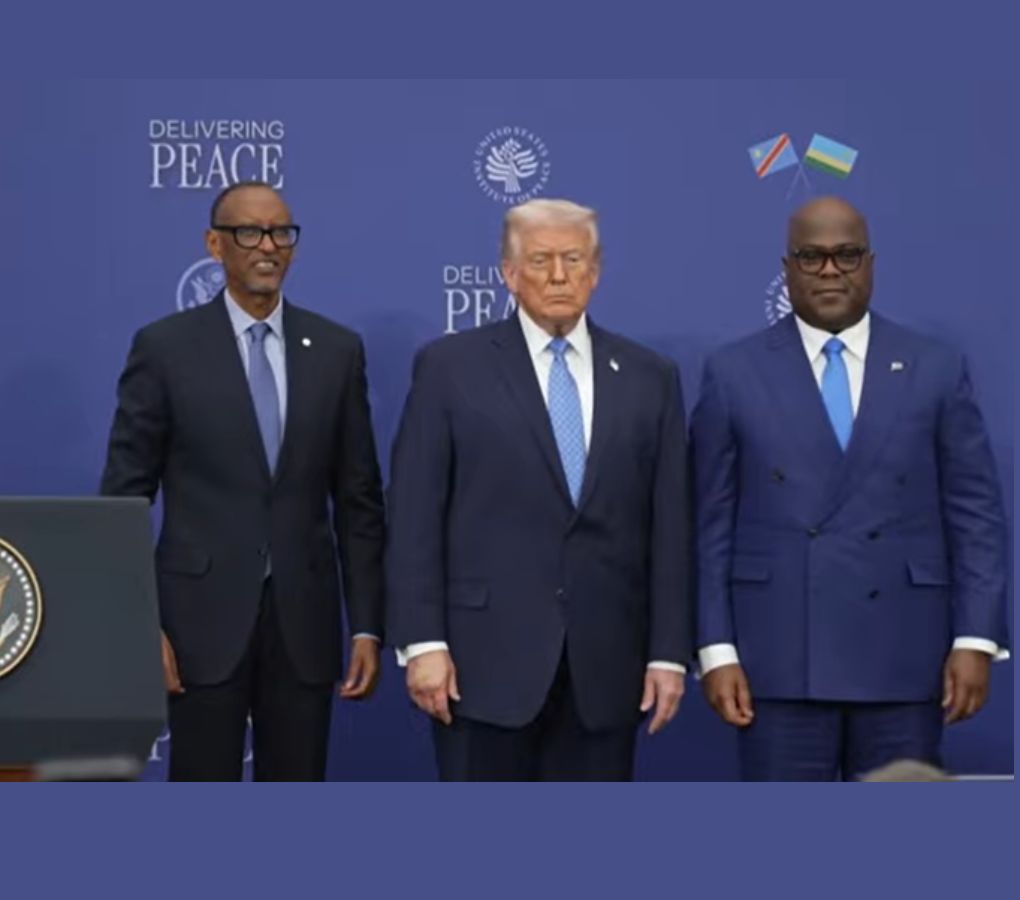
Deconstructing the Washington Accords for Peace and Prosperity
On December 4, 2025, President Donald Trump presided over the formal signing of the so-called Washington Accords for Peace and Prosperity, [1] described as a “landmark” agreement between Democratic Republic of Congo (DRC) President Félix Tshisekedi and Rwanda President Paul Kagame. This diplomatic initiative represented a continuation of the fraudulent peace accords historically imposed on African peoples since the Berlin Conference of 1884, which was itself presented as a peace conference.[2] Far from promoting the genuine end to fighting, these accords reinforced the militarization of the Great Lakes region, with diplomatic efforts serving primarily to advance the Trump administration’s ambitions for deeper US capital entry into the mineral extraction processes underway in the DRC. Regrettably, African leaders complicit in destructive extraction practices—without adequate protections for workers—accepted roles as witnesses. These leaders including the Presidents of Togo, Angola, Burundi, Kenya, and Vice president of Uganda, alongside the African Union Chairperson and ministers from Qatar and the United Arab Emirates, signaled broad regional and global endorsement of what can only be described as a farcical exercise.
The Washington Accords sought to merge three earlier frameworks that were themselves non-binding and largely ineffective: the June 27, 2025 Peace Agreement, the April 25, 2025 Declaration of Principles, and the November 7, 2025 Regional Economic Integration Framework. In addition to these, several bilateral agreements were signed during the ceremony, notably the US-DRC Strategic Partnership Agreement, the US-DRC Security Partnership Memorandum of Understanding, and the US-Rwanda Framework for Shared Economic Prosperity. Collectively, these instruments aim not at fostering proper relations of mining and trade to support socioeconomic development in the heart of the African continent, but at reinforcing U.S. global competitiveness in mineral extraction competition with China, opening opportunities for private equity speculators linked to the Trump administration, and creating mechanisms for deepening exploitation and militarization—particularly in sectors guaranteeing U.S. access to the DRC’s vast mineral wealth.
According to the official U.S. position and State Department communiques, the Washington Accords are characterized as ‘historic,’ a narrative that masks their true purpose: enabling U.S. capital to expand its footprint in Africa under the guise of peacebuilding. The Accords prioritize U.S. access to critical minerals while ignoring the structural drivers of plunder and marginalizing transformative projects, such as the African Integrated High-Speed Railway Network (AHSRN) and the Ruzizi III Regional Hydropower Project, which could foster genuine regional cooperation. U.S. imperial forward planners have shown particular concern over securing cobalt supplies, seeking to restructure global supply chains to diminish the influence of the EU and China’s global technological and economic competitive dominance, while ensuring the perpetuation of value-added processing remaining outside Africa which was founded as a pillar of colonial economic models. This comprehensive framework thus exemplifies a strategic vision rooted in doublespeak—promoting peace rhetorically while advancing Western geopolitical and economic interests through mechanisms of extraction and dependency.
Revisiting Fraudulent Peace
When the previous Agreement was signed, I produced an analysis that argued that the June 2025 DRC-Rwanda peace accord brokered by the US and Qatar is fundamentally fraudulent.[3] In highlighting the fraud, I contended that the agreement lacked enforcement mechanisms, excluding key parties like M23, and highlighted Trump’s statement that it gives the US access to $2 trillion in mineral rights. A UN report confirmed that Rwanda commands M23 rebels, explaining why they weren't party to the deal. Since that critique numerous journalistic outlets in all continents have criticized this deal. Scholarly publications and think tanks have also weighed in with their criticism with entities such as the United States Institute of Peace and the Oakland Institute highlighting the emptiness of these accords. One of the scholarly publications deployed the concept of ‘Geopolitical Entrepreneurship’ to convey the exact meaning of the kind of peace that is embedded in the Washington Accords.[4]
In a continent where the Bretton Woods Agencies have been promoting ‘entrepreneurship,’ ‘geopolitical entrepreneurs’ make money out of war by controlling the entire battle supply chain—planes, ships, vehicles, weapons, intelligence, personnel, and logistics—transforming geopolitical tensions into profitable business opportunities. This business model that flourished under the US military support for private military contractors thrives on sustained warfare, unrest, conflict, and crisis, creating a perverse incentive structure where genuine ceasefire and peace would eliminate the conditions necessary for profitability. Consequently, these ‘military entrepreneurs’ have a structural interest in managing rather than resolving conflicts, making genuine peace incompatible with their commercial imperatives.
Exposing the Façade of Neo liberal Peace.
It was fitting and appropriate that this fraudulent peace was signed at the United States Institute of Peace (USIP), now renamed, Donald Trump Institute of Peace. For more than forty years this appendage of the US military and the military industrial complex utilized this institution to advance the interests of the US capital. After the wars against the peoples of Indochina in the sixties and seventies, the opposition to warfare had heightened to the point where there was a constituency inside the political system for the creation of a think tank that would be counterweight to the US Military Academy, Naval Academy, Air Force Academy and War College. Critical scholarship had exposed the ways in which USIP was reframed as an ideational weapon that subjugated the knowledge of the American peace movement on behalf of the US military. This reframing was especially virulent in Africa where elements such as Chester Crocker actively campaigned from the USIP to deflect from the US support for apartheid. Chester Crocker served as Chairperson of the Board of the USIP from 1992 to 2004, after which Crocker continued on as a board member until 2011. From this perch Crocker had propagated his book, High Noon in Southern Africa: keeping Peace in a Rough neighborhood after the African peoples and the Cubans defeated the apartheid regime in battle at Cuito Cuanavale.[5]
In the aftermath of the defeat of the apartheid army, the NGO model in Africa was refined with the USIP gaining a front row seat in this new imperial business model of NGOization. By professionalizing dissent and co-opting susceptible militants, the NGO business model transformed radical resistance into a salaried, 9-to-5 "career," effectively acting as a safety valve that defuses political anger by offering aid as a temporary benevolence in place of permanent systemic rights. African scholars have rightly termed this form of peace and human rights as "Humanitarian Imperialism." The rhetoric of democracy and peacebuilding served as a "discursive shield" for what scholars’ term “imperialism," wherein NGOs frame complex political crises as technical malfunctions to justify Western intervention and the securing of strategic mineral corridors.
Sreeram Chaulia in his critique of the US Institute for Peace , “ONE STEP FORWARD, TWO STEPS BACKWARD: THE UNITED STATES INSTITUTE OF PEACE” had invoked the authority of Johan Galtung to clarify the US preoccupation with negative peace while ignoring structural and cultural violence.[6] USIP training materials distributed across universities and colleges worldwide were employed as instruments to assert hegemony over the concept of 'peace,' primarily through high-profile public workshops and campus outreach programs. This kind of work of the USIP lauded Rwanda to the point where students who considered themselves serious peace supporters started to trumpet Rwanda as a base for peace and reconciliation.
U.S. Investment in the Great Lakes Region as a Peacekeeping Partner
The political and military leadership in Rwanda had perfected the scam of talking about peace while fighting. This strategy had been copied from Jonas Savimbi in Angola who exemplified the strategy of negotiating peace agreements while simultaneously maintaining military operations - a pattern that prolonged Angola's brutal war for 27 years (1975-2002). In an earlier work on the role of Rwanda in the DRC, I had outlined how Paul Kagame and the Rwandan army had refined Militarism as a mode of politics while charming western bleeding hearts who had stood by while the genocide in Rwanda unfolded in 1994. The current war is a continuation of the war that was supposed to have ended after the signing of the Lusaka Ceasefire agreement in July 1999. Then, in many parts of the DRC, the fighting actually intensified as a result of the signing of the Lusaka Agreement as different forces jockeyed for military positions prior to the deployment of verification teams. Rwanda became a proving ground for plunder and looting while attracting support from western imperialists as a peace maker in Africa.
The United States Institute of Peace (USIP) has been deeply involved in ‘conflict-resolution’ training and ‘capacity-building’ efforts in both the Democratic Republic of Congo (DRC) and Rwanda. In the DRC, USIP collaborated directly with local officials, artisanal mining communities in eastern regions, and policymakers to develop so-called conflict resolution mechanisms. USIP’s flagship Conflict Management Training for Peacekeepers (CMTP) program, implemented since 2008 in partnership with the State Department’s Global Peace Operations Initiative (GPOI), offered mission-oriented, scenario-based instruction to national military units. This program—which included modules on human rights, cultural awareness, civilian protection, bias and power dynamics, communication, and mediation—has trained nearly 10,000 soldiers from 22 African militaries, including Rwanda, along with police-led Formed Police Units intended for UN missions.
Since 2005, the United States has invested over $1.5 billion in Rwanda through the Global Peace Operations Initiative (GPOI), positioning Rwanda as one of the leading contributors to United Nations peacekeeping missions—often ranked second globally and first in Africa.[7] U.S. programs have trained Rwandan military forces in areas such as “conflict resolution,” “protection of civilians,” and peacekeeping operations. In 2021, the U.S. State Department praised Rwanda as “widely recognized as a high-performing contributor and staunch advocate for the protection of civilians.” Additionally, since 2014, the International Police Peacekeeping Operations Support (IPPOS) program has trained Rwandan police units for international deployments.
The Simultaneous Reality of supporting peace while Rwanda’s Destabilization of the DRC continues
During the same period, Rwanda has actively supported the M23 movement in eastern Democratic Republic of Congo (DRC), contributing to mass atrocities documented by the United Nations. Evidence accumulated by civilians and by peace activists exposed how Rwanda supplied M23 with weapons, ammunition, training, logistics, and direct military reinforcement. M23’s violations include mass killings, systematic sexual violence (with victims as young as eight), forced recruitment of children, and the displacement of millions. By December 2025, the US ambassador to the United Nations, Mike Waltz acknowledged that Rwandan forces have provided “logistics and training support to M23” and are fighting alongside the rebels in eastern Congo, with “roughly 5,000 to 7,000 troops as of early December.”[8]
The Paul Kagame regime has been supported in the public relations push of presenting Rwanda as a model of economic reconstruction and peace. Every branch of western capitalism including major league soccer in Europe has been ensnared in masking the violent role of the Rwanda armed forces in Congo.[9] The world professional cycling association (the UCI) chose to hold the 2025 World Champion professional cycling race in Kigali, Rwanda. In these instances, sportswashing followed peacewashing as one component of the image management strategy used by Paul Kagame and the Rwanda military entrepreneurs to legitimize their actions and deflect criticism.
This image management strategy was also supported by the US military establishment so that the US could deflect from criticisms of its military engagement with Rwandan armed forces. From time to time, the US had announced symbolic cuts in its aid to Rwanda such as in 2012–2013. Then the pentagon cut $200,000 in military aid—a negligible reduction from a $200 million program—after M23 captured Goma. Denmark cancelled a $25 million peacekeeping training facility, prompting Rwanda to temporarily withdraw support for M23. In 2023, the U.S. suspended military aid under the Child Soldiers Prevention Act after Rwanda was implicated in recruiting child soldiers, yet President Biden delegated waiver authority to Secretary Blinken, allowing flexibility in aid decisions. Throughout these episodes, U.S. funding for peacekeeping training continued, even as other forms of military assistance were suspended.
The Military Quandary of the United States in the Great Lakes Region
The Rwandan controlled M23 rebels seized Uvira, a key city in eastern Democratic Republic of Congo (DRC), on December 9, 2025, completing their takeover by December 10, following a rapid offensive that put pressure on a recent U.S.-brokered peace deal. In response, the US Secretary of State Marco Rubio stated that, “Rwanda’s actions in eastern DRC are a clear violation of the Washington Accords signed by President Trump,” Rubio posted on X, “and the United States will take action to ensure promises made to the President are kept.”[10] This empty statement by Marco Rubio exposed the quandary of the US military and security apparatus in the region of central Africa and the Great lakes. There are too many variables in the plunder of the Congo for the US to solve this Rwanda violation as simply a ‘problem’ of the peace process.
A problem is a temporary state of acute disequilibrium that demands immediate attention and resolution. It typically possesses characteristics that make it solvable: a defined scope, identifiable solutions, actionable steps, and measurable outcomes. By contrast, a quandary is an intractable problem—fundamentally different because it cannot be “fixed.” It represents an enduring state of perplexity or uncertainty, often rooted in contradictions between imperial ambitions and shifting geo-economic, geopolitical, and financial realities.
The unfixable nature of the U.S. quandary in the Great Lakes region stems from structural conditions of multipolarity and the volatility of different forces of global capitalism. Allies such as the United Arab Emirates, Israel, Qatar or private security entrepreneurs like Erik Prince will not consistently act in alignment with the interests of U.S. capital networks surrounding figures like Donald Trump. Moreover, while it might be US government policy to try and reduce China’s global dominance in mineral processing, it is likely not in the commercial interests of the venture capitalists around Donald Trump acting as new “middlemen” to break the global supply chains that ensure that the processing of the minerals is carried out in China. The Trump private equity elements want to cash in on the largesse of plundering the Congo, as opposed to investing in replicating mineral processing in the Congo.
This unpredictability, combined with competing global powers and resource-driven imperatives, ensures that the predicament persists as a systemic feature rather than a temporary disruption—making it resistant to conventional policy remedies. The United States faces a structural military quandary in the Great Lakes region rather than an acute crisis: it seeks to promote peace and repositions the dominance of US capitalists while relying on supine ‘partners’—especially Rwanda—for peacekeeping and logistics, even as those ‘partners’ seek to carve out their own niche for capital accumulation. Destabilizing Congo, capturing Uvira and continuous fighting are central to the business model of Paul Kagame and his surrogates. The contradiction is stark: U.S.-brokered accords and economic frameworks aimed at stabilizing supply chains for critical minerals coexist with battlefield realities in which M23, backed by Rwanda, seizes strategic terrain and displaces civilians. The Washington Accords and associated integration frameworks promise de-escalation and investment yet exclude or sideline the working peoples of the region and leave enforcement mechanisms weak, producing “managed instability” that protects mineral corridors more than it delivers durable security. This dynamic has been widely noted with the representatives of the DRC at the UN beseeching decisive international action against Rwanda’s violations of the Washington Accords.
Calls for decisive military intervention against Rwanda?
On December 12, 2025, Democratic Republic of Congo (DRC) Foreign Minister Thérèse Kayikwamba Wagner delivered an unequivocal appeal to the United Nations Security Council outlining five specific measures:
- imposing targeted sanctions on military and political leaders responsible for attacks,
- banning mineral exports from Rwanda—particularly coltan and gold,
- prohibiting Rwanda from contributing troops to UN peacekeeping missions,
- freezing assets and imposing travel bans on Rwandan officials,
- and establishing a comprehensive arms embargo on Rwanda.
Her warning was stark: “The entire process [Washington Accords] is at stake,” coupled with a sharp critique of the Security Council’s “lack of action.”
The Congolese political leadership whose experience in plunder equals that of Rwanda emphasized the paradox of Rwanda’s continued financial and reputational gains from its status as a troop-contributing country to UN peacekeeping missions, even while actively violating the peace agreement. In comments to the Associated Press, Wagner stressed that economic agreements with the Trump administration “will hinge on stability,” signaling that mineral extraction deals cannot proceed without enforcement of the accords. This linkage between security and economic cooperation underscores the fragility of the current diplomatic framework.
The U.S. Response: Condemnation Without Enforcement
The U.S. reaction to Rwanda’s actions has been rhetorically strong but substantively weak. On December 13, Secretary of State Marco Rubio declared that “Rwanda’s actions in eastern DRC are a clear violation of the Washington Accords, and the US will take action to ensure promises made to the President are kept.” Similarly, on December 17, Deputy Secretary Landau assured Wagner that “the United States is ready to take action to enforce” the peace deal. However, these statements remain deliberately vague, offering no specifics on sanctions, enforcement mechanisms, or military support.
Rubio’s public condemnation after M23’s capture of Uvira—calling Rwanda’s actions a “clear violation” of the Washington Accords and vowing U.S. “action”—sharpened the US military quandary but did not resolve it: Enforcement must rely on coercive tools short of direct intervention (e.g., sanctions, aid suspensions, diplomatic pressure) while preserving cooperation with a top U.N. troop-contributing partner and key node in U.S. peacekeeping architecture. Reports from Al Jazeera, DW, and AP document both the human toll (hundreds killed, over 200,000 displaced) and the strategic significance of Uvira’s fall near the Burundi border, alongside indications that U.S. pressure contributed to a partial or tactical M23 withdrawal—yet without restoring durable control or trust on the ground. Rubio’s statements thus operate as deterrent signaling within the constraints of the U.S. model: assertive rhetoric and threatened penalties to uphold an accord that Washington cannot—or will not—enforce through troop deployments, reflecting the post-Somalia aversion to direct entanglement and the preference for proxy peacekeeping and mediation leverage.
Theogene Rudisangwa in the last issue of Pambazuka stated clearly that,
“The capture of Uvira by the Rwanda-backed M23 movement on December 10, 2025, should mark a turning point in how Africa and the world understand the conflict in eastern Democratic Republic of Congo. It is not just another episode in a “complex” war, nor a temporary setback on the path to peace. It demonstrates something more troubling: the increasing normalization of territorial conquest by proxy, enabled by ongoing impunity and international hesitance.”[11]
The quandary endures because it is anchored in wider geopolitical entrepreneurship where the US supported military entrepreneurs are not the only players. Moreover, the military and financial objectives of capitalists in the United Arab Emirates and Israel are not always aligned with the interests of US capital. Hence, US diplomats such as Mike Waltz and Marco Rubio must balance reputational credibility as accord guarantor, avoidance of ground force commitments, and continuity of critical mineral access from DRC’s cobalt-rich south—precisely the axis threatened by M23’s maneuvers around Uvira and beyond. Analysts underscore that excluding key armed actors from formal accords, weak coercive instruments, and overlapping mediation tracks (Washington, Doha, Luanda/Nairobi) have produced a fragmented peace architecture susceptible to fundamental reversals and warfare as peacebuilding.
In practice, Rubio’s harder line illustrates the ceiling of U.S. leverage when former surrogates central to ‘peacekeeping’ are simultaneously parties to extensive warfare. US political pressure can compel momentary withdrawals. However, without robust military and political interventions, including the weaponization of the dollar, sanctions can be violated. In the absence of political inclusion of combatants and local stakeholders, conflicts revert to controlled equilibrium that safeguards supply chains more than civilian security. The US approach which in diplomatic speak is called ‘deterrence at a distance’ means that Rubio and Waltz are seeking to discourage aggression without direct involvement—protects U.S. interests but does nothing to solve the DRC’s political problems or dismantle the Rwanda military and the M23 proxy elements.
Expanded warfare or Pan African intervention for peace?
After more than thirty years, Mobutu Sese Seko was removed by armed force. Rwanda inherited the mantle of Mobutu as the fixer for US imperialism in the Great Lakes region. Paul Kagame proved useful in the past thirty years and represented himself as a peacemaker contributing troops to the UN peace keeping missions. This model has now expired. But the expiration emerged at the same moment as the economic and military quandary for the United States. Michael Hudson in 2024 compared the rapidly growing debt burden of the United States to environmental pollution that drives global warming, arguing that it undermines economic health in the same way long COVID debilitates human bodies. He described this situation as an economic quandary rather than a mere problem: while problems can be solved, a quandary has no viable solution because any attempt to address it only worsens the condition.
Efforts by the United States to curb Israel, the UAE and Rwanda at this historical juncture will only worsen the conditions as we have witnessed in Sudan. The contradictions of US militarism are not a mere policy failure but reflect the exhaustion of the unipolar world where the US could act with impunity in all parts of the world. Rwanda’s dual role—as a celebrated peacekeeping contributor and an active destabilizer in the DRC—provided Washington with strategic advantages. The U.S. avoids direct troop deployments in Africa (a legacy of the Somalia debacle) while securing access to critical minerals such as cobalt and coltan through “managed instability.” Rwanda’s peacekeeping status offers diplomatic cover and plausible deniability for extractive interests. Training in “conflict resolution” thus became a mechanism for conflict management—not to end violence but to regulate it in ways that sustain resource flows and geopolitical leverage. The ultimate mockery is that U.S.-trained Rwandan forces, lauded for protecting civilians, have simultaneously facilitated atrocities and even killed UN peacekeepers during M23 offensives, underscoring the deep contradictions of contemporary peacebuilding discourse. I will end as I argued in the previous article that genuine peace requires Pan-African unity and reconstruction, not so-called peace deals serving as narrative covers for imperial mineral extraction interests rooted in colonial-based economic models of foreign direct investment.
Horace G. Campbell is a peace and social Justice activist. He is also Professor of African American Studies and Political Science at Syracuse University and Chairperson of the Global Pan African Movement, North American Chapter. He is the author of Global NATO and the Catastrophic Failure in Libya, Monthly Review Press, 2013.
Endnotes
[1] https://www.state.gov/releases/office-of-the-spokesperson/2025/12/signing-of-the-washington-accords-for-peace-and-prosperity-between-the-democratic-republic-of-the-congo-and-rwanda/
[2] Sybil Eyre Crowe, The Berlin West African Conference, 1884-1885 (London: Longmans, Green and Co., 1942; reprinted Westport, CT: Negro Universities Press, 1970) . See also Adam Hochschild, King Leopold’s Ghost, A Tory of Greed, terrorism
[4] Brewer, C., & Brokenshire, K. (2025, July 3). What the DRC-Rwanda peace deal means for the U.S. and Africa’s mineral-rich Great Lakes region. United States Institute of Peace. Retrieved from https://www.usip.org
Ray, C. A. (2025, August). Conflict in the Democratic Republic of the Congo: The peace that never was. Foreign Policy Research Institute. Retrieved from https://www.fpri.org
Oakland Institute. (2025, July). Profit off peace? Meet the corporations poised to benefit from the DRC peace deal. Oakland Institute. Retrieved from https://www.oaklandinstitute.org
Seifu, B. (2025, August 8). Minerals over peace? Rethinking the DRC-Rwanda accord. Modern Diplomacy. Retrieved from https://moderndiplomacy.eu
[5] Chester Crocker, High Noon in Southern Africa: Making Peace in a Rough Neighborhood, Norton, 1993
[6] Sreeram Chaulia, “ONE STEP FORWARD, TWO STEPS BACKWARD: THE UNITED STATES INSTITUTE OF PEACE,” International Journal of Peace Studies, Vol. 14, No. 1 (Spring/Summer 2009), pp. 61-81
[7] The U.S.-Rwanda Preparatory Meeting for the 2021 Peacekeeping Ministerial - United States Department of State
[8] "US accuses Rwanda of violating the peace deal as M23 rebels seize a key eastern Congo city," The Manila Times, December 13, 2025. https://www.manilatimes.net/2025/12/13/world/americas-emea/us-accuses-rwanda-of-violating-the-peace-deal-as-m23-rebels-seize-a-key-eastern-congo-city/2242802
[9] Itamar Dubinsky, “(Don’t) Visit Rwanda: Rwanda’s Sportswashing and Its Western Facilitators,” African studies review, July 2025