


South Africa’s National Intelligence Agency (NIA) gave the green light to the 2004 Equatorial Guinea coup attempt, along with the intelligence agencies of America, Britain, China and Spain, mercenary Simon Mann has claimed. Mann told London’s Daily Mail on Saturday night: 'I believe Britain and America had full visibility on what we were doing. The South Africans passed on intelligence to the UK and the USA, who had vested interests.'
The decision by the United Nations Educational, Scientific and Cultural Organisation's executive board on 4 October 2011, to defer any action on a highly controversial life sciences prize named after and funded by President Teodoro Obiang Nguema Mbasogo of Equatorial Guinea blocked a move to reinstate the prize immediately, but the board should eliminate the prize permanently, six civil society organisations said.
UNESCO is considering the implementation of a highly controversial international prize that would lend credibility to one of the world’s most ruthless leaders. Angela Stuesse explains what the issues are and how you can take action to stop the prize.
A year ago, human rights activists thought they had squashed a proposed United Nations Educational, Scientific and Cultural Organization ( UNESCO) prize in the life sciences that would honor Teodoro Obiang, the longtime dictator of Equatorial Guinea. But that celebration may have been premature. The controversial award is back on the agenda of UNESCO's Executive Board, which will meet in Paris -and this time, Obiang has the backing of the entire African Union.
In early 2010, the government of Equatorial Guinea accepted more than 100 recommendations made by United Nation (UN) member countries at the UN Human Rights Council’s Universal Periodic Review (UPR). The accepted recommendations were aimed at improving several key areas related to the protection and promotion of human rights and civil liberties. It is unclear how or if the government of Equatorial Guinea is implementing the UPR recommendations; to date it has not provided the UN Human Rights Council with any updates to this effect, reports EG Justice.
The government of Equatorial Guinea’s ratification of the African Union Protocol on the Rights of Women is a potentially important step toward gender equality in Equatorial Guinea, but to be meaningful it must be followed by concrete reforms designed to promote and protect the economic, political, and social rights of women, EG Justice said. Equatorial Guinea became the 31st African Union member country to ratify the Protocol, also known as the Maputo Protocol. It guarantees the equal rights of women to political participation, economic and social equality, reproductive rights, and an end to genital mutilation. Despite existing laws intended to forbid domestic violence and defend women’s rights, to date the Equatoguinean government has failed to consistently safeguard and advance the rights of women.
Equatorial Guinea is principally a destination for children subjected to conditions of forced labour. Children are recruited and transported from nearby countries – primarily Nigeria, Benin, Cameroon, and Gabon – and forced to work as domestic servants, market laborers, ambulant vendors, and launderers. This is according to a 2011 US State Department report that finds Equatorial Guinea's response to human trafficking to be inadequate, particularly given the government’s substantial financial resources.
'We write to express our grave disappointment that the African Union Summit currently taking place in Malabo, Equatorial Guinea, unlike previous summits, does not include a parallel civil society gathering for foreign and domestic groups.'

Dismayed by the AU’s willingness to host its summit at a luxury complex in Equatorial Guinea despite the government’s violation of human rights, Eyob Balcha says the summit will not improve the lives of ordinary Africans. What’s more, given the ongoing crises across the continent, the summit’s theme of youth empowerment will be the last thing on the mind of delegates.
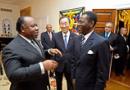
The 17th African Union Summit takes place from 23 June to 1 July in Malabo, Equatorial Guinea. Will the African Union violate its own Constitutive Act and policy standards by hosting the summit in Equatorial Guinea? asks Geoffrey Njora.
Equatorial Guinea's government has spent lavishly on diplomatic accommodations while neglecting the rights of the country's poor in the lead-up to hosting the African Union summit, Human Rights Watch and EG Justice said. The government has also sharply limited public dissent and critical reporting. While most citizens of Equatorial Guinea languish in poverty, President Teodoro Obiang's government, which holds the revolving AU chairmanship, spent more than US$830 million to construct a luxury complex for the summit outside the nation's capital, Malabo.
Security forces in Equatorial Guinea have detained more than 200 youth in the past week. The reasons for the detentions remain unclear, although government authorities chastised parents for giving their children too much liberty, writes EG Justice.
Equatorial Guinea has built a multimillion-pound deluxe 'city' to host African leaders while the majority of its people live in dire poverty. Sipopo boasts 52 luxury presidential villas, a conference hall, artificial beach, luxury hotel and the county's first 18-hole golf course. It was built over two years to host an African Union (AU) summit that will last just a week. 'It's definitely a misplaced priority by the Equatorial Guinea government,' said Tutu Alicante, executive director of EG Justice, a group focused on human rights in the west African nation. 'This is a country where 75 per cent of people are living on less than $1 (60p) a day. This attempt to give an image of prosperity is totally misguided.'
EG Justice and other civil society organisations have credited UNESCO’s Executive Board for soundly rejecting a petition by the government of Equatorial Guinea to reinstate a prize funded by and named after its president, Teodoro Obiang Nguema Mbasogo. In a decision on 9 May 2011, the Executive Board declined to consider a 4 May request by the Obiang government to reverse its prior decision and award the prize without delay. UNESCO indefinitely suspended the $3 million UNESCO Obiang Nguema Mbasogo International Prize for Research in the Life Sciences in October 2010 after an unprecedented global outcry seeking its cancellation.
Two senior opposition figures arrested in late April in Equatorial Guinea have been released, a senior party colleague said. Vicente Nze and Juan Manuel Nguema Esono of the main opposition Convergence for Social Democracy (CPDS) party had been released late Friday (29 April), CPDS secretary general Placido Mico Abogo told AFP. Esono was detained for having put up a poster calling for a demonstration against President Teodoro Obiang Nguema on Sunday, 1 May, said a CPDS statement.
A new report released by the US Department of State documents the ongoing violation of human rights and basic freedoms by the government of Equatorial Guinea against its citizens, the group EG Justice has said. The report’s findings strongly contradict the Equatoguinean government’s claim that it has 'turned the page' and disassociated itself from the abuses that have marred the country for decades, EG Justice says.
After banning the planned mass protests in Equatorial Guinea, government sent out massive police forces to prevent the opposition from taking to the streets on 23 March. Equatorial Guinea's main cities - the capital Malabo and the mainland's main city Bata - were dominated by heavily armed police troops to prevent any possible gathering of persons opposing the repressive regime of lifetime President Teodoro Obiang Nguema.
EG Justice has released a policy paper titled 'Transparency and Accountability in Equatorial Guinea: Policy Recommendations for the Obama Administration'. The paper outlines the ongoing political and economic challenges confronting Equatorial Guinea, including corruption, a lack of respect for civil liberties, democratic procedures, and the rule of law, and the inability of civil society organisations to operate freely without government intervention.
Equatorial Guinea must amend laws that hinder effective civil society mobilisation and activism inside the country, says by advocacy group EG Justice. The report highlights ‘the gaps that exist between the government’s commitments to regional and international covenants that promote basic civil liberties'.
Citizens in Equatorial Guinea trying to take advantage of the government’s pledge to allow greater citizen participation continue to face serious obstacles that hinder their efforts, EG Justice says in a new report. The country was delisted from the Extractive Industries Transparency Initiative (EITI) - a voluntary international effort to strengthen governance in resource-rich countries through improved transparency and accountability - in April 2010 for its failure to comply with the EITI’s requirements, including failing to allow unfettered civil society engagement. Nearly one year later, the Equatoguinean government has not implemented the necessary reforms to guarantee citizen participation and to increase the likelihood that the country will be readmitted to the EITI. The 37 page report, 'Disempowered Voices: The Status of Civil Society in Equatorial Guinea', identifies systematic failures on the part of the Equatoguinean government to allow the full and independent participation of civil society organisations.