


As emerging transnational stakeholders or co-development actors, the diaspora holds the key to sustainable peace and advancement of North Africa following the ‘Arab Spring.’
Beyond chanting mantras and slogans, the devil seems to lie in the details. How does the AU-diaspora engagement take place and in what form? Who actually are the diaspora and who represents them?

An abridged version of the final text submitted by the diaspora platform to the European EC Public Consultation ‘Towards a post-2015 development framework’. Drafted by Onyekachi Wambu on behalf of diaspora organisations
Remittances, amounting to £60 billion in 2012, are the first step in harnessing the potential of the diaspora for African development. Individuals and organisations in the diaspora are ideally suited to drive key projects, as they have better local understanding and a clear commitment to seeking sustainable change

This Special Issue focuses on the role of the diaspora, especially the UK diaspora, in Africa’s development by beginning the process of opening up the themes and issues surrounding this important segment of the African people
There is a need to teach African youth in the diaspora to keep their identity while also providing them with opportunities to play a role as active citizens in their countries of origin. Eritrea has vibrant examples of this
While the heads of state busied themselves with neo-liberal discourses about ‘poverty reduction and governance’ at last week’s AU Summit, the intellectuals, activists, artists and writers focused on acceleration of the full unification of the peoples of Africa and the need for concrete steps towards a government that can defend Africans at home and abroad
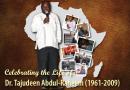
This special issue celebrates not only 50 years of the Organisation of African Unity (OAU) and its successor, the African Union (AU), but also the life of the late Tajudeen Abdul-Raheem, a staunch Pan-Africanist. Some of the themes of this issue are set out, as well as future challenges facing the AU and Pan-Africanists
In a personal reflection of the late Dr.Tajudeen Abdul-Raheem, a foremost champion of Pan-Africanism in recent years, he is remembered as one who spoke truth to the powerful and the powerless with indefatigable commitment to the poor of Africa
The AU is well placed to articulate the Pan-African agenda for the benefit of the people, yet the majority of African presidents are busy with self-preservation and less supportive of initiatives that promote regional and continental integration. When will the Union to stop being a talking and become a serious institution?

The African Union must cultivate a united Africa and national governments need to be keenly wary of the divide-and-rule tactics of external powers pursuing selfish interests
I believe that Tajudeen loved young people because he could see in them the potential to transform society for the better before it transformed individuals for the worse
Toronto, ON -The Toronto chapter of the Group for Research and Initiative for the Liberation of Africa (GRILA), will commemorate the African Liberation Day 2013 on Saturday, May 25th 2013 at 5:00 p.m. This will mark the 50th anniversary of the creation of the OAU (Organization of African Unity). This public education event will take place at A Different Booklist which is located at 746 Bathurst (next to the Bathurst Subway station).
In the New Scramble for Africa, the continent is facing the dual threat of militarization and capitalist-driven land grabs. In militarist terms, the US and its European allies are increasingly consolidating their imperialist stranglehold in the region. Under the auspices of the so-called United States Africa Command (AFRICOM), the US is seeking the recolonization of the continent in bid to secure unfettered access to vital resources in the wake of China’s ascendancy in Africa. The bloody military intervention in Libya was swiftly followed by deployment of Special Forces in Uganda, paving the way for militarization in the Central African region and the new escalation by President Obama of America’s two decades old war in Somalia.
In the Sahel region, Mali has suddenly become the centre of a new global “war on terror.” Paradoxically, US-backed, French forces in Mali are fighting the same terrorist bands trained by US and NATO Special Forces, now justifying a full-fledged, neo-colonial invasion of Mali by France. Under the pretext of fighting terror, the French-led militarization strategy in Mali is rooted in AFRICOM’s hegemonic military objectives of securing vital resources, countering China’s strategy and confronting the revolutionary wave sweeping across the continent.
The choice of Mali as a new staging ground for a joint AFRICOM/NATO military offensive on the African continent is not a mere coincidence. With proven oil reserves as well as gold and uranium deposits, resource-rich Mali is strategically located in the heart of the oil-rich Sahel region. Its proximity to oil-rich Libya to the north and the vastly oil-rich, Gulf of Guinea region to the south comprising of oil-producing states of Nigeria, Equatorial Guinea, Gabon and newly oil-rich Ghana, makes it a convenient springboard to direct a new phase of imperialist-driven, military intervention in the continent. Mali is touted as a potential site for AFRICOM’s proposed base in Africa.
In addition to threats posed by AFRICOM/NATO militarization, there is also a growing threat to African food security and prosperity from massive land grabs by external capitalist forces. Africa is being used to bail out the world’s food crisis by secretive, powerful land grabbers seeking control over land and water resources. The new scramble for prime African land erstwhile dubbed the “Great Land Grab,” is driven by biofuel demands in the European Union and other industrialized nations and renewed global attempts to augment food security in other regions of the world, principally in the Persian Gulf and East Asia. The threat posed by AFRICOM’s militarization and ongoing land grabs calls for sustained Pan-African response from the grassroots level to national and continental level. On Saturday, May 25th, 2013, join concerned Pan-Africanists at an African Liberation Day Panel discussion on the unfolding situation in the continent.
Date:Saturday, May 25, 2013
Time: 5pm - 7pm
Location: A Different Booklist -746 Bathurst (South of Bloor), Toronto
Brought to you by the Group for Research and Initiative for the Liberation of Africa (GRILA – Toronto Chapter) .org Email: [email][email protected], [email][email protected] Phone: (416) 721 – 4531
NOTE: A major international campaign around these issues (Militarization and Land Grab) will be announced the same day.
Liberation movements, progressive governments, left parties, peace and anti-war organizations, solidarity coalitions and social justice groups must continue their support and alliances with the Palestinian people, the resistance forces and the progressive states throughout the Middle-East
How can ties of solidarity be strengthened between continental Africans and black movements in Brazil? To start with, a deep appreciation of a shared of heritage of the two peoples is necessary

Economist Camille Chalmers is a leader in Latin American social movements and executive secretary of the Platform for Alternative Development in Haiti (PAPDA) and was interviewed by Beverly Bell. He shares his views on Chávez’s vision of a revolutionary Latin America that sought internationalist solidarity with Haiti, Africa and Asia among other issues.
Sobukwe was an indefatigable Pan-Africanist, theoretician and revolutionary humanist who selflessly dedicated his life to one thing only — the liberation of humanity and, in particular, the liberation of black people
There is a growing consensus to establish a continental network of organised inhabitants that will solidify linkages between activist groups across Africa

A long memory is necessary in untangling the political relationships among the Zulus as well as the historic conflict between the ANC and Inkatha, which Gary Busch assesses in his rejoinder to William Gumede

Zuma has skillfully used Zulu or African ‘traditions’ to cover-up poor personal choices, indiscretions and wrong behavior, and portrayed those who oppose such poor behavior of being opposed to African ‘traditions’ or ‘culture,’ argues William Gumede.